



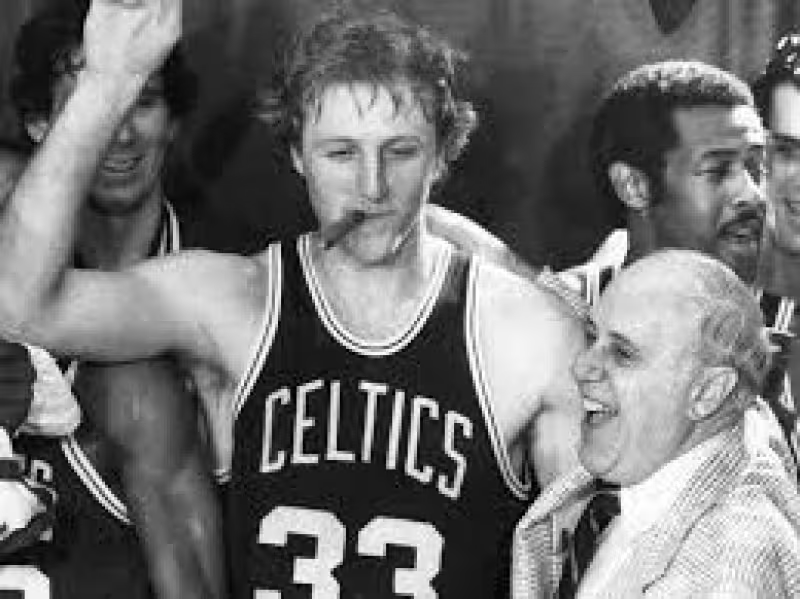
Kevin McHale laughed and then sharpened the point: "I just laugh at these people today," he said in a recent phone call, dismissing critics who doubt whether Larry Bird would be a superstar in 2026.
McHale opened the call by putting Bird next to the modern benchmark, Luka Doncic. "These are the same dudes that can’t guard [Lakers star] Luka Doncic, and Luka Doncic is lighting them up," McHale said, and then doubled down: "Larry is bigger, stronger, faster, and meaner than Luka Doncic. And if Luka is lighting these dudes up, it’d be a five-alarm fire what Larry would do."

The bluntness is designed to settle a debate that resurfaces whenever teams pick through draft boards or analysts compare eras. McHale pointed to Bird’s attributes — size, speed, physicality — and to modern training as multiplying factors. "Larry would go by you a hell of a lot faster than Luka would go by you. He was a straight-line driver, and he was also just a horse," McHale said. He added that advances in sports science would give Bird the tools and support to dominate today’s game.
Bird’s résumé, McHale implied, already argues the case: a 12-time All-Star, three-time MVP and three-time NBA champion with the Celtics from 1979-92. Those honors anchor McHale’s interpretation of how a generational player translates across eras. He did acknowledge a counterpoint embedded in Bird’s history — "Larry dealt with injuries throughout his career" — but treated modern conditioning and medical support as a likely offset to that vulnerability.
The comments arrive amid two overlapping conversations: that era-comparison argument and the immediate business of roster construction. The Celtics, the franchise most tied to Bird’s legend, hold the 27th and 40th picks in the NBA Draft that begins June 23. A league source cautioned that the talent pool in that range may be "slightly watered down" because some prospects now have another very good option — the proliferation of NIL money has made it more lucrative for many prospects to remain in college rather than become a second-round pick or a late first-round choice.
McHale used Luka as the contemporary measuring stick because, he argued, defenders struggling against Doncic expose schematic and personnel limits that Bird would have exploited. That insistence is the rub for skeptics who say today's game — quicker, more versatile, with different spacing and defensive rules — is not simply a faster version of 1980s basketball. McHale’s response is that Bird’s combination of strength and directness would overwhelm those modern weaknesses.
The phone call also threaded in local context about how teams evaluate competitive traits. Brad Stevens weighed in elsewhere on the Celtics’ present, noting, "The reality is Hugo has had a great rookie year, and I think is a critical part of us moving forward because his athleticism can meet the moment in the big games" and, "That’s a real thing. You can see it, you know it. His strength is off the charts. He’s probably the strongest … he’s one of the strongest guys on our team, pound for pound, right now as a 20-year-old, so he’s got a bright future." Jamal Gomes added a different angle on competitiveness in the organization: "That kid was a winner back when he was 11, 12, 13 years old," and "what made Joe a winner was he was a fierce, fierce competitor. When the lights came on, you always knew what you were going to get out of Joe, and that was starting back in middle school." Those remarks underline how franchises marry raw athleticism with an eye for intangible competitive traits — the very qualities McHale credits Bird with possessing.
The unresolved question at the center of McHale’s claim is also the simplest: can a player forged in a different ruleset, with different patterns and injuries, still be expected to dominate when every advantage has been reconfigured? McHale’s answer is emphatic — yes — and he points to measurable choices teams are making now as proof. The nearest, practical test will be visible on draft night and in how franchises prize size, strength and the sports-science infrastructure that McHale says would have pushed Bird from great to overwhelming when the NBA’s next season begins after the June 23 draft.



