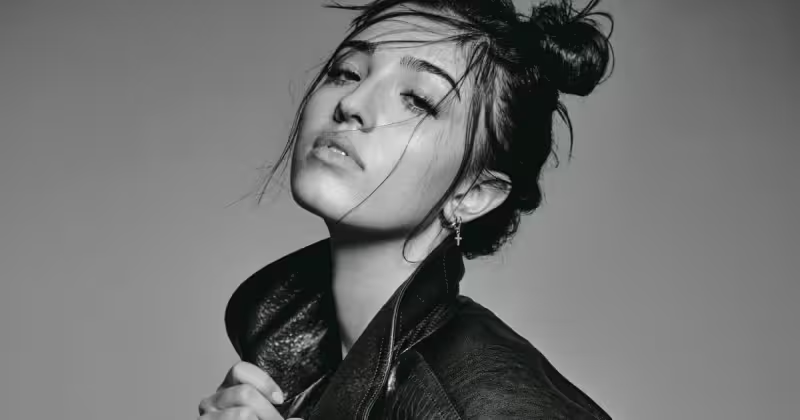
"Je suis une vraie pile électrique qui a du mal à tenir sur place," Léonie Cassel says — a line that opens a portrait published by Madame Figaro just after she turned 16 on May 20. The younger daughter of Monica Bellucci and Vincent Cassel used the interview to sketch a life that is part ordinary schoolday and part on-set memory, and to name her sister Deva as both role model and closest companion: "Ma grande sœur est mon modèle et ma meilleure amie."
Cassel is a seconde at a Paris high school and described herself as drawn to literary subjects, especially philosophy. She also speaks five languages — French, Italian, English, Spanish and Portuguese — a detail that underlines how marked her childhood was by travel and film. The combination of a 16th birthday, bilingual upbringing and public family ties is what gives the interview its weight: a teenager who moves easily between classrooms and cinema sets and who is already becoming a public figure in her own right.

The family context is compact and prominent. Léonie is the younger daughter of Monica Bellucci and Vincent Cassel; her older sister Deva, now 21, is established as a model and actress and appears in Léonie’s account as a constant influence. Cassel said she had inherited "la quête d’harmonie de ma mère, de l’esprit aventureux de mon père et de la franchise sans détour de Deva," a neat summation of the domestic forces shaping her tastes and temper.
Those forces show up in the details Léonie offers. "Je suis née à Rome, sous le soleil," she says, and she remembers early trips to film sets: at 5 she and Deva accompanied their mother to Serbia for the shoot of On the Milky Road directed by Emir Kusturica — "Quand j’avais 5 ans, Deva et moi avons accompagné notre mère en Serbie sur le plateau de On the Milky Road, d’Emir Kusturica." She also recalls doing extra work at age 8 in Vidocq while her father had the lead role: "Je jouais une petite villageoise, j’avais adoré interagir avec les acteurs et les équipes." Those anecdotes place her childhood inside the same creative orbit that made her parents public figures.
Still, Cassel interrupts any tidy narrative that she is already choosing a public career. She insists she is a student first: a teenager who attends classes in Paris and who says she is especially attracted to philosophy. At the same time she names aesthetic preferences that track with her household — a love of "univers oniriques, l’étrange, ce qui dérange" and director-driven horror such as Hérédité and Midsommar. The result is a friction that runs through the interview: a normal lycée life lived alongside lived experience of film and fashion, with a sister already visible in the industry and parents whose work placed cameras and crews within the family orbit.
The interview supplies clear personal color but not a roadmap. Léonie frames Deva as a model in the full sense — an example to follow and a friend — but she does not declare a professional intention. For now, the answer to whether she will follow her parents into acting or fashion is simple and factual: she remains a 16‑year‑old in seconde focused on school and on literary curiosity. That decision, stated rather than dramatic, is itself the most consequential choice the interview reveals — Cassel is allowing adolescence and study to govern the next stage of her life, even as the film sets of her childhood and the example of Deva shape the possibilities ahead.