



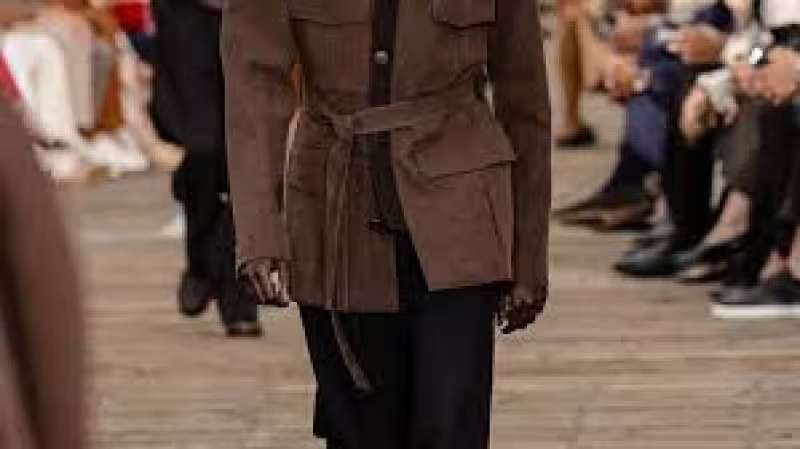
Rami Malek was among the invited guests who watched Zegna present its Summer 2027 collection on Malibu Pier on Friday evening, then moved with the house to Chateau Marmont for an intimate shopping and made-to-measure program.
Alessandro Sartori framed the mood in one word—"La Villeggiatura"—and in a string of images: "The dog, the grandma, everything." He recalled a childhood ritual: "I still remember even myself, we were going to the seaside in the same place every year for two weeks. The car was so full, and we were bringing everything." The memory was the through-line for a show that mixed seaside ease with sartorial refinement.

The scale was deliberately limited: Sartori said there were 120 customers at the event, roughly half of them American, and that including plus-ones the guest count reached about 240. Guests arriving on the pier were greeted with citrus-colored cocktails, striped parasols and matching orange-and-yellow deck chairs before the runway, then escorted to the Chateau where the collection was displayed across a series of cottages. "We have 120 customers that are here tonight — they can buy the collection of the show," Sartori said, adding plainly, "We take care of them for five days."
Weight came in both numbers and access. After the presentation, clients could shop runway looks and place made-to-measure orders on site—an activation designed to convert the spectacle into sales. Zegna also offered a small selection of signature pieces made exclusively for the occasion, giving those 120 customers immediate access to items otherwise unavailable to the broader public.
The clothes themselves kept to a summer register—soft tailoring, matching striped separates and lightweight outerwear—yet the materials complicated that reading. Sartori balanced linen and seersucker alongside fabrics more commonly associated with cold-weather luxury: vicuña, ultra-fine cashmere and 12-micron wool. The collection used raw silk, washed hemp, Oasi Lino linen, silk gabardines, seersucker and soft napa leather, while a new woven-leather technique—developed over more than a year using strips of suede and napa—added an artisanal detail to the mix.
That contrast was the show’s quiet tension: clothing presented as summer dressing without adding weight, and at the same time dependent on some of the most prized, tactile fibers in menswear. The pieces most emblematic of that balancing act were the belted safari jackets, boxy cropped jackets with dropped shoulders, leather bombers and shirt-jackets—forms that read casual on the pier but gained gravitas when realized in vicuña or 12-micron wool.
Sartori also pointed to the house’s in-house weaving atelier, Tessitura Ubertino, noting that vintage jacquard looms from the 1950s and 1960s have been restored and adapted with modern technology. Those looms, and the long process behind the new woven-leather method, were the technical answer to a design brief rooted in memory and mobility: clothes you can travel with, and that travel back to you richer for the journey.
The immediate commercial gambit—inviting a concentrated group of top clients to buy on the spot—was not new for the brand, which has staged similar client-focused activations in Milan and Dubai. What made Malibu distinct was the pairing of a sunlit pier show with the domestic intimacy of Chateau Marmont cottages, and a selection of occasion-only pieces made in vicuña, ultra-fine cashmere and 12-micron wool.
For now, the most consequential outcome is straightforward: those who attended can place made-to-measure orders during the five days Sartori promised, and the pieces most likely to translate into orders are the event’s special signatures—the vicuña and ultra-fine cashmere exclusives—and the tailored outerwear that married summer ease to luxury materials. Which runway looks will ultimately emerge as commercial standouts will be decided in the coming days at Chateau Marmont and by the bespoke orders that follow.



