



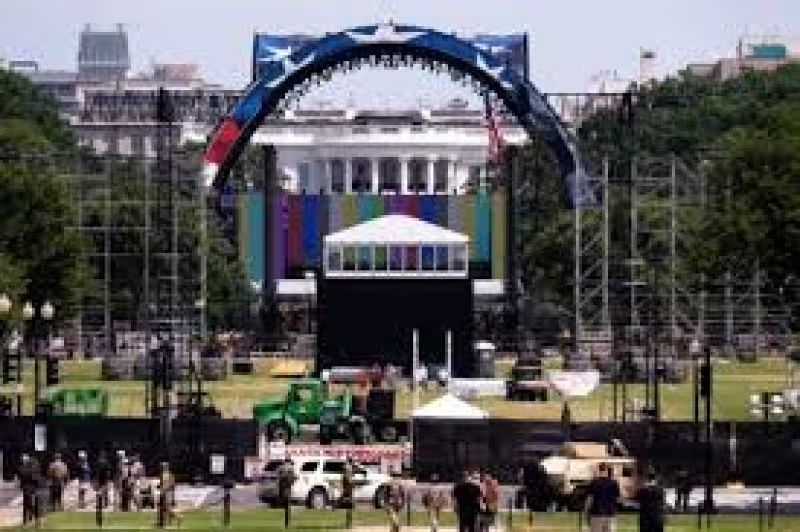
The UFC will stage its Freedom 250 fight card on the White House South Lawn on June 14 without involvement from D.C.'s Combat Sports Commission.
The card will instead be sanctioned by the Association of Boxing Commissions, which the ABC president said has confirmed the bouts are licensed and that the promotion has promised to meet required medical and safety protocols. "The UFC has further confirmed that it will abide by all applicable regulatory requirements in support of this event, including all required medical examinations, pre-bout and post-bout physicals, and athlete safety protocols," Timothy Shipman said, adding that "all bouts on this card are officially licensed and sanctioned contests."

That assurance is the weight behind an unusual move: the UFC chose not to use the D.C. commission, the local agency that normally supplies judges, referees and post-fight health checks. The promotion has previously worked with the commission at Capital One Arena events in 2011 and 2019.
Andrew Huff, chair of D.C.'s Combat Sports Commission, said the UFC determined it was not required to use the agency because the event sits on federal land. "In essence, it’s another example of federal overreach into our local affairs," Huff said, and he added bluntly, "This is an event that’s happening in our jurisdiction. Our commission, in our view, has the authority to sanction and regulate the event, and we are not doing so."
The dispute lays out the core conflict ahead of June 14: the promotion says ABC oversight and its own resources will ensure a highly regulated card, while the District says the event occurs within its jurisdiction and that local sanctioning authority still applies. That tension matters because the commission is the neutral supplier of on-site officials, the officials who stop fights for safety and administer ringside medical protocols.
Shipman said the UFC requested "the most qualified group of judges, referees, and inspectors in the world" and that the ABC would endorse the event's licensure and medical plans. ABC sanctioning, he said, carries obligations the UFC has agreed to meet — paperwork, medical exams and pre- and post-bout physicals — which are the technical controls regulators use to protect athletes.
Huff said he had not previously known of an ABC-sanctioned fight card and that he attended the ABC's annual conference; he said the organization's history of unified MMA rules and the UFC's resources offered some comfort about fighter safety. Still, he warned that bypassing the local commission removes a plainly impartial on-site regulator. "There’s always the possibility that that individual, because they’re not necessarily impartial, would allow a fight to continue, and someone could get really injured," Huff said, contrasting that with a commission official who would "have no stake, no interest in the event, other than working the event and doing their job."
Huff also suggested the decision could set a precedent for future shows on federal land. He pointed to the hypothetical of a promoter staging a boxing card in Malcolm X Park and declining to work with local regulators because the National Park Service controls the site.
Practical logistics are partly settled: the ABC will license the bouts, and D.C. fire, police and other city agencies will assist on site alongside federal law enforcement, Huff said. The specific operational chain of command for judges, referees and immediate medical oversight, however, has not been publicly detailed beyond the ABC's assurances and the UFC's promises.
For fans and fighters the immediate next step is simple: the card goes on June 14. For regulators and anyone tracking the governance of combat sports, what to watch is whether this event becomes a template for working around local commissions whenever an arena or ground is under federal control.
The most consequential unanswered question before the Freedom 250 is not who will headline the card but who will exercise practical control when a fight must be stopped or a fighter needs urgent care. That question — which agency’s authority will prevail in the moment — remains unresolved as the promotion prepares to hold one of the most visible, and potentially precedent-setting, cards in the sport's history.



