



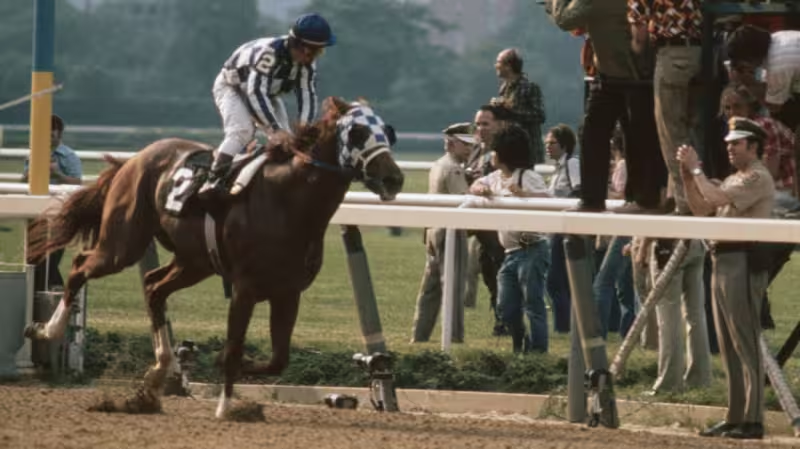
Ron Turcotte settled Secretariat alongside Sham in the early stages of the 1973 Belmont Stakes, then allowed the horse to extend — and the race stopped being a contest. Fifty‑three years on, that single ride is the shorthand for one of the most dominant performances in American sports: Secretariat, the 1‑10 favorite, finishing 31 lengths clear of Twice a Prince and stopping the clock at a world‑record 2:24 for 1½ miles.
The scale is simple and brutal. Secretariat covered three‑quarters in 1:09 4/5, reached the mile mark in just over 1:34 and hit the quarter‑pole at 1:59. From there the race dissolved into a procession; track announcer Chic Anderson’s call — "Secretariat is alone. He is moving like a tremendous machine!" — became part of the moment, followed later by, "He's 25 lengths in front!" Those lines are not hyperbole: the official margin was 31 lengths.

The performance completed Secretariat’s sweep of the Triple Crown and made him the ninth horse in racing history to do so, the first since Citation in 1948 — a 25‑year gap that underscored how rare it had become. The numbers after the fact only burn the memory in deeper: Secretariat won 16 of 21 career starts, was named Horse of the Year twice, and after the Belmont ran nine more times, adding six wins, two seconds and a third to his ledger.

The Belmont time has served as the measuring stick for generations. Contemporary comparisons underline its strangeness: A.P. Indy and Easy Goer, greats of later decades, would still have fallen short by about 10 lengths on Secretariat’s split; secretariat.com notes Gallant Man would have been beaten by 13. Even the modern era’s average Belmont finishing time since 2000 — 2:28 3/5 — leaves Secretariat more than four seconds faster than what has become routine at the distance.
Part of the fascination is physiological. Secretariat died in October 1989; only then was it discovered he had the largest heart ever recorded for a horse. The finding offers a tidy biological explanation for extraordinary stamina, but it is also an incomplete one. Trainers, jockeys and scientists still point to a tangle of variables — breeding, conditioning, track bias, race dynamics — and no single item accounts for how Secretariat could sustain world‑record fractions and still accelerate in the final turns.
That tension is visible in how the run has been remembered. It is a moment narrated by a jockey who kept the colt within reach of a rival early, by an announcer whose spare phrases have become scripture, and by a clock that produced a number nobody has approached in half a century. It is also a case study in limits: even with the heart measurement, experts cannot definitively parse which combination of factors — horse, rider, split times, or race‑day variables — made 2:24 possible.
For Ron Turcotte, the ride is the defining professional act on a long résumé; for the sport, it is a permanent benchmark. Secretariat’s Belmont does not invite repeat performances so much as demands them as a reference point — each fast Belmont is measured against a run that, by time and margin, refuses to belong to any other era. The unanswered question that endures is not just who could beat that time, but what exact alchemy produced it that afternoon — a question that keeps the legend alive and the record unassailable.



