



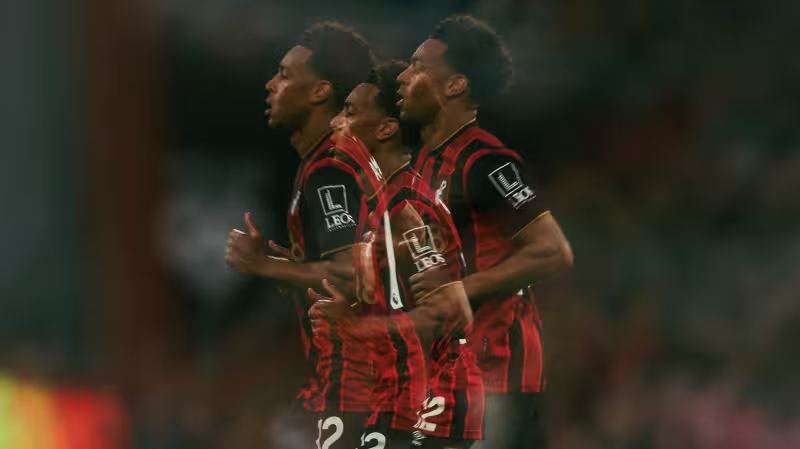
“I found out that I was going to be on the World Cup squad before the last game of the season,” Tyler Adams wrote in a May 26 diary entry in Manhattan, and then described how he parked the private thrill to finish a historic club campaign. Adams said he flew back into New York feeling both excited and oddly displaced: “It’s weird flying back into New York, which has been home for me for so many years in my life,” he wrote, adding that it “maybe feels a little bit strange, because it’s not where my family is necessarily anymore, like my wife and kids.”
The stakes on the ground in England had not evaporated. Adams had played 100 minutes in Bournemouth’s 1-1 draw at Nottingham Forest just 48 hours before his New York appearance, and the club closed the season unbeaten in 18 matches to finish sixth in the Premier League. That finish secured Europa League football for AFC Bournemouth for the first time in the club’s 127-year history — a milestone Adams said was worth staying locked in for even after national-team news arrived.

“Obviously, that’s always a little bit strange when you have so much to play for still in Bournemouth,” Adams wrote, and then laid bare the balancing act: “So I had to put that excitement on the back burner and really focus and stay present with what we were trying to achieve.” He singled out one moment from the season — a lofted shot from midfield at Sunderland he described as perhaps the Premier League goal of the year — as part of the momentum that carried Bournemouth to Europe.
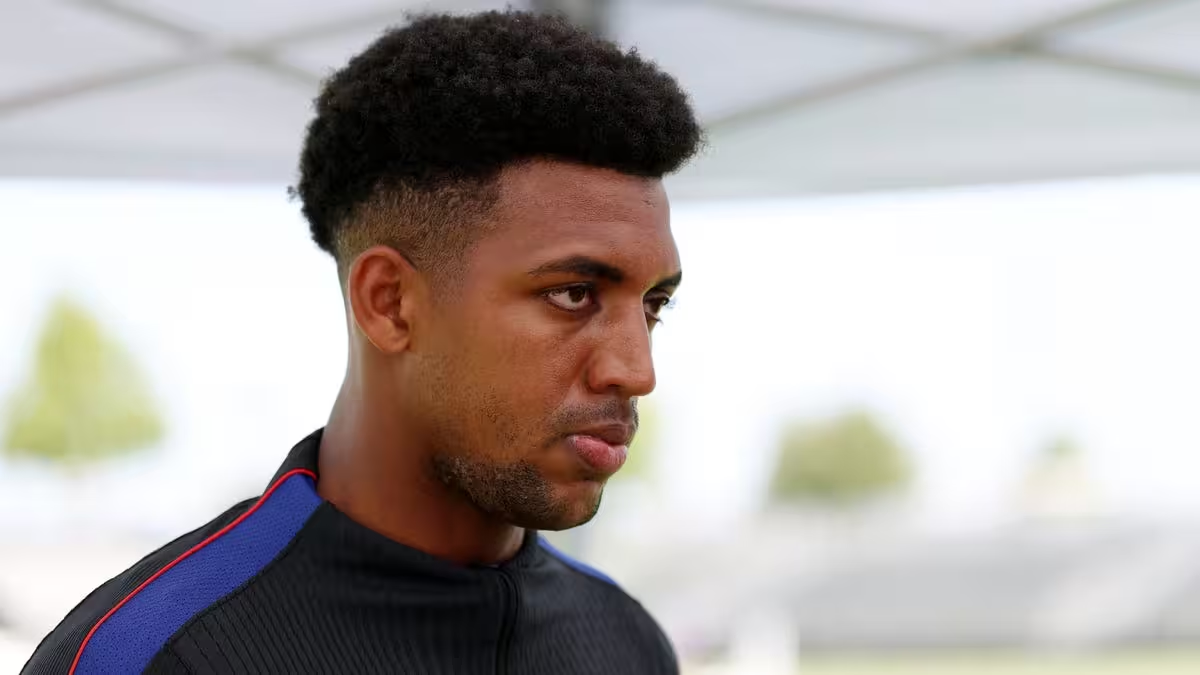

The personal arc is plain. Adams, a midfielder for the USMNT and AFC Bournemouth who grew up in Wappingers Falls, New York (population 6,107), is preparing to play in his second World Cup on home soil. “It’s really exciting to have the opportunity to play in a second World Cup, to be able to represent your country in front of friends and family,” he wrote, adding, “I dreamt of playing in World Cups as a kid and to have an opportunity to play in my second [on home soil] is going to be a bit surreal.” The tournament runs from June 11 to July 19 across 16 cities in the United States, Mexico and Canada.
Adams threaded purpose through his personal reflection. He framed the U.S. style in blunt terms: “You need to have that grit, that energy. And I feel like that’s what the U.S. leans on, like that’s who we are. That’s in everything that we do.” He said he wants youngsters watching to see a path: “I want these kids that are watching to be able to watch me play and say, ‘I want to be the next Tyler Adams. Like, how do I do that?’”
The friction in Adams’s account is not sentimental — it is practical. He learned of his World Cup selection ahead of Bournemouth’s final match but had to remain focused while the team completed a season-defining run. Bournemouth had already secured its Europa League place before that last game, yet the club still had results to finish the campaign on a high. Adams’s diary makes clear he spent the closing weeks splitting attention between two legitimate claims on his body and mind: club history and a World Cup on home turf.
The immediate calendar leaves little breathing room. Adams returned to New York in late May and will be expected to join the U.S. squad ahead of a tournament that begins June 11. The most consequential unanswered question after his diary entry is how his minutes, form and recovery from a long Premier League run will translate to the compressed, emotionally charged schedule of a home World Cup — and what role he will occupy when the U.S. takes the field in June.



