



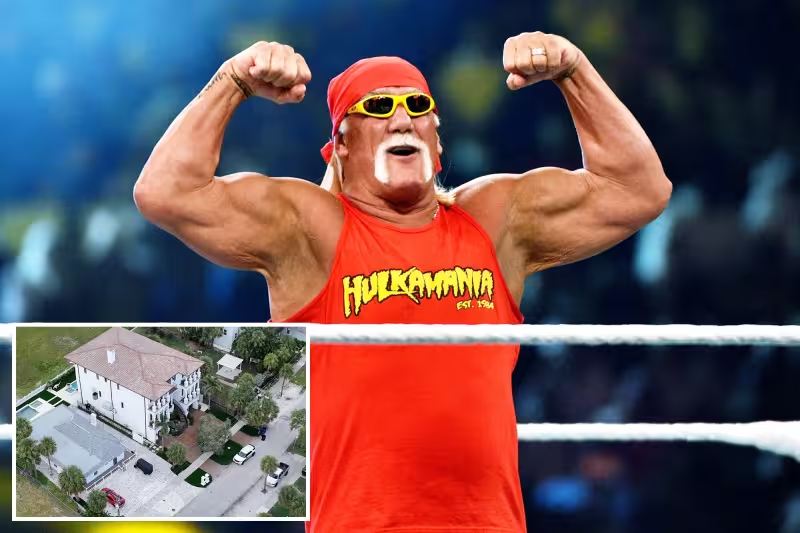
Clearwater police announced Friday that their nearly 11-month investigation into Hulk Hogan’s death found no evidence of criminal wrongdoing and that the case is being classified as "an attended natural death," officials said in a 70‑page case master report released the same day.
Investigators said Terry Bollea — known publicly as Hulk Hogan — died on July 24, 2025, at his Clearwater, Fla., residence after he stopped breathing while seated in his recliner. He was with his wife, Sky, and two healthcare workers at the time; Sky called 911 while one of the medical professionals administered CPR, and Hogan was transported to a nearby hospital where he was pronounced deceased.

The report says people close to Hogan told investigators he had been in rough shape following multiple recent surgeries. Police and the investigative team reviewed witness interviews, medical records, surveillance footage from inside the residence and a visual inspection of the body as part of the inquiry before reaching their conclusion.
A private autopsy cited in the case file found that Bollea died "exclusively from compelling natural disease, with no reasonable traumatic or terminal toxicologic contributions," a finding investigators flagged as central to their decision to rule the death natural and not the result of external causes.

Clearwater Police Department spokesperson Rob Shaw thanked Hogan’s family for cooperating with investigators and said that family cooperation allowed access to sensitive information the department otherwise could not legally obtain. Shaw said the family — specifically Sky, Nick and Brooke — and their attorney, Kevin Hayslett, were helpful during the inquiry.
Police wrote in their summary that there has been no evidence to indicate the death of Terry Bollea was anything other than natural, and that there has been no evidence to indicate any criminal wrongdoing related to his death. The department said the investigation will be closed and "will be considered solved, non-criminal."
The final report arrives after months of public questions about how Hogan died; his daughter Brooke publicly said multiple times after his death that she had significant questions about the circumstances surrounding his passing. The police findings do not detail the specific concerns Brooke raised, and the report does not identify anything in the evidence that supported criminal suspicion.
For readers tracking the legal status of the matter, the practical next step is administrative: the department has closed the file. With investigators citing the private autopsy and the combined record of interviews, recordings and medical documentation, prosecutors and detectives have signaled they will take no further action because the evidence does not support criminal charges.
The conclusion resolves the official inquiry into a high‑profile death that drew public attention precisely because family members and others pressed for answers; police say their review found the medical record and witness accounts consistent with natural disease and post‑surgical decline. With the case labeled solved and non‑criminal, the unresolved item left on the table is the specific content of the questions Brooke raised — the department’s report does not explain what those were, and the public record ends with the closure announced Friday.



