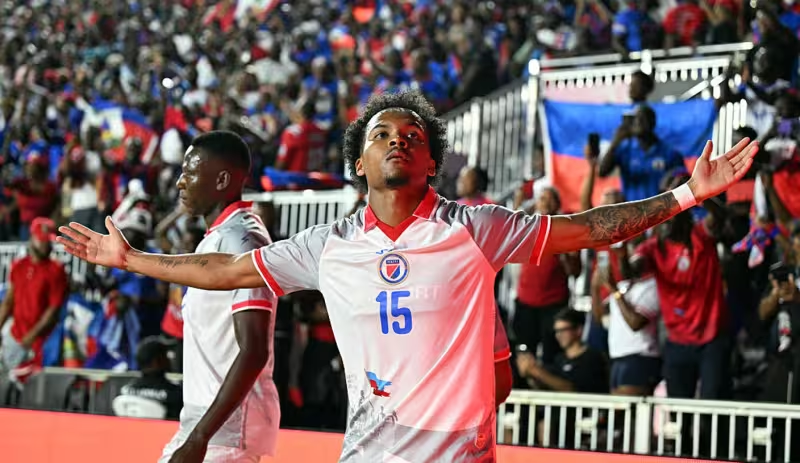
Nu Stadium in Northwest Miami-Dade was expected to host about 26,000 fans for Haiti’s friendly against Peru on June 5, 2026, with kickoff scheduled for 7:30 p.m., a sellout that gave South Florida supporters a rare live look at the Grenadiers.
The crowd marked Haiti’s second appearance in South Florida in a week and offered a local outpost of celebration: fans spent part of the afternoon in Miami’s Little Haiti hunting jerseys, flags and other gear before heading to the stadium, and Peruvian supporters and La Franja, Peru’s organized cheering squad, were also expected in large numbers.

The size of the turnout is the statistic that matters: an estimated 26,000 people in a market that has not seen the national side in force for decades. For many in the stands, this friendly was the closest thing to a home match they are likely to get — Haiti’s qualification for the 2026 FIFA World Cup, its first tournament appearance since 1974, has energized a diaspora audience that cannot easily watch games on Haitian soil.
That absence from home grounds is the source of an awkward reality: despite celebrating World Cup qualification, the Grenadiers still cannot reliably host matches in Haiti because of ongoing instability and violence. Haiti will play its official World Cup fixtures in Boston, Philadelphia and Atlanta, with its tournament opener against Scotland set for June 13, 2026 — meaning this Miami friendly was as much about rehearsal and morale as it was about turnout.
The human detail underlining the sellout came from people in the crowd. Jean Luckner, who has spent substantial time between Miami and Haiti, said bluntly: "For over five years, the country has been shut down." He added, "Now this is a second home we have here in Miami, and at the same time, Haiti gets to play here in Miami," capturing why a South Florida stadium felt consequential to supporters who cannot gather at home.
On the pitch, the matchup carried contrasting stakes: Peru, eliminated in CONMEBOL qualifying and missing the World Cup, arrived as the favored side for this friendly — a point noted by FOX Sports — while Haiti used the match as preparation before heading into Group C play in the tournament. Rodentz Josias, speaking before the game, put the mood plainly: "Futbol is in our soul" and "We like soccer, we like playing soccer, and today it's a pleasure to see our team." Those lines framed the evening as celebration first, experiment second.
Practical details mattered for attendees: kickoff was set for 7:30 p.m., and the presence of Peruvian fans meant the stadium atmosphere promised a bilingual, binational noise level. What remains unclear — and what will be watched afterward by analysts and Haitian organizers alike — is how the crowd broke down by allegiance. Organizers estimated overall attendance; precise ticket sales by nationality or fan group were not reported publicly, leaving an open question about how much of the energy in Nu Stadium came from Haitian supporters versus visiting Peruvians.
What happens next is concrete. Haiti’s immediate trajectory is toward the World Cup: the team opens on June 13 against Scotland in Group C, and then faces its remaining group opponents in Boston, Philadelphia and Atlanta. The unanswered tally of how many of the 26,000 in Miami were Haitian — and how that crowd’s support translated into on-field confidence — is the detail that will connect this sellout to Haiti’s performance in the tournament.