



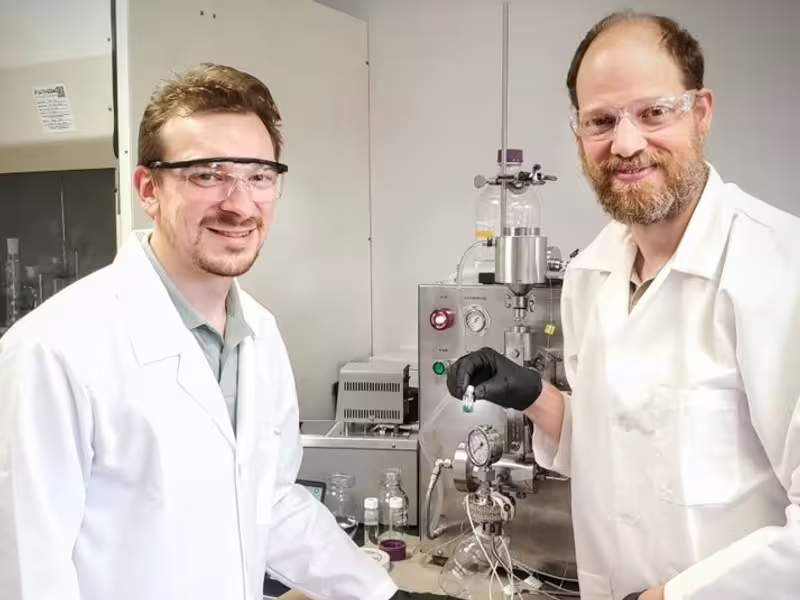
CEPI said on 3 June 2026 it will provide up to US $9.7 million more to POP Biotechnologies to push its SNAP vaccine platform into Phase 1 clinical testing for a candidate against H5N1 avian influenza. The funding builds on an initial US $1.5 million investment announced in July 2025.
The award matters because it moves a platform concept closer to human testing, while also testing whether a faster production method can help with a virus that has already spread widely in birds and increasingly infected mammals. CEPI is backing the work as part of its 100 Days Mission, which aims to develop vaccines against a new pandemic threat within 100 days of identifying it.

In plain terms, SNAP is designed to tag vaccine antigens with a small protein marker and embed them in liposomes, a process CEPI says could make vaccine delivery more targeted and immune responses stronger. The agency also says the approach could remove potential contaminants from antigens in as little as 30 minutes, far faster than conventional purification methods that can take several days and are often costly and complex.
That speed is the promise. But the platform still has to clear early clinical testing before it can be used in any vaccine, and the next step is Phase 1, the first stage meant to check safety and basic immune response in people. CEPI said the trial will evaluate the SNAP-based H5N1 candidate, but it did not give a start date.
Kent Kester, CEPI’s vaccine research lead, said antigens have to be purified to ensure safety, efficacy and consistency, and that shaving days off that process could help contain a fast-spreading viral threat. He also said validating SNAP against H5N1 would show whether it could be adapted quickly for other epidemic and pandemic threats, including a future Disease X.
Jonathan Lovell, POP BIO’s co-founder, said the company was excited to continue its partnership with CEPI to translate the SNAP technology for a H5N1 protein nanoparticle vaccine, calling the project a big step forward for the company. For now, the funding answers one question clearly: POP Biotechnologies has the money to move ahead. The unanswered one is how quickly the platform can prove that its speed in the lab can survive the first test in people.



