



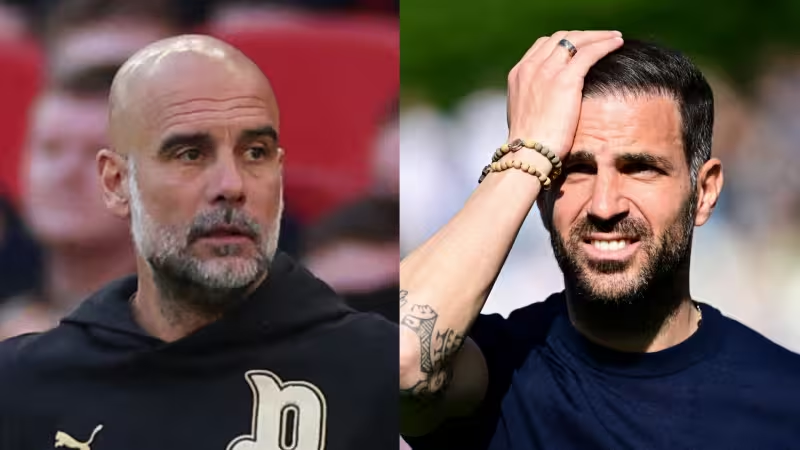
Silvio Baldini began his brief reign as Italy’s interim head coach by unloading on the people who run the game and rejecting headline-grabbing targets such as Pep Guardiola and Cesc Fabregas. In his first press conference on Friday, Baldini said bluntly that “Italian football is in the hands of directors who think about their own interests and not about the growth of the game,” and warned that talk of big, unattainable names was pointless.
The remarks came alongside concrete, immediate choices. Baldini named a squad that includes 20 uncapped players for the two friendlies scheduled during this international window — Luxembourg on June 3 and Greece on June 7 — a clear signal he intends to use the matches to test new faces rather than chase headlines.

Those selections are the clearest evidence yet of the approach Baldini described: a focus on experience gained through playing and on rebuilding identity from the pitch up. “You get experience by playing,” he said, and asked where the logic lies in prioritizing short-term market deals over youth, asking rhetorically, “Where is the advantage in signing a 39-year-old player instead of finding one in the academy?”
Baldini’s critique extended beyond transfer policy. “The aim is to do well on the transfer market with older players, not with younger players,” he said, naming the tension he sees between immediate financial returns and long-term growth. He singled out a recurring pattern: “Some people call them ‘cheats’, and they often have the reins of the game in their hands.” He added, “Without serious directors, it will continue to be a problem.”
He was equally explicit about managerial fantasies. “There's no point in mentioning unattainable names like Guardiola or Fabregas; in Italy we have plenty of skilled coaches, and the ones we hear about are absolutely capable of giving the team a strong identity,” Baldini said, later adding, “If I had to choose, I’d go for coaches with solid resumes.” The comments read as a rebuke to a national conversation that has already floated big foreign names to solve systemic weaknesses.
The press conference doubled as a stopgap briefing. Baldini was appointed on an interim basis after Gennaro Gattuso resigned following Italy’s failure to qualify for the 2026 World Cup. Baldini framed his role in modest terms: “As for me, I hope whoever arrives sees me as a useful resource and not a hindrance,” he said, positioning himself as a bridge rather than a long-term fix.
That stance creates the central friction in Baldini’s early stewardship. Italy remain without a permanent head coach, and the federation is not expected to name one before the FIGC Presidential elections on June 22. Baldini’s public criticism of the structure that produced the recent failures, paired with his interim posture and willingness to blood uncapped players, underlines the unsettled state of the job ahead of the vote.
What happens next is immediate and institutional. On the field, Italy will test a largely unproven roster in friendlies on June 3 and June 7. Off the field, the decisive question is who will be installed after the FIGC presidential vote and whether that successor will tackle the governance and youth-development issues Baldini laid bare. Baldini’s opening salvo makes clear the debate he expects to follow: appoint a name — or change the system that produced the need for one.



