



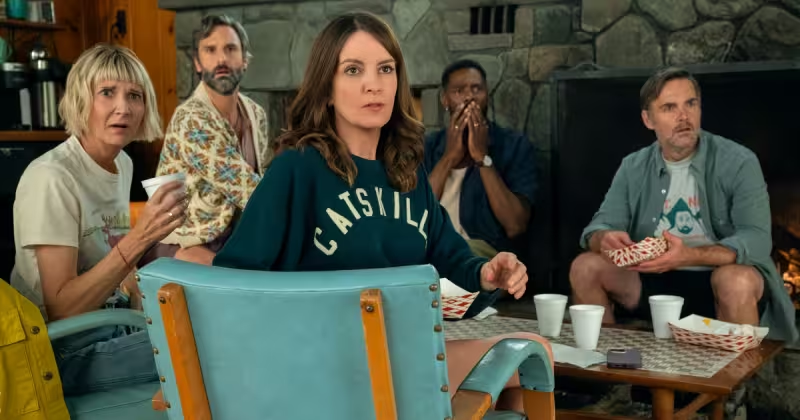
Season 2 of The Four Seasons opens with the group climbing an upstate mountaintop to scatter Nick’s ashes and immediately confronts the practical fallout of his death: because Nick’s divorce from Anne was never finalized, Anne inherits all of Nick’s money and Ginny—who is pregnant with his child—will not receive child support.
Viewers hunting for the four seasons season 2 have found a show that keeps its comic register while digging into midlife uncertainty; a review called the second season even more “perspicacious, poignant and hilarious than the first,” and the series lays its story across four fancy holidays with two gag‑packed episodes for each one. That formal ambition helps explain why conversation about the show has spiked now—the season frames grief, finances and family across a tight, dateable arc that ends by leaving several personal and legal questions open.

The season earns that framing in concrete beats. The friends repeatedly fail to get the ashes moment right: small misfires, arguments and the awkward logistics of scattering remains turn a cinematic gesture into a messy, human ritual. Kate and Jack’s marriage, already frayed, unravels and reknots over the course of the trip; Jack admits in a rare candid line that “Something’s lurking, you wouldn’t be so obsessed with trying to fix me if there wasn’t something eating you up too.” He’s been smoking weed to soothe his anxieties, and Kate pushes him toward action—she encourages Jack to run a marathon in Italy to try to turn the year around.
Those personal turns ripple into other plans. Kate’s long‑held hope to open a bed and breakfast with Danny is crushed when Danny decides to move to Italy, a choice that also puts Claude and Danny at odds about having a child at their age. Danny’s brusque moment—he uses the word “freeballing” in conversation—signals how casual decisions collide with stakes that are anything but. The season moves these private frictions into the open without smoothing them over into tidy lessons.


At the center of the season’s moral and plot friction is Ginny’s pregnancy and the will that leaves Anne with all of Nick’s money. That legal fact rewires every relationship: Anne, who was married to and divorcing Nick, wakes up to a windfall and to a social hostility she voices bluntly—“Ladies aren’t supposed to be friends with the woman their dead husband left them for.” Ginny, much younger than Nick, must carry a pregnancy and the uncertainties of single parenthood without the automatic support the show’s setup might otherwise have delivered.
The creators make the age and life‑stage questions explicit. Tracey Wigfield says, “It was exciting to not tell love stories that are at the very beginning but decades in and talk about what marriage is really like.” Lang Fisher frames the season’s central question plainly: “Sometimes in your 50s or 60s you are like, ‘Well, what is next? Is there a next? What do I do and who am I now?’” Those lines capture why the series can be both funny and quietly brutal: it stages midlife as a time when legal technicalities, old loyalties and plain exhaustion collide.
The season closes with relationships shifted but without resolving the single largest real‑world consequence on screen—how Ginny will handle the pregnancy and the lack of financial support now that Anne controls Nick’s estate. That gap is the clearest hinge left for whatever comes next: the show gives its characters emotional reckonings but stops short of settling the legal and parental questions it opened.
If The Four Seasons Season 2 has a demand for a future season, it is this: will the writers move past elegy and marital excavation to show the practical, possibly adversarial steps—custody, inheritance settlement, co‑parenting negotiations—that follow a death in which paperwork, not sentiment, ultimately decides who is provided for?



