Claude Lemieux, a four-time Stanley Cup champion and one of the NHL’s most feared postseason players, died at 60, the Montreal Canadiens announced Thursday.
Fans searching for “lemieux cause of death” have found no answer: the Canadiens’ announcement gave his age and mourned his passing but did not disclose how he died, and the absence of a cause is sharp because Lemieux had been in Montreal this week as the Bell Centre torchbearer for Game 3 of the Eastern Conference Final.

Lemieux’s hockey résumé is the reason his death landed across the sport. A 21-season NHL veteran, he won Stanley Cups with Montreal in 1986, the New Jersey Devils in 1995 and 2000, and the Colorado Avalanche in 1996. He was a postseason force — he scored 10 goals and added six assists in the Canadiens’ 20-game run to the 1986 title and earned the Conn Smythe Trophy in 1995 after scoring 13 goals in 20 playoff games with the Devils. His teams made the playoffs in 15 straight seasons; his 234 postseason games rank sixth in NHL history and his 80 playoff goals rank ninth.

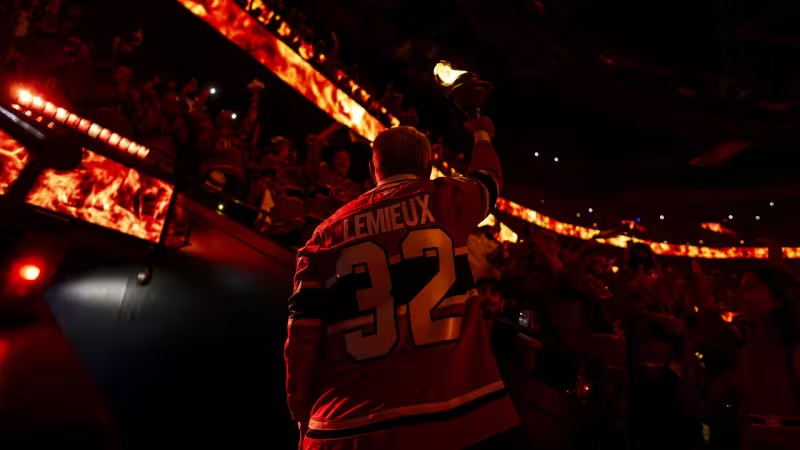
His ties to Montreal were immediate and recent: the Canadiens picked him in the second round, 26th overall, of the 1983 NHL Draft, and he returned this week to serve as the Bell Centre torchbearer on Monday before Montreal’s 3-2 overtime victory over the Carolina Hurricanes in Game 3 of the Eastern Conference Final. That presence — a champion back at his home rink during the conference finals — intensified the reaction when the club announced his death on Thursday.
Lemieux’s career was defined by a duality that still divides opinion. Teammates and opponents alike called him a clutch performer who lifted teams when it mattered most; he left a record in the postseason that few players match. At the same time, his style of play made him an irritant, and he routinely drew the ire of rivals for pushing the game’s physical and ethical boundaries. In recent years he shifted from the ice to the business side of hockey, working as a player agent representing some of the NHL’s top stars.
League and club officials framed his death through that same double lens. The NHL’s commissioner said the league mourns the passing of “a four-time Stanley Cup champion and one of the greatest big-game players in hockey history,” and noted Lemieux’s postseason achievements and later work as a player agent, while offering condolences to his wife, Deborah, and their children Brendan, Claudia, Michael and Christopher. The Canadiens’ owner described the day as dark for the Canadiens family, calling Lemieux a fierce, tenacious competitor who embodied what it meant to wear the Montreal Canadiens sweater and expressing his deepest condolences to the family.
The immediate unanswered question is the one most people are looking for now: what was the lemieux cause of death? The club did not provide details, and no family statement with medical information has been released. What comes next is likely straightforward: an official update from the Canadiens or a family representative, and until that appears the public record will hold only his age, the timing of his sudden passing and the outline of a Hall of Fame–caliber postseason legacy.