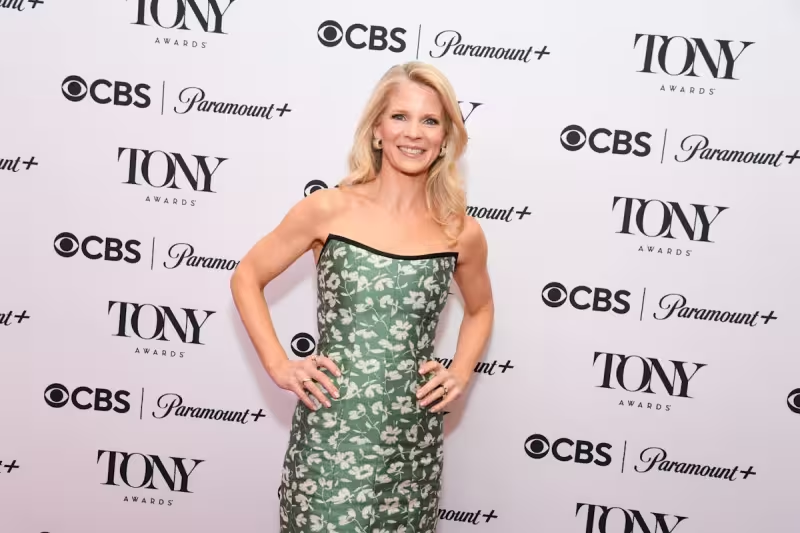
Rose Byrne is co-starring with Kelli O’Hara in the current Broadway revival of Noël Coward’s Fallen Angels, the 100-year-old play that tracks two friends whose evening of martini- and Champagne-fueled confessions turns into jealousy and competition when a former lover returns to town.
The production has become a showcase: both O’Hara and Byrne received Tony Award nominations for their work in the show, and the play’s mixture of comic mischief and frank female desire has drawn renewed attention to Coward’s 1920s text.

“The play was incredibly ahead of its time and was banned and almost not allowed to be on until it was just decided that it was so farcical and would never happen in real life — as if women would ever have such desires,” O’Hara said, arguing that Fallen Angels was treated as scandalous in another era even as audiences now recognize its bite and wit.
O’Hara, who had last appeared on Broadway in Days of Wine and Roses, said she and Byrne leaned into different instincts for their characters: “We’re going to be better together. You’re going to do your thing. I’m going to do mine. We’re nothing alike.” She described the two parts as written distinctly — one as the alpha and the other as the wild card — and praised Byrne’s instincts onstage. “She’s a comedian through and through,” O’Hara said, adding that Byrne came in with bold choices.
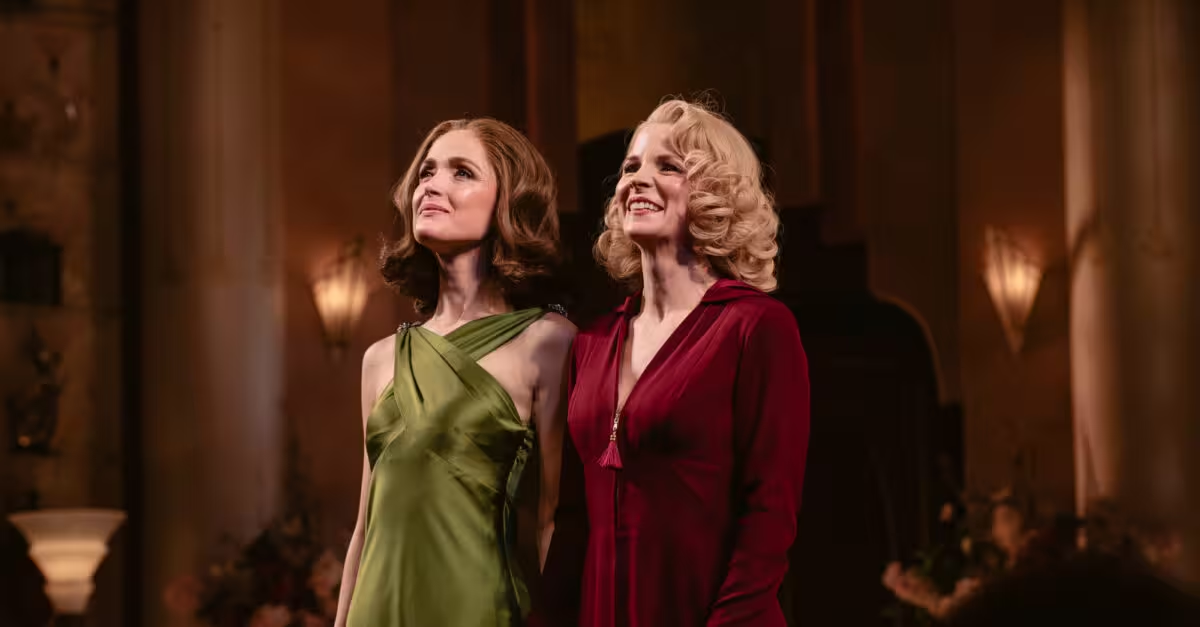


The play’s action — two women confronting a shared past and a returning lover in a single evening — remains compact and theatrical by design. O’Hara said she and Byrne aimed to give the storytelling more agency, to bend the evening toward friendship rather than pure rivalry: “We tried to just have a little bit more agency in the storytelling, and also really make it about our friendship and lean a little against the rivalry by making it a shared passion — even though we, of course, get drunk and get mad at each other.” The result is a revival that foregrounds female connection as much as comic fracture.
For O’Hara the choice of this work speaks to a larger career impulse. She called Fallen Angels’ lead a pleasure to play at her age, saying, “And what a fun thing to get to play, at my age — this sexual, passionate, hungry, funny, alive person.” O’Hara has been candid about wanting to keep portraying energetic, full-of-life characters after turning 50 and said she is looking for collaborators who will build those parts with her. She also noted the steadiness of the grind: there is something she described as beautiful and calming about an eight-shows-a-week schedule.
The revival’s success sits on a contrast: a play once treated as too racy for the stage has been reclaimed and rewarded decades later. That tension — between the old censure O’Hara names and the contemporary embrace that led to Tony nominations for both leads — is the production’s central friction point. The characters themselves are written to tug against one another and, in this staging, to find an uneasy solidarity that undercuts the idea that the evening is simply a contest.
Byrne’s billing alongside O’Hara has helped frame Fallen Angels as more than a period curiosity; the revival deliberately uses Coward’s century-old comedy to ask why stories of appetite and rivalry feel fresher now. For audiences, the answer is in the staging and the performances: two performers who choose imbalance over neat reconciliation and, in doing so, insist that life on stage — for women of any age — continues to offer appetite, risk and laughter. “Let us be bold. Let us not decide that life ends,” O’Hara said, and the revival makes that a concrete, theatrical proposition rather than a slogan.