



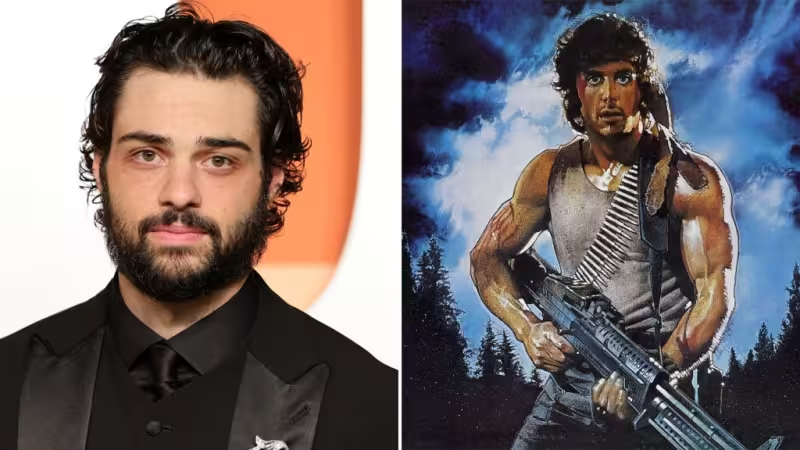
Lionsgate will open John Rambo on June 4, 2027, and Noah Centineo will inherit the title role from Sylvester Stallone in a prequel that traces the character’s origins before 1982’s First Blood.
The new film is directed by Jalmari Helander and will feature David Harbour as Major Trautman; James Franco is also listed among the cast in an unspecified part. Lionsgate bills John Rambo as a look back at the events that forged the cinematic soldier, and the studio has set a firm summer release date for the project.

The casting decision is the clearest headline: Centineo, a younger actor taking over an icon long associated with Stallone, anchors a revival that is explicitly a prequel to the franchise’s first film. Stallone, who brought Rambo to the screen in 1982 and led the series for decades, is credited on the new picture as an executive producer.
John Rambo joins a franchise that began with First Blood in 1982 and continued with Rambo: First Blood Part II in 1985, Rambo III in 1988, Rambo in 2008 and Rambo: Last Blood in 2019. The five films in the series have grossed north of $819 million at the global box office.
The announcement bundles several notable pieces: a set release date, a director with a clear vision attached, a high-profile supporting turn from Harbour as Trautman, and a recasting that shifts the on‑screen identity of Rambo away from the actor who defined the part for most viewers. Lionsgate’s planned June 4 date places the film in the studio summer calendar where it will sit near other big releases.
There is an inherent tension in the production: the project is billed as an origin story for a character long associated with Stallone, yet the lead will be played by Centineo. That contradiction is partially resolved on paper by Stallone’s executive producer credit — a formal tie to the franchise without an on‑screen return as the character he made famous.
Beyond names, the casting choices amplify questions about tone and audience. A prequel invites a reexamination of how the character was forged, and presenting that reexamination with a new actor turns what might have been a continuation into an explicit re‑framing. The film’s success will depend in part on whether audiences accept Centineo as a plausible younger Rambo and whether Harbour’s Trautman proves a credible bridge to the world established in First Blood.
For viewers tracking the series, the mechanics are simple and consequential: John Rambo is not a sequel and not a cameo‑driven reunion; it is a narrative set before the 1982 story, opening on June 4, 2027, from Lionsgate. The studio has attached a director and a supporting cast intended to populate Rambo’s earlier life, and it has given Stallone a production credit that keeps him tied to the brand without returning him to the title role.
The clearest conclusion is this: Sylvester Stallone’s imprint on the character remains official — he is listed as an executive producer — but the on‑screen mantle of John Rambo has been passed to Noah Centineo. The film will test whether that handoff convinces both longtime fans and a new audience when it hits theaters next summer.



