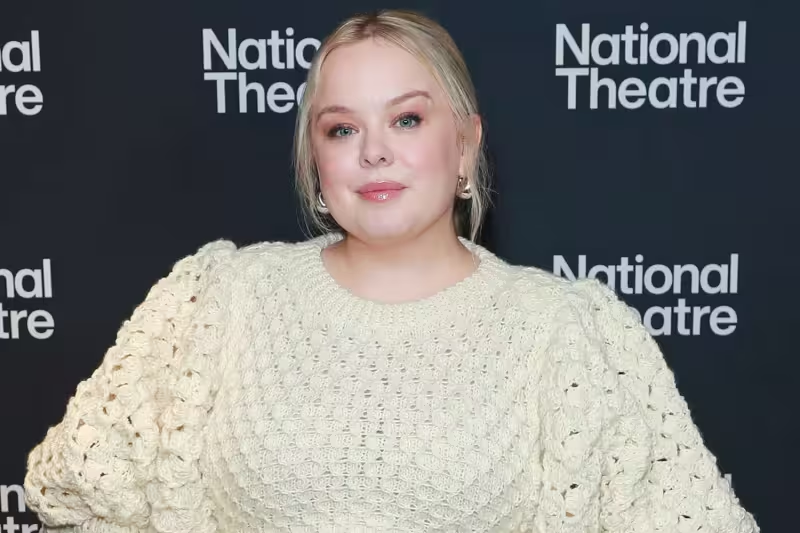
Nicola Coughlan has become one of the clearest modern examples. Her work in Derry Girls and Bridgerton has made her one of television’s most recognizable performers, yet much of the public conversation around her has repeatedly drifted back to her body, her clothes, her romantic scenes and whether her presence on screen should be read as “brave.” Coughlan has asked people not to send her opinions about her body and has spoken about how frustrating it is when months of work are reduced to commentary about how she looks.
That dynamic is not new. What has changed is the speed, volume and intimacy of the judgment. The old celebrity press turned women’s bodies into magazine covers, red-carpet rankings and tabloid headlines. Social media turned the same impulse into a permanent, participatory feedback loop, where millions of strangers can deliver judgments directly to the person being judged.

The result is a culture that often claims to celebrate women’s success while still treating their bodies as public property.
Nicola Coughlan And The Modern Debate
Nicola Coughlan’s career should be easy to discuss on artistic terms. She is a sharply comic actor who became internationally loved as Clare Devlin in Derry Girls, then moved into a very different kind of fame as Penelope Featherington in Bridgerton. Her work depends on timing, emotional precision, vulnerability and tonal control. She can play panic, wit, shame, longing and defiance without flattening a character into a single note.
Yet the conversation around her has often revealed how difficult it remains for audiences and media outlets to talk about a woman’s performance without also talking about her body.
Coughlan has repeatedly pushed back against that framing. In 2022, she asked followers not to send her comments about her body, even comments they believed were kind. She explained that receiving thousands of opinions about how she looked was difficult, regardless of intent.
The request was notable because it rejected both insult and praise as forms of entitlement. Coughlan was not merely objecting to cruelty. She was objecting to the assumption that public visibility makes a person’s body an open discussion forum.
That distinction matters. Modern celebrity body discourse often hides behind approval. A woman is “brave” for wearing a dress, “refreshing” for not appearing conventionally thin, “real” for having a body that deviates from a narrow ideal, or “unrecognizable” when she loses weight. Each phrase may sound different, but all of them keep the body at the center.
When Coughlan became the romantic lead of Bridgerton Season 3, the body commentary intensified. Instead of focusing only on the character arc, the chemistry, the writing or the meaning of Penelope’s transformation, some coverage and online commentary became preoccupied with what it meant for a woman like Coughlan to be filmed as desirable. Co-star Simone Ashley publicly defended her amid body-shaming comments during the Bridgerton press cycle.
This is the trap: the culture asks for more varied representation, but when that representation arrives, it often turns the performer into a referendum. Coughlan is not allowed to simply be an actor playing a romantic lead. She is asked to carry the burden of proving something about beauty standards, body positivity, desirability, feminism and television history.
That burden is exhausting because it converts professional achievement into a public debate about flesh.
How Celebrity Coverage Has Changed
Celebrity coverage has always traded in appearance. The old studio system built stars as visual commodities. Actresses were styled, lit, posed and promoted according to carefully managed ideals of femininity. Their faces sold tickets. Their bodies sold magazines. Their romantic availability sold fantasy.
In the mid-to-late 20th century, Hollywood gossip columns and fan magazines helped shape the language of celebrity femininity. Weight, age, glamour, pregnancy, marriageability, sexuality and “comebacks” became recurring categories. A woman’s career was often narrated through whether she had preserved, lost or regained the version of herself the public first approved.
By the 1990s and 2000s, tabloid culture became more openly punitive. Paparazzi photography, beach-body spreads, “worst dressed” lists and post-pregnancy weight-loss headlines turned women’s bodies into weekly scoreboard material. The language was often casual, even playful, but the message was brutal: a famous woman’s body could be inspected, mocked and ranked as entertainment.
This era shaped a generation of media consumers. Female celebrities such as Britney Spears, Jessica Simpson, Jennifer Aniston, Tyra Banks, Janet Jackson, Kate Winslet, Renée Zellweger and many others were repeatedly discussed through weight fluctuations, wardrobe choices, aging, sexuality and supposed physical decline. The underlying assumption was that appearance was not just part of fame; it was the public’s right.
The 2010s brought a partial correction. Feminist media criticism, body positivity, mental health advocacy and celebrity self-publishing through Instagram and TikTok made it harder for mainstream outlets to mock women as openly as before. Many publications became more careful. “Beach body” culture faced backlash. The language of wellness replaced some of the language of dieting. Stars had more power to answer back.
But the appetite did not disappear. It adapted.
Today, celebrity appearance coverage often presents itself as concern, admiration, analysis or empowerment. Instead of openly asking whether a woman has gained weight, the internet asks whether she is “healthy.” Instead of saying she looks older, commenters ask whether she has had work done. Instead of mocking a body, they debate whether calling it beautiful is progressive. Instead of treating a romantic scene as acting, they treat it as a cultural event because of who is doing the scene.
The packaging has changed. The surveillance remains.
Why Appearance Still Dominates Headlines
Appearance dominates headlines because it is easy, visual, emotional and commercially reliable.
A performance requires interpretation. A body requires only a photograph. A role may demand context, but a red-carpet image can be turned into instant content: best dressed, worst dressed, transformation, reaction, clapback, fan concern, viral moment. The celebrity economy rewards speed, and appearance is the fastest material available.
There is also a gendered expectation at work. Female celebrities are expected to be both exceptional and relatable, aspirational and accessible, polished and authentic, desirable but not vain, aging but not visibly aged, confident but not arrogant, sexual but not too sexual, thin but not alarmingly thin, curvy but not too curvy. The rules are contradictory, which is precisely why they generate endless commentary.
Successful actresses face appearance-focused coverage because success increases visibility. The more prominent a woman becomes, the more images circulate, the more fans invest, the more critics scrutinize and the more content creators exploit the attention. Achievement does not protect women from body commentary. It often makes them larger targets.
Nicola Coughlan’s case shows how this works. Her rise as a leading figure in one of Netflix’s major franchises should have produced sustained conversation about acting range, romantic comedy tradition, Shondaland’s period fantasy, fan culture and television stardom. Those conversations did exist. But they competed with a louder question: how should audiences talk about her body?
That question was not neutral. It carried centuries of expectation about who gets to be desired on screen and who gets treated as a novelty for being desired.
When an actress does not match the narrow template historically assigned to romantic heroines, the industry often congratulates itself for allowing her to be seen. But that celebration can become another cage. It implies that the performer’s body, rather than her work, is the story.
The same pattern appears with actresses across body types. Women who are thin face speculation about whether they are too thin. Women who gain weight face rumors and judgment. Women who lose weight are accused of betrayal, illness or vanity. Women who age naturally are told they look tired. Women who use cosmetic procedures are accused of artificiality. Women who reject beauty standards are still discussed in relation to beauty standards.
There is no body that escapes the machine. There are only different categories of commentary.
The Social Media Amplification Effect
Social media did not invent celebrity body shaming. It democratized it, accelerated it and made it harder to escape.
In the tabloid era, criticism was filtered through editors, photographers and headline writers. That system was often cruel, but it had visible gatekeepers. Today, the crowd is the gatekeeper. A comment can begin as a joke, become a meme, turn into a trend, generate a response from the celebrity, produce a wave of coverage about that response and then become part of the celebrity’s permanent public narrative.
Platforms reward this cycle because emotional content travels. Outrage, comparison, surprise, mockery and praise all produce engagement. An image of a female celebrity can be reposted not because the audience cares about the project she is promoting, but because her body has become the discourse of the day.
The directness is also new. Coughlan’s 2022 request was powerful because it identified a modern problem: celebrities do not merely read criticism in magazines. They receive it in their mentions, comments and direct messages.
That direct access creates a false intimacy. Fans and critics behave as if the celebrity is a friend, a rival, a symbol or a public utility. They say things they would never say to a person sitting across from them, partly because the screen reduces empathy and partly because fame seems to make the target less human.
Social media also collapses different kinds of speech into the same visible space. A thoughtful critique of styling, a cruel insult, a fan’s compliment, a journalist’s question, a meme and a medicalized speculation about weight can all appear under the same post. The celebrity receives them as a mass of commentary about the body.
That volume changes the meaning. One comment may be dismissible. Ten thousand comments become an environment.
The amplification effect also encourages people to frame appearance commentary as participation in a larger cause. A person may believe they are defending body positivity by praising a celebrity’s shape. Another may believe they are defending health by criticizing weight. Another may believe they are defending authenticity by accusing a star of cosmetic work. The stated politics differ, but the outcome is similar: the body remains public property.

The Mental Health Cost Of Public Scrutiny
The mental health cost of appearance scrutiny is difficult to measure precisely because celebrities rarely disclose the full private impact. But the pattern is visible: many stars have described body commentary as draining, humiliating, destabilizing or impossible to ignore.
Coughlan has said that it is hard to spend months working on a project only for the discussion to come down to how she looks. That statement captures the professional insult as much as the personal pain. Appearance scrutiny does not merely hurt feelings. It diminishes labor.
Acting is work. It involves rehearsal, emotional exposure, technical discipline, long hours, collaboration, physical stamina and repeated vulnerability. When the public response centers on weight, clothes or attractiveness, it tells the performer that her craft is secondary to her body’s acceptability.
The cost is also cumulative. Female celebrities often face scrutiny from adolescence into adulthood. They are watched through puberty, pregnancy, illness, divorce, grief, aging and career transitions. Their bodies are treated as evidence of moral success or failure. Weight gain becomes laziness. Weight loss becomes suspicious. Aging becomes decline. Confidence becomes arrogance. Sexuality becomes desperation. Privacy becomes secrecy.
For audiences, the damage spreads outward. Celebrity body commentary teaches viewers how to judge themselves and each other. When a famous woman’s body is dissected, ordinary people absorb the standards behind the dissection. They learn which bodies are considered surprising, acceptable, brave, shameful, desirable or in need of explanation.
Young viewers are especially vulnerable because celebrity images often become templates for identity. When every visible woman is turned into a before-and-after, a concern thread or a debate about desirability, audiences learn that the female body is never allowed to simply exist.
This is not only about cruelty. Positive commentary can also reinforce surveillance. When fans flood a celebrity with praise for weight loss, they may believe they are being supportive. But the message can still be that the body has improved because it has changed. When fans praise an actress as “brave” for showing skin, they may intend empowerment. But the implication can be that her body required courage to be seen.
That is why Coughlan’s request not to receive body commentary, even when well-meaning, was so resonant. It challenged the idea that praise cancels out objectification.
What Has Improved And What Hasn't
Some things have improved.
Mainstream entertainment journalism is less openly cruel than it was in the height of tabloid body-shaming culture. Many outlets now recognize that mocking weight, aging or appearance can produce backlash. Celebrities have more tools to respond. Audiences are more willing to call out sexism, fatphobia, ageism and double standards. The language of consent, boundaries and mental health has entered public discussion.
There is also more variety on screen. Television and film have expanded, however unevenly, the range of women allowed to be funny, sexual, powerful, complicated and central. Streaming platforms have created space for performers who might not have fit older studio formulas. Audiences have shown enthusiasm for heroines who do not conform to a single visual ideal.
Coughlan’s Bridgerton prominence is part of that progress. A romantic season built around Penelope Featherington reached a massive audience and gave viewers a heroine whose desirability was written into the story rather than treated as a joke. That matters.
But progress has limits.
The backlash to women’s visibility often arrives through the same channels that celebrate it. A wider range of actresses may now receive leading roles, but they are still asked to explain what their bodies mean. The industry may speak the language of inclusivity, but publicity campaigns often still rely on transformation narratives, beauty spreads, fashion coverage and physical reinvention.
Social media has also made old forms of judgment more persistent. A tabloid cover used to disappear from newsstands. A viral body-shaming post can be resurfaced forever. Search engines, fan accounts, reaction videos and aggregation sites keep the cycle alive.
Another unresolved problem is that the burden of correction often falls on the women being scrutinized. The actress must respond gracefully. She must educate the public, set boundaries, make jokes, defend herself, avoid sounding bitter and keep promoting the project. Even resistance becomes part of the content economy.
That burden is unfair. A woman should not have to become a media critic of her own objectification in order to be allowed to work.
The cultural conversation has improved enough that body shaming is more likely to be challenged. It has not improved enough that women are free from being reduced to bodies in the first place.
Lessons For Media Consumers
The first lesson is simple: not every thought about a celebrity’s body needs to be published.
That does not mean audiences cannot discuss fashion, performance, representation or celebrity image-making. Culture depends on interpretation. Red carpets are designed to be seen. Costumes matter. Styling communicates. Screen images are part of storytelling.
But there is a difference between analyzing the visual language of celebrity and treating a person’s body as an object for public correction.
A useful test is whether the comment gives the celebrity personhood. Discussing how a costume functions in a scene is different from speculating about an actress’s weight. Critiquing how a magazine photographs women is different from mocking one woman’s face. Examining beauty standards is different from making an individual performer the battleground for those standards.
Another lesson: beware of “concern” as a disguise for judgment. Online culture often medicalizes appearance. People say a woman looks unhealthy, tired, too thin, too heavy, swollen, aged or altered. Unless the person has chosen to discuss her health, these comments usually reveal more about the audience’s discomfort than the celebrity’s reality.
A third lesson is to recognize the asymmetry of attention. The viewer may spend ten seconds writing a comment. The celebrity may receive thousands of similar comments over years. What feels minor to the sender may feel relentless to the recipient.
A fourth lesson is to separate representation from ownership. Viewers may feel seen by a celebrity’s body, style or public stance. That feeling can be meaningful. But the celebrity does not owe the public a fixed identity. She does not have to maintain the same body, reject weight loss, embrace body positivity, avoid cosmetic procedures, explain health changes or serve as a permanent symbol.
Nicola Coughlan’s body does not belong to a movement. It belongs to Nicola Coughlan.
That principle should extend to every public woman. The more culture learns to treat female celebrities as workers, artists and people rather than mirrors for collective anxiety, the better the conversation becomes.
FAQ
Why are female celebrities judged more harshly for appearance than male celebrities?
Female celebrities are more often judged through beauty standards because entertainment culture has historically linked women’s value to youth, desirability and visual presentation. Male stars face appearance scrutiny too, but they are more frequently allowed to age, change weight or appear unconventional without having their professional worth reduced to their bodies.
Why is Nicola Coughlan often mentioned in body-shaming discussions?
Nicola Coughlan has repeatedly addressed unwanted commentary about her body while rising to global fame through Derry Girls and Bridgerton. Her experience reflects a wider pattern in which successful actresses are asked to discuss their appearance even when promoting serious creative work.
Is it wrong to compliment a celebrity’s appearance?
Not always, but context matters. A general compliment is different from repeated, direct commentary about weight, body shape or perceived change. Coughlan’s point was that even well-meaning body comments can become overwhelming when they arrive constantly and directly.
What is the difference between criticism and harassment?
Criticism addresses work, styling, public messaging or cultural context. Harassment targets the person with insults, repeated unwanted comments, threats, invasive speculation or dehumanizing language. Criticism can be part of public culture; harassment is abuse.
Why do actresses face body commentary when they become more successful?
Visibility increases scrutiny. When an actress becomes more famous, more images circulate and more audiences feel entitled to comment. Success also challenges expectations about who is allowed to be glamorous, sexual, powerful or central on screen.
Has social media made body shaming worse?
Social media has made body shaming faster, more direct and more participatory. It allows strangers to send comments directly to celebrities and rewards emotional reactions with engagement. It has also made it easier for celebrities and fans to push back against harmful narratives.
Does body positivity solve the problem?
Body positivity has helped challenge narrow standards, but it can still keep attention fixed on the body. Some celebrities prefer body neutrality: the idea that a person’s body does not need constant evaluation, praise or public meaning.
How does celebrity body commentary affect audiences?
It teaches audiences to judge themselves and others through the same standards applied to public women. Constant discussion of celebrity bodies can reinforce insecurity, comparison and the belief that appearance is always open for public review.
What can media outlets do better?
Media outlets can focus on work, craft, context and cultural impact rather than body speculation. They can avoid transformation headlines, medicalized appearance commentary and framing women’s visibility as bravery unless the subject chooses that frame herself.
What can readers do better?
Readers can pause before commenting on a celebrity’s body, avoid sharing cruel posts, support coverage that centers work and remember that public visibility does not erase a person’s right to boundaries.