



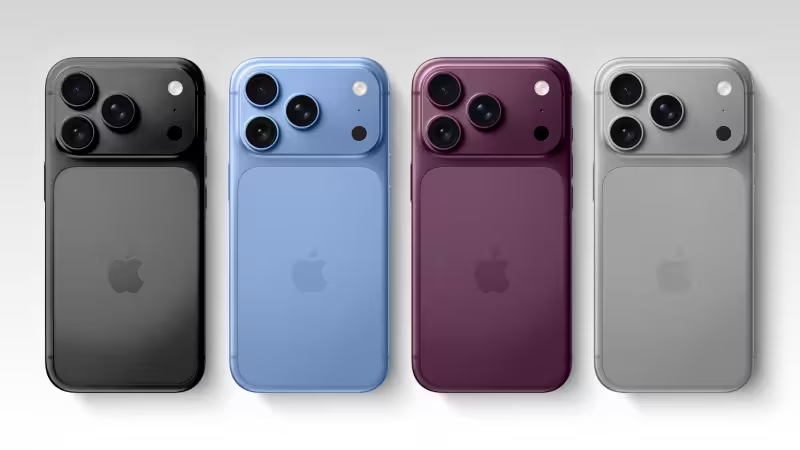
The iPhone 18 is shaping up to be one of Apple’s most important smartphone generations in years. Not because Apple has officially revealed it — it has not — but because the broader iPhone roadmap appears to be changing.
For more than a decade, Apple trained buyers to expect a familiar rhythm: new flagship iPhones in September, a few Pro upgrades, camera improvements, a new chip, and a familiar set of storage and pricing tiers. The iPhone 18 cycle may be different. Current reporting points to a more complicated launch strategy, with premium models arriving first and standard models possibly arriving later. The same cycle may also introduce Apple’s long-rumored foldable iPhone, which would make the iPhone 18 era more than a normal annual refresh. ()

That makes the iPhone 18 worth watching even for people who do not upgrade every year. It could affect how Apple prices its phones, how it separates Pro and non-Pro models, how it handles artificial intelligence features, and how it positions the iPhone against foldables from Samsung, Google, Honor, OnePlus, and other smartphone makers.
This guide explains what is known, what is rumored, what is plausible, and what buyers should keep in mind before deciding whether to wait for the iPhone 18.
Is the iPhone 18 Confirmed?
Apple has not officially announced the iPhone 18. That is normal. Apple typically reveals new iPhones close to launch, and it rarely confirms future product names, specs, or release schedules far in advance.
Even so, the iPhone 18 name is a reasonable expectation because Apple has followed a numbered iPhone naming structure for most recent flagship generations. The details are less certain. Apple could adjust naming, model tiers, or release timing before launch.
The safest way to understand the iPhone 18 right now is this: it is Apple’s expected next major iPhone generation after the iPhone 17 family, but most hardware details remain unofficial until Apple confirms them.
Expected iPhone 18 Release Date
The most widely discussed change is the release schedule.
Current reports suggest Apple may launch the iPhone 18 Pro and iPhone 18 Pro Max in September 2026, alongside a foldable iPhone. The standard iPhone 18 and a lower-cost iPhone 18e may arrive later, potentially in spring 2027. ()
That would be a major shift. Instead of launching the full lineup at once, Apple would separate premium and mainstream devices into different windows. This strategy could give Apple more room to market its highest-end models in the fall while using the spring window for more affordable iPhones.
A split schedule would also reduce crowding. If Apple introduces a foldable iPhone, the company may not want it competing for attention with every other iPhone model at the same time. A fall launch focused on Pro and foldable devices would make the premium story clearer.
Still, this remains unofficial. Apple could keep the traditional September lineup, delay certain models, or change the release order depending on production readiness, supply chain conditions, and market strategy.
Possible iPhone 18 Lineup
The iPhone 18 family could include several models:
-
iPhone 18
-
iPhone 18e
-
iPhone 18 Pro
-
iPhone 18 Pro Max
-
Foldable iPhone, possibly branded separately
The key uncertainty is whether the foldable iPhone will be treated as part of the iPhone 18 family or marketed as a separate premium device. Some reports refer to it as an iPhone Fold, while others suggest Apple could use a different name, such as iPhone Ultra. Apple has not confirmed the branding. ()
The distinction matters because Apple’s naming affects buyer expectations. A device called “iPhone Fold” would be seen as a new category. A device called “iPhone Ultra” would suggest the highest tier of the iPhone family. A device launched alongside the iPhone 18 Pro models would still influence the iPhone 18 cycle, even if it does not carry the iPhone 18 name.
Design Expectations
The standard iPhone 18 is expected to preserve the broad design language of recent iPhones: a glass-and-metal body, flat display, advanced camera system, Face ID, USB-C, and MagSafe support. Major visible redesigns are more likely to appear first on Pro or foldable models.
The iPhone 18 Pro models may receive more ambitious changes, though the exact design remains uncertain. Rumors have pointed to display refinements, camera hardware changes, and continued work toward reducing visible sensor cutouts. However, reports have also cautioned that under-display Face ID may not be ready for the iPhone 18 Pro generation. ()
That caution is important. Apple tends to wait until a hardware change meets its performance, durability, and manufacturing standards. Under-display Face ID is technically attractive because it could create a cleaner screen, but it must work reliably in different lighting conditions and viewing angles. If the trade-off affects speed, security, or display quality, Apple may delay it.
Display and Face ID Rumors
The biggest display rumor is whether Apple can further reduce the Dynamic Island or move Face ID components beneath the display.
Earlier rumors suggested the iPhone 18 Pro could adopt under-display Face ID. More recent reporting has been more cautious, indicating that the technology may not be ready for this generation. ()
That would mean the iPhone 18 Pro may continue using a visible front-facing camera and sensor area, even if Apple refines its size or shape. For many users, that may not matter much. The Dynamic Island has become part of the modern iPhone interface, and Apple has used software to make the cutout feel more functional.
For ProMotion, Apple is likely to continue using high-refresh-rate displays on Pro models. The bigger question is whether Apple expands premium display features more aggressively to standard models. Apple has historically used display technology to separate Pro and non-Pro iPhones, so any change there would affect the value proposition of the standard iPhone 18.
A20 Chip and Performance Expectations
The iPhone 18 Pro models are expected to use a next-generation Apple chip, likely branded A20 Pro. Reports suggest this chip could be built using a 2-nanometer manufacturing process, which would represent a major step after the 3-nanometer chips used in earlier generations. ()
A smaller chip process does not automatically mean every user will feel a dramatic difference in daily use. Modern iPhones are already fast enough for messaging, browsing, video, social media, and photography. The bigger benefits may appear in efficiency, heat management, gaming, camera processing, and on-device AI tasks.
Apple’s chip strategy matters because iPhone performance is no longer only about opening apps faster. It now affects computational photography, video processing, language models, image generation, voice features, augmented reality, and privacy-focused on-device intelligence.
If the A20 generation improves efficiency significantly, the most noticeable benefit may be battery life under heavy use rather than benchmark scores.
Camera Rumors: Variable Aperture and Pro Photography
One of the most interesting iPhone 18 Pro rumors involves a variable aperture main camera. A variable aperture would allow the camera lens to adjust how much light reaches the sensor, potentially giving users more control over exposure and depth of field. ()
On traditional cameras, aperture control is central to photography. On smartphones, the benefit is more complicated. Phone sensors and lenses are small, and iPhones already rely heavily on computational photography. Portrait blur, night mode, HDR, and image sharpening are often driven as much by software as by optics.
A variable aperture could still matter. It may help in bright conditions, improve flexibility for advanced users, and give Apple another tool for controlling image character. But it should not be viewed as automatically revolutionary. The real value would depend on sensor size, lens quality, software processing, and how much manual control Apple chooses to give users.
For most buyers, the better question is not whether the iPhone 18 Pro has a variable aperture. It is whether the camera produces more natural photos, better motion capture, improved low-light results, cleaner zoom, and more reliable video.
Battery Life and Charging Expectations
Battery life is one of the most important iPhone 18 questions, but it is also one of the hardest to predict before launch.
Apple can improve battery life in several ways: a more efficient chip, better display power management, larger battery capacity, improved thermal design, and software optimization. If the A20 chip moves to a more advanced process, efficiency could be a major selling point.
Charging is less predictable. Apple has moved carefully with fast charging compared with some Android competitors. The company tends to prioritize battery health, heat control, and accessory ecosystem stability over headline charging speeds.
USB-C is expected to remain standard. MagSafe is also likely to continue, since it has become central to Apple’s accessory strategy.
Software and Apple Intelligence
The iPhone 18 will almost certainly ship with the newest version of iOS available at launch. Software may become one of the biggest differentiators in this generation.
Apple has been investing heavily in Apple Intelligence and on-device AI features. Future iPhones may need more memory, stronger neural processing, and better thermal performance to support more advanced AI tasks. That could make the iPhone 18 generation important even if the exterior design looks familiar.
AI features may influence:



-
Siri improvements
-
Writing and summarization tools
-
Photo editing
-
Notification management
-
Personal context features
-
On-device privacy
-
App automation
-
Accessibility tools
The challenge for Apple is not simply adding AI. It is making AI feel useful without making the iPhone feel less private, less predictable, or more complicated. Apple’s advantage is ecosystem control. Its challenge is speed: competitors are moving quickly, and users increasingly expect AI features to work across apps and services.
The Foldable iPhone Connection
The foldable iPhone may be the biggest story of the iPhone 18 cycle.
Reports suggest Apple’s first foldable iPhone could launch around the same window as the iPhone 18 Pro models. It may have an outer display for normal phone use and a larger inner display for tablet-like tasks. Current rumors point to a premium device with a high price, possibly well above the standard Pro Max tier. ()
The foldable iPhone matters even for people who do not plan to buy one. It could reshape Apple’s lineup in three ways.
First, it could create a new ultra-premium tier above the Pro Max. Second, it could push Apple to improve multitasking, app continuity, and large-screen iOS experiences. Third, it could change how Apple spaces out its releases.
Apple is entering foldables later than several Android brands. That delay may work in its favor if the company can solve durability, software polish, app optimization, and battery life. Foldable phones have improved, but many mainstream buyers still see them as expensive, delicate, or unnecessary. Apple’s task would be to make the form factor feel practical rather than experimental.
Expected iPhone 18 Price
Apple has not announced iPhone 18 pricing.
The standard iPhone 18 may remain near the pricing structure of recent mainstream iPhones, while Pro models could stay in the premium flagship range. However, component costs, tariffs, storage tiers, new camera hardware, display upgrades, and chip manufacturing costs could all affect final pricing.
The foldable iPhone, if launched, is expected to be far more expensive than a standard iPhone. Some reports and analyst discussions have suggested a price potentially near or above $2,000, though Apple has not confirmed pricing. ()
A reasonable buyer expectation is this:
The iPhone 18 will not be a budget phone. The iPhone 18 Pro models will likely remain premium devices. The foldable iPhone, if released, will likely target early adopters, professionals, and Apple users willing to pay for a new form factor.
Should You Wait for the iPhone 18?
Whether you should wait depends on your current phone.
If you use an iPhone 15, iPhone 16, or iPhone 17, waiting may make sense unless you need a new device immediately. The iPhone 18 cycle could bring meaningful improvements in performance, AI features, camera hardware, and model choice.
If you use an iPhone 13 or older, the decision is more practical. A current iPhone may already offer a major upgrade in battery life, display quality, camera performance, USB-C, safety features, and software support. Waiting for the iPhone 18 could be worthwhile, but only if your current phone still works well.
If you are interested in foldables, the iPhone 18 cycle is worth watching. Apple’s first foldable could be expensive, but it may also influence the direction of future iPhones.
If price matters most, waiting for the iPhone 18 may not be necessary. New iPhone launches often make previous models more attractive through carrier deals, trade-ins, and refurbished pricing.
What Remains Uncertain
Several major questions remain unanswered:
-
Will Apple officially split the iPhone 18 launch schedule?
-
Will the standard iPhone 18 arrive in 2027 rather than fall 2026?
-
Will the foldable iPhone launch alongside the iPhone 18 Pro?
-
Will Apple use the iPhone Fold, iPhone Ultra, or another name?
-
Will the iPhone 18 Pro include under-display Face ID?
-
How meaningful will the rumored variable aperture camera be?
-
How much will A20 improve battery life and AI performance?
-
Will prices rise?
These are not minor details. They affect whether the iPhone 18 feels like a normal upgrade or the beginning of a new iPhone strategy.
FAQ
When will the iPhone 18 be released?
Current reports suggest the iPhone 18 Pro and iPhone 18 Pro Max may launch in September 2026, while the standard iPhone 18 could arrive in spring 2027. Apple has not officially confirmed the schedule. ()
Will there be an iPhone 18 Pro?
Yes, an iPhone 18 Pro is widely expected. Apple has not announced it, but the Pro model remains central to Apple’s iPhone strategy and is expected to receive the most advanced chip, display, and camera upgrades.
Will the iPhone 18 have a foldable model?
Apple is rumored to be preparing its first foldable iPhone for the iPhone 18 cycle. It may launch alongside the iPhone 18 Pro models, though the final name and release timing remain unconfirmed. ()
What chip will the iPhone 18 use?
The iPhone 18 Pro models are expected to use an A20-generation chip, possibly built on a 2-nanometer process. The standard iPhone 18 may use a different version, depending on Apple’s lineup strategy. ()
Will the iPhone 18 have better cameras?
The iPhone 18 Pro is rumored to include camera upgrades, including a possible variable aperture main camera. The practical benefit will depend on Apple’s final hardware and image-processing software. ()
Will the iPhone 18 have under-display Face ID?
Earlier rumors suggested under-display Face ID could arrive with the iPhone 18 Pro, but more recent reporting indicates the technology may not be ready for that generation. ()
How much will the iPhone 18 cost?
Apple has not announced pricing. The standard iPhone 18 is expected to remain below the Pro models, while the foldable iPhone, if released, could be significantly more expensive than the iPhone Pro Max.
Is the iPhone 18 worth waiting for?
It may be worth waiting for if you want the newest Apple chip, possible camera upgrades, stronger AI features, or a foldable iPhone option. If your current phone is old or failing, a current iPhone may still be the better practical choice.



