





















Trump State Of The Union: Big claims on border, inflation and crime put several key details in question

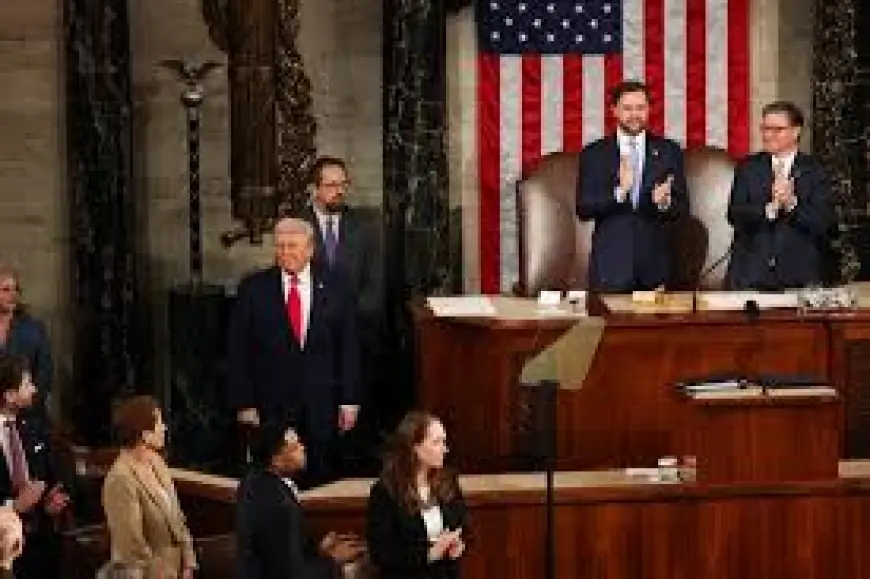
The transcript of President Trump’s Feb. 24 address shows sweeping assertions about immigration, inflation, crime and consumer costs — and that’s why the trump state of the union matters now: the speech stakes a political case while leaving several verifying details unclear. Here’s the part that matters for communities first affected by those claims — border towns, drivers, homeowners, law enforcement and people worried about fentanyl.
Trump State Of The Union — what’s unclear and why it matters
Risk and uncertainty are the defining frame here. The president presented rapid, large-scale improvements across multiple areas in a single year. For audiences trying to parse policy impact or political consequence, the core issue is not whether claims were emphatic — it is that the transcript offers strong assertions without accompanying verification in the provided text, leaving open questions that could shift public reaction.
What’s easy to miss is how many different policy areas he folded into a single narrative: border security, drug interdiction, crime statistics, inflation metrics, gasoline prices and mortgage costs all appear in the same section of the address.
Event details and orientation
President Trump delivered his 2026 State of the Union address on Tuesday night, Feb. 24, and a transcript was posted Feb. 25, 2026 at 4: 44 AM ET. The speech opened by addressing Speaker Johnson, Vice President Vance, the first lady, the second lady and members of Congress before moving into an extended statement of national renewal: he said the nation is “back: Bigger, better, richer and stronger than ever before. ”
He framed the coming July 4th as the 250th anniversary of American independence and repeatedly contrasted the current year with the situation “12 months ago, ” when he said he had inherited a nation with a stagnant economy, record inflation, a wide-open border, poor recruitment for military and police, rampant crime at home and wars abroad. He described the past year as a “turnaround for the ages. ”
Claims and the specific figures he cited
- Border: He said “today our border is secure” and called it “the strongest and most secure border in American history. ”
- Admissions: He said that “in the past nine months, zero illegal aliens have been admitted to the United States. ”
- Fentanyl: He said deadly fentanyl across the border is down by a record 56% in one year.
- Crime: He said the murder rate saw its single largest decline in recorded history and described the murder count as the lowest in over 125 years, referencing 1900 in his comparison and mentioning his father, Fred, in an aside.
- Inflation: He said core inflation has been driven down to the lowest level in more than five years and that in the last three months of 2025 it was 1. 7%.
- Gasoline: He said gasoline reached over $6 a gallon under his predecessor but is now below $2. 30 a gallon in most states, with some places at $1. 99 and Iowa at $1. 85 — “the lowest in four years. ”
- Housing: He said the annual cost of a typical new mortgage is down almost $5, 000 since he took office, and added that lower interest rates will solve the “Biden-created housing problem” while protecting values — the sentence ends mid-thought and is unclear in the provided context.
What the speech left out from the transcript and the practical implications
The real question now is which specific policies, data sources or timelines were omitted from the address as presented in the transcript. The speech repeatedly asserts improvement across multiple indicators, but the provided text does not supply the underlying datasets, agency actions, or implementation steps that would explain how each change was achieved. That lack of detail creates practical uncertainty for the groups he named: border communities, immigrants seeking legal entry, law enforcement agencies, families dealing with fentanyl risk, motorists watching fuel prices and homeowners tracking mortgage costs.
Short aside: The bigger signal here is how many claims are clustered together—when a single speech covers border security, drug interdiction, crime drops, inflation and gas prices at once, readers should expect follow-up detail to sort cause from coincidence.
Key takeaways and forward signals
- Central claims in the transcript: secure border, zero admissions in nine months, 56% drop in fentanyl at the border, largest recorded decline in murder rate, 1. 7% core inflation in the last quarter of 2025, gasoline at or below the stated price points, and a $5, 000 drop in annual mortgage cost since taking office.
- Groups most immediately affected: border communities and legal migrants, drivers and state gas markets, homeowners and mortgage holders, and local police and public-health officials dealing with fentanyl.
- Signals that would confirm movement: release of contemporaneous enforcement or admissions logs, official crime statistics showing the stated decline, inflation series matching the 1. 7% figure for late 2025, and market data showing average state gasoline prices at the cited levels. The provided transcript does not include those corroborating items.
The transcript itself repeats several sweeping comparisons — for instance, contrasting today’s conditions with those “12 months ago” and invoking “four years” of prior border challenges — but it does not, in the provided text, supply the corroborating documents that would resolve the uncertainties flagged above.
If you’re wondering why this keeps coming up for voters and policymakers, it’s because statements that bundle wide-ranging claims into a single political narrative raise both immediate policy questions and potential political consequences as the calendar progresses toward July and November.