

























Cryptocurrency: Bitcoin Falls Below $65,000 Amid U.S. Stock Rout

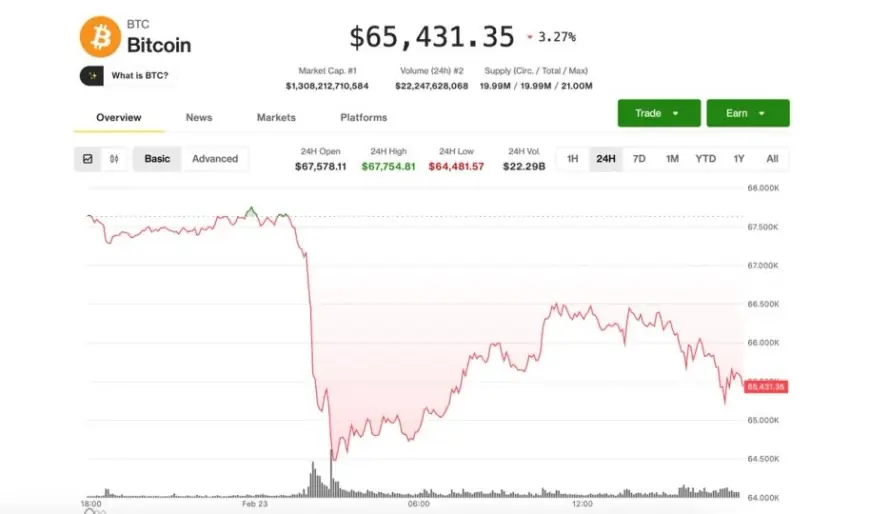
cryptocurrency markets moved sharply on Monday as bitcoin dipped below $65, 000 in early trading before paring losses, a shift tied to a broader U. S. stock sell-off and renewed tariff uncertainty. The pullback and expert commentary focused attention on whether the drop reflects macro shocks or deeper structural weakness.
Cryptocurrency market reaction to equities
Bitcoin experienced a steep overnight selloff that briefly pushed prices to about $64, 923. 69, then staged a modest rebound that faded during U. S. morning trade. Near 12: 00 p. m. ET, bitcoin was trading around $65, 400 and was described as down roughly 35% over the prior 24-hour period. The move came as major U. S. indices fell more than 1%, with software and private-equity–linked names leading declines.
That correlation has been visible in recent price action: a tech-software exchange-traded fund sank another 5% to a fresh 52-week low and is now down nearly 35% since October, reinforcing a view in markets that bitcoin has been moving like a high-beta proxy for technology and broader liquidity conditions.
Tom Lee frames Bitcoin decline
Tom Lee characterized the recent 50% drawdown in bitcoin as a "crypto squall" rather than a structural collapse, arguing the move reflects macro shocks more than fundamental flaws in blockchain networks. He highlighted accelerating activity in other tokens and infrastructure, pointing specifically to parabolic growth in daily transactions on a major smart-contract network, expanding tokenization and increased Wall Street integration as signs the market is still broadening.
Lee contrasted this episode with past abrupt collapses: he described the current retracement as a slower, psychologically taxing grind rather than an immediate, euphoric crash followed by a rapid deeper drop. He also noted that strong performance in gold has drawn risk appetite away from speculative assets and that the absence of leverage in crypto means some traders have rotated toward precious metals.
Prices, drivers and the near-term outlook
Market participants pointed to an intersecting set of drivers: worries about generative AI's impact on software business models, pressure in private-equity–exposed names, and renewed uncertainty over tariffs. One market note connected a recent court ruling limiting broad executive tariff powers to an initial relief rally, while subsequent tariff actions under a trade statute lifted levies to 15%, contributing to risk-off flows.
On policy, Lee argued that if tariffs ease headline inflation and the labor market softens — measures that could give the Federal Reserve room to cut rates — monetary conditions might become more favorable for risk assets, including cryptocurrency. Conversely, persistent tech-sector stress or renewed liquidity worries could keep bitcoin trading inside a tight $60, 000–$70, 000 range as risk appetite stays fragile.
Key takeaways
- Bitcoin slipped below $65, 000 in early trading, then recovered toward roughly $65, 400 near 12: 00 p. m. ET.
- Tom Lee called the 50% drawdown a "crypto squall, " attributing it to macro shocks rather than network fundamentals.
- Tariff developments, tech-stock weakness and liquidity concerns are the primary near-term drivers to watch.
Market participants will watch upcoming policy and tariff developments alongside tech-sector performance for signals on whether the recent pullback is transient or will persist. If headline inflation eases and rate-cut expectations rise, that could create a more constructive backdrop for risk assets; if tech and liquidity stress continue, bitcoin may remain range-bound.