

























Three Sleds Flip at Curve 7 as 4 Man Bobsleigh Olympics 2026 Event Sees Hospitalization and Delay

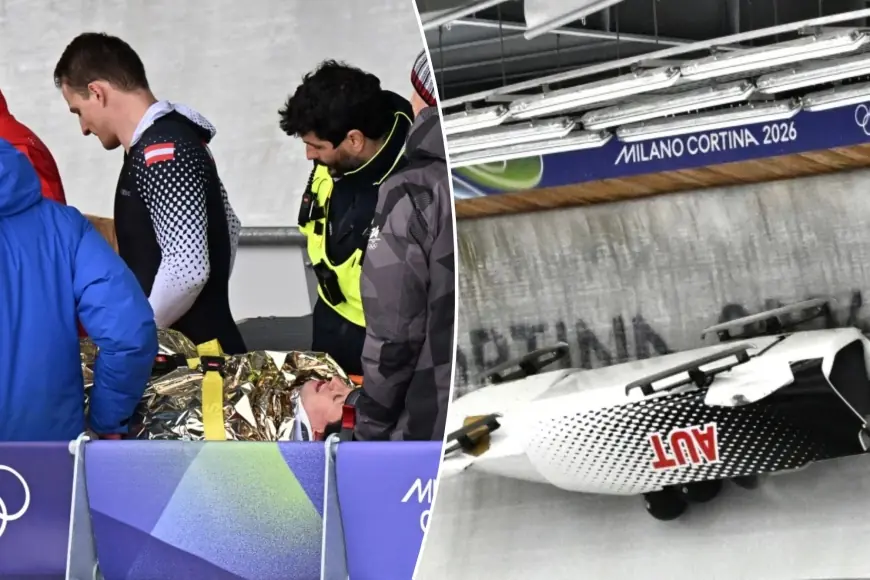
The second heats of the 4 Man Bobsleigh Olympics 2026 competition in Cortina d’Ampezzo were interrupted when three sleds tipped at the same curve, leaving one pilot transported to a hospital and forcing a delay in racing. The cluster of crashes has immediate consequences for standings and teams still slated to race Sunday morning.
Development details: 4 Man Bobsleigh Olympics 2026 crashes at Curve 7
During Saturday’s second heats at the Cortina Sliding Centre, three four-man sleds rolled over around Curve 7, roughly halfway down the 1, 750-meter track that contains 16 curves. The teams from Austria, France and Trinidad & Tobago all tipped and slid for a long stretch—nearly to the finish—before coming to rest. A stretcher was used on the scene and officials halted the competition for approximately 20 minutes while medical staff attended to the athletes and the track was cleared.
The Austrian crew involved included pilot Jakob Mandlbauer and teammates Daniel Bertschler, Sebastian Mitterer and Daiyehan Nichols-Bardi. Mandlbauer was examined on the track and then taken to a Cortina hospital; Christoph Iglhauser, the Austrian team press attaché, described the move as a precaution and said Mandlbauer would be checked for possible neck and back issues. Bertschler, Mitterer and Nichols-Bardi were seen walking away from the scene under their own power. The French sled carried pilot Romain Heinrich with Nils Blairon, Dorian Hauterville and Antoine Riou; the Trinidad & Tobago sled listed Axel Brown, Shakeel John, Aundre de John and Xaverri Williams.
Context and escalation
The three crashes occurred at the same distinctive U-shaped turn known as Curve 7. The combination of the track’s design—dropping to a low point then rising again toward the finish to slow sleds—and the dynamics at that turn produced conditions that led to multiple teams tipping during the second heats. Earlier in the season one top pilot crashed on this venue during training at a different turn, illustrating that the track’s technical sections had already posed challenges to competitors. Canadian pilot Jay Dearborn, who was in the leader box at the time, described the difficulty of watching sleds overturn mid-competition.
Because bobsled rules require all four athletes and their sled to cross the finish line for a run to count, none of the three teams that flipped completed their runs; each was recorded as a Did Not Finish and disqualified from the event. None of those three teams had been in medal contention going into the second run.
Immediate impact
The immediate effects were tangible: a roughly 20-minute stoppage of racing, three disqualifications from the four-man event, and the removal of a pilot to hospital for evaluation. Austria’s other sled, piloted by Markus Treichl, remained in competition and sat in 10th place heading into the third run scheduled for Sunday morning. France and Trinidad & Tobago each had only one sled entered in the event, meaning their disqualifications eliminated their teams from contention in the four-man competition.
Medical staff on site and an Austrian Olympic Committee doctor provided first response care at the track. Mandlbauer was described as alert and moving his limbs during on-scene checks and was transported for further assessment; team officials emphasized the hospitalization was precautionary. Broadcasts of the event noted that sleds on the course can reach speeds as high as 90 miles per hour, underscoring the potential severity of accidents on the sliding surface.
Forward outlook
The third run is scheduled for Sunday morning, and the standings will resume with the remaining competing teams, including Austria’s second sled in 10th place. Organizers will proceed with medical follow-up for the hospitalized pilot and routine track inspections before racing restarts. What makes this notable is how a single turn produced multiple simultaneous crashes that reshaped the immediate competition and eliminated three national entries; the timing matters because those DNFs occurred during the second heats, directly affecting which teams advance into the final runs.
Officials have not announced further procedural changes to the schedule beyond the earlier delay, and teams will continue with the prescribed third run timetable. The field will reconvene Sunday morning to complete the remaining heats and finalize placements for the four-man event.