



















Hawaii Basketball Prepares for Nationally Televised AC Carter Night and No. 23 Jersey Retirement

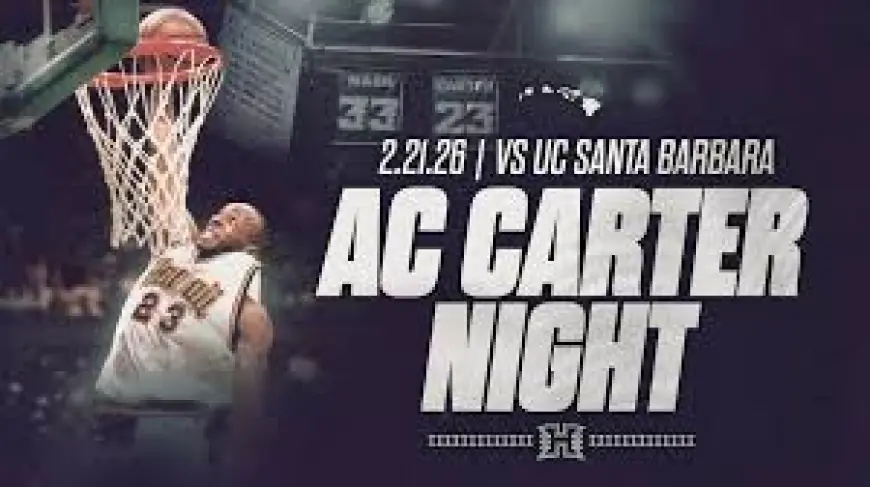
Anthony "AC" Carter has returned to Manoa ahead of a nationally televised matchup that will culminate in the retirement of his No. 23 jersey. The event is a focal point for hawaii basketball, underscoring a legacy that helped redefine the program in the late 1990s.
Hawaii Basketball: Development details
The university will permanently enshrine Carter's No. 23 inside Bankoh Arena at Stan Sheriff Center during the ceremony scheduled for Saturday night. Carter, who arrived in Honolulu after transferring from Saddleback Community College, finished his two seasons in Manoa with more than 1, 000 career points and was honored as the 1997 Western Athletic Conference Pacific Division Player of the Year. He ranks third all-time in assists for the program and still holds the single-season assists record.
Officials have organized a nationally televised program around the jersey retirement, with the men's team hosting UC Santa Barbara as part of the celebration branded an AC Carter Night. The decision to retire Carter's number makes him only the second player in the program's history to receive that distinction, joining former great Bob Nash.
Context and escalation
Carter's tenure in Honolulu coincided with one of the most celebrated stretches in the program's 106-year history. His teams captured conference championships, made national tournament appearances and produced upset wins over high-profile opponents including Indiana and Kansas. Those seasons generated sustained local interest, peaking with a 1998 campaign that produced a then-record 12 sellouts at the arena.
Coaching leaders past and present have framed the retirement as a recognition of both performance and character. Head coach Eran Ganot emphasized the program's long history and the opportunity to honor former players, while former coach Riley Wallace described Carter as an energizing presence whose playmaking and leadership elevated teammates. Carter later extended his career with 13 seasons as an NBA player—most notably under coach Pat Riley with the Miami Heat—and subsequently spent more than a decade working as an NBA coach.
Immediate impact
The ceremony and the national broadcast are drawing attention from alumni, donors and long-time supporters, reinforcing Carter's continuing connection to the program: he remains one of the larger financial contributors to the Rainbow Warriors. The retirement recognizes measurable achievements—No. 23, 1, 000+ points, top-three all-time in assists, and a single-season assist record—and signals institutional acknowledgment of his role in building fan engagement that produced those 12 sellouts in 1998.
On the court, the event frames the team's home game against UCSB as more than a regular-season matchup, converting it into a milestone for past and present players. For fans who witnessed the late-1990s run, the ceremony offers formal closure; for current players and recruits, it serves as a public reminder of the program's capacity for national relevance.
Forward outlook
The immediate schedule is clear: Carter is back in town, the Rainbow Warriors will host UC Santa Barbara in a nationally televised game, and the university will retire the No. 23 jersey during the Saturday-night ceremony. The retirement itself is the primary milestone; beyond that, the program will carry the symbolic and practical effects of renewed attention and donor engagement into the remainder of the season.
What makes this notable is the breadth of Carter's impact: statistical milestones, signature upset victories and continued financial support combine to make the jersey retirement both a celebration of past success and a tangible investment in the program's future.