






















Trump Secures U.S. $10 Billion Pledge at Inaugural Board Of Peace Meeting

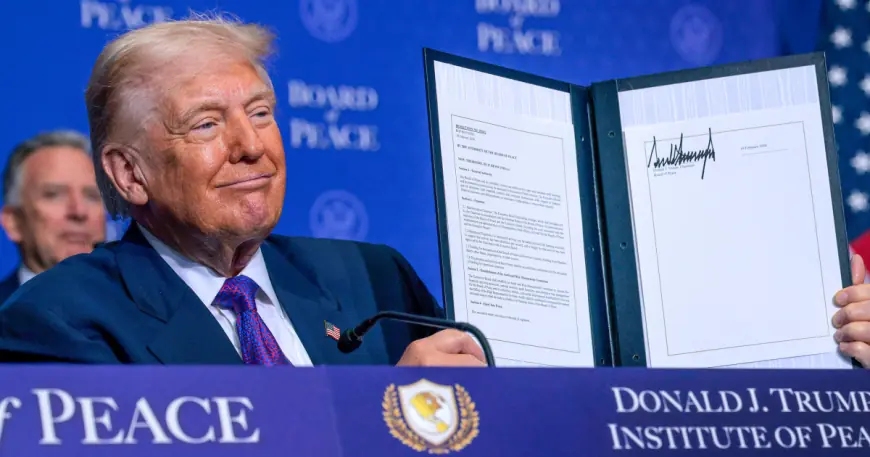
The president used the inaugural Board Of Peace meeting to announce a $10 billion commitment from the United States and to hail fresh international pledges aimed at Gaza reconstruction, setting a high-stakes global agenda ahead of a political trip to Georgia on Thursday, Feb. 19, 2026 (ET).
Board Of Peace: cash, troops and an ambitious pitch
In Washington, the first convening of the Board Of Peace produced concrete financial and military offers. The president said nine board members agreed to contribute a combined $7 billion toward a Gaza relief package, and he announced that five countries had agreed to deploy troops for an international stabilization force in the war-battered territory. He presented the additional U. S. pledge of $10 billion as part of the initiative’s opening thrust, while acknowledging he did not specify the source of the funds.
Even with the new commitments, the president acknowledged the gap between pledges and reconstruction needs: the $7 billion from partners was described as only a fraction of the estimated $70 billion required to rebuild Gaza. The meeting included representation from at least 40 countries and featured a broad, public pitch that the body would not be limited to Gaza but would intervene in other global "hotspots. " The president framed the Board Of Peace as a central element of his agenda going forward, casting it as both a legacy project and an alternative role-maker on the world stage.
Political stakes and a regional warning
After the Washington meeting, the president traveled to Georgia, where the day’s agenda shifted back to domestic politics and economic messaging. The trip was designed to bolster his party’s standing ahead of the midterms and to emphasize economic issues that he says deserve greater attention. He also signaled impatience with a pending Supreme Court decision tied to his tariff policies, describing the wait as frustrating.
On security matters, the president used the Board Of Peace platform to issue a fresh warning about Iran, saying that "bad things will happen" if a deal on the nuclear program is not reached and offering a roughly ten-day window for developments. That timetable and the assertions of escalating pressure underscore how the initiative’s international ambitions are being paired with immediate, pointed diplomacy and the potential for military posture adjustments.
Ambition, skepticism and the next steps
The inaugural session showcased both pomp and practical commitments: world leaders attended, delegates received symbolic items, and pledges were tallied. But questions remain about the mechanics of the declared U. S. funding and how the Board Of Peace will operate alongside existing international institutions charged with conflict resolution and humanitarian response. The president said the new board would look over established bodies to ensure proper functioning, framing the initiative as a force-multiplier rather than a mere adjunct.
Operational details were sparse at the close of the meeting. The president highlighted troop pledges and financial packages but did not provide a roadmap for disbursing the announced U. S. funds. Meanwhile, the mix of reconstruction pledges and security commitments — set against a backdrop of a fragile ceasefire and a large estimated reconstruction bill — suggests the Board Of Peace will face immediate pressure to translate headline pledges into on-the-ground results.
As the president departed for Georgia, the dual aims were clear: press the political case at home while insisting the Board Of Peace has the capacity to reshape international responses to crises. The coming days and weeks are likely to test whether the new body’s early commitments can be converted into durable support and whether the president’s diplomatic timetable — including the warning tied to Iran — will produce tangible outcomes.