























New Dinosaur Discovered: Scimitar-Crested Spinosaurus mirabilis Rekindles Swim Debate

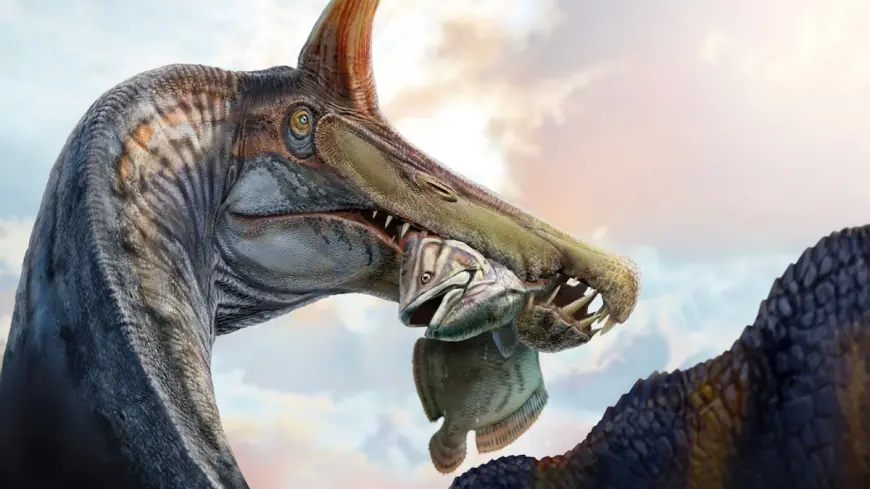
The expedition’s find marks a New Dinosaur Discovered in the central Sahara: a scimitar-crested Spinosaurus that is reigniting the long-running question of whether these sail-backed predators swam.
New Dinosaur Discovered: the scimitar crest and what it means
Fieldwork in a dry, remote area called Jenguebi produced a curved, sword-like bone that proved to be a dramatic head crest. The fossil, first noticed in 2022 by paleontologist Daniel Vidal while excavating in Niger, belongs to an identified new species named Spinosaurus mirabilis. The crest is described as scimitar-like and may have been covered in a keratin sheath that could have made it sit higher than the skeletal reconstruction, giving the animal a striking silhouette alongside its spiny back sail.
The discovery added multiple partial skeletons to the record: bones from three individuals of S. mirabilis were found at the site. The excavations also uncovered remains of another predatory dinosaur, two long-necked sauropods, crocodiles, turtles, and a freshwater fish species that could reach 12 feet long. The density and diversity of fossils at Jenguebi make the site notable for this period in Africa.
New clues and a revived debate over aquatic habits
The scimitar-shaped crest and the broader fossil assemblage have reopened discussions about how Spinosaurus lived and hunted. The new species, S. mirabilis, is tied to an ancient river ecosystem from the Late Cretaceous roughly 95 million years ago, and its unusual skull crest has prompted fresh interpretations of display behavior and ecology. Researchers suggest the crest most likely served as a visual signal—perhaps to attract mates or deter rivals—while the setting of the fossils alongside aquatic species underscores lingering questions about whether Spinosaurus was adapted to swim.
Excavators working the central Saharan terrain described the site as stark and sandy, a far cry from the riverscape the bones once occupied. Local place names reflect the present aridity; the area where the fossils were recovered is known by residents as Sirig Taghat, which translates to a phrase that evokes the absence of water. The team first scouted the locality with a local guide on a moped and retrieved a Spinosaurus jawbone in an earlier season before the 2022 discovery that produced the crest.
Outside specialists have highlighted the importance of finding multiple partial skeletons from this interval in Africa. The combination of a novel crest morphology, several individuals of the same species at one site, and associated aquatic fauna gives scientists new material to test competing ideas about locomotion and feeding in spinosaurids. One clear development is that S. mirabilis displays a crest unlike those seen on other spinosaurids, which strengthens interpretations of the crest as a display structure. Another concrete development is the richness of the Jenguebi assemblage—three S. mirabilis individuals plus multiple other vertebrates—offering an unusually complete window into the ancient river ecosystem.
While the new fossils do not settle the question of swimming behavior, they have shifted the conversation by introducing a distinct anatomical trait and a well-sampled site that together demand closer study. The team published their findings in a scientific journal, and the discovery is now central to renewed analysis of spinosaurid form and function.
For now, the New Dinosaur Discovered—Spinosaurus mirabilis—stands as both a striking addition to the fossil record and a prompt for further fieldwork and debate about how these oddball predators made a living in ancient waters and along their shores.