MSFT stock steadies after Microsoft earnings as Azure growth stays the headline


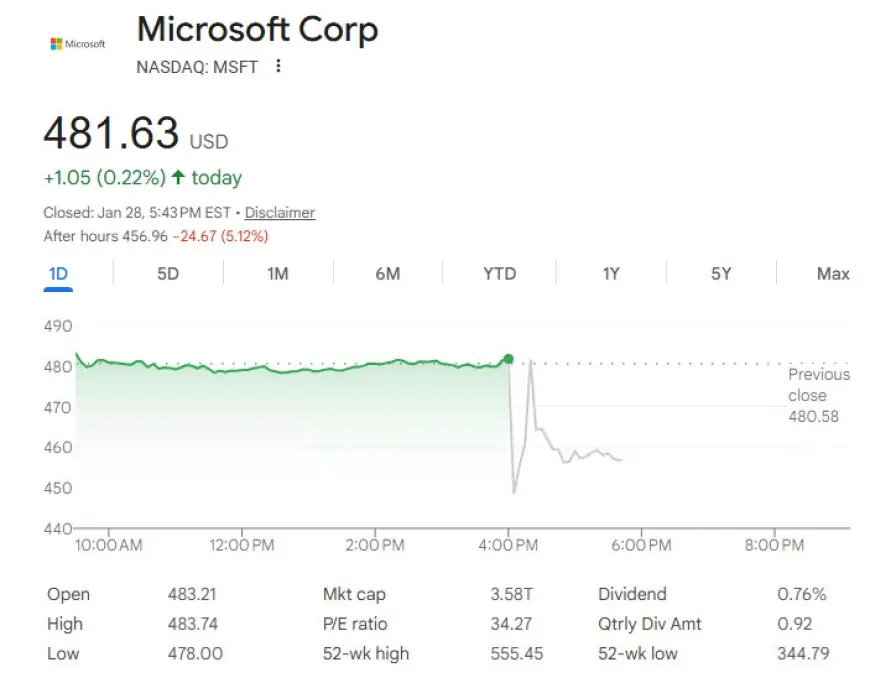
MSFT stock remained volatile but near recent highs in late trading after Microsoft earnings landed Wednesday, as investors weighed strong cloud results against the ongoing cost of building out artificial intelligence infrastructure. Microsoft stock has been moving on a familiar set of inputs this cycle: Azure growth, cloud margins, and any clues about when capacity additions will start translating into smoother, less constrained demand fulfillment.
Microsoft reported results for its fiscal 2026 second quarter, the period that ended December 31, 2025, and held its earnings call after the market close on Wednesday, January 28, 2026 ET.
Microsoft earnings: revenue tops $81 billion as cloud crosses $50 billion
Microsoft said quarterly revenue rose 17% year over year to $81.3 billion, with operating income increasing 21% to $38.3 billion. Net income on a GAAP basis rose 60% to $38.5 billion, and diluted earnings per share on a GAAP basis increased to $5.16. On an adjusted basis, Microsoft reported net income of $30.9 billion and adjusted earnings of $4.14 per share, up 23% and 24% year over year, respectively.
The company highlighted that Microsoft Cloud revenue crossed $50 billion for the quarter, with Microsoft Cloud revenue of $51.5 billion, up 26%. A key backlog indicator also surged: commercial remaining performance obligation increased 110% to $625 billion, pointing to substantial contracted business scheduled to be recognized over time.
Further specifics were not immediately available in a simple written format for the full forward-looking guidance discussed on the earnings call.
Azure, Intelligent Cloud, and the segments investors track most closely
Azure and other cloud services revenue increased 39% year over year, a pace that continues to anchor the broader “AI trade” around Microsoft stock price moves. Intelligent Cloud segment revenue rose 29% to $32.9 billion, while Productivity and Business Processes increased 16% to $34.1 billion.
More Personal Computing was the softer spot, with revenue down 3% to $14.3 billion. Within that segment, Windows OEM and Devices was up 1%, while Xbox content and services declined 5%. Search and news advertising revenue excluding traffic acquisition costs increased 10%, offering a steadier counterpoint to the gaming dip.
Microsoft also said it returned $12.7 billion to shareholders through dividends and share repurchases during the quarter, up 32% from the prior-year period, reinforcing the company’s message that it can fund heavy investment while still distributing cash to investors.
Some specifics have not been publicly clarified about how quickly new data center capacity will ease bottlenecks across regions and workloads.
How MSFT stock price reacts to earnings and why GAAP vs adjusted matters here
Earnings today can move MSFT stock quickly because the market is effectively repricing two things at once: near-term growth and the durability of profit margins. When cloud demand is strong but spending is rising, investors tend to focus on whether the incremental revenue is coming with enough operating leverage, or whether margins are being squeezed by depreciation, energy, and accelerated infrastructure buildouts.
Microsoft’s quarter is also a reminder that GAAP and adjusted figures can diverge meaningfully when large investment marks are involved. The company said its fiscal second-quarter GAAP results reflected net gains from its investments in OpenAI, which increased net income by $7.6 billion and boosted earnings per share by $1.02. Microsoft’s adjusted results exclude that impact to help investors compare underlying operating performance across periods without the noise of large investment revaluations.
In trading, MSFT stock price action reflected that push and pull. Shares swung widely during the session, ranging from the mid-$440s to the mid-$480s, and were around $482 in late trading, underscoring that the market’s main debate is no longer whether Microsoft is growing, but how the growth is being funded and when the investment cycle normalizes.
Who feels the impact of Microsoft stock moves and what comes next
Two groups feel the immediate effect of a sharp Microsoft stock move: shareholders, including retirement savers holding broad-market funds where Microsoft is a heavyweight, and employees whose compensation may include stock-based awards. A second set of stakeholders includes enterprise customers and software partners, because Microsoft’s cloud and AI spending pace can influence product roadmaps, pricing discussions, and the availability of capacity for large deployments.
The next verifiable milestone is Microsoft’s next quarterly earnings release for fiscal 2026 third quarter, when management will again be expected to detail Azure momentum, cloud margin trends, and the cadence of AI infrastructure spending as the company heads deeper into 2026.