



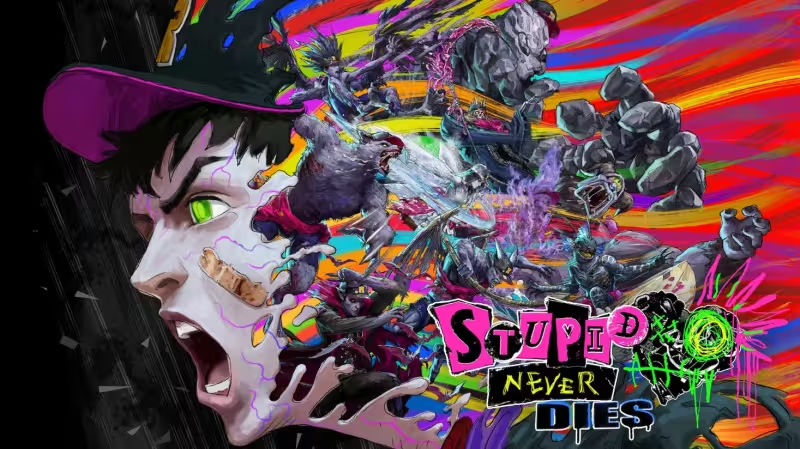
“The game is not a soulslike-style title,” producer Hiroyuki Kobayashi said, then added, “I explicitly told my team that wasn’t the genre they’d be going for.” The blunt clarification is meant to settle an early debate about GPTRACK50’s debut, Stupid Never Dies, as the studio prepares for a Fall 2026 launch on PC via Steam and PS5.
Kobayashi’s comments carry weight because they come alongside concrete details of how the game will play: an average run should take about 20 to 30 hours, the player is Davy — described as a bottom-tier zombie boy on a quest to bring Julia, a frozen human girl, back to life — and the team says players who have never held a controller will find the game challenging. “If you’ve never held a controller in your life, clearing Stupid Never Dies is going to be a challenging task,” Kobayashi warned, while adding that players with a reasonable amount of gaming experience can reach the ending.

Those lines of demarcation are the story’s weight: Kobayashi is positioning Stupid Never Dies as an accessible, story-driven action RPG rather than an intentionally punishing soulslike. He is not promising handholding — the team frames the difficulty as a design choice that rewards familiarity with action games rather than endurance through trial-and-error.
That positioning matters because of how the game’s systems actually behave. Director Eiichiro Sasaki described a mix of progression that sometimes resets and sometimes does not. “I think the interesting part of this game is that it mixes progression you can control with progression you can’t. The fact that not everything is under the player’s control is what gives it a sense of challenge, and I think we’ve struck a pretty good balance there,” Sasaki said. He also confirmed certain progression elements reset when you die or clear a dungeon, while some abilities carry over and accumulate so players are not thrown back to zero.
The reset-plus-carryover combination is the friction point. Reset mechanics are a hallmark of soulslikes, which tie repeated deaths to learning enemy patterns and slowly grinding forward under persistent penalties. GPTRACK50 counters the label by stressing carryover systems and a median run length of 20–30 hours, and by promising variety: the team has said there are up to ten different monster combat styles and players can use up to two at a time, a design that leans into experimentation rather than rote repetition.
Details of how that experiment plays out are more than academic. GPTRACK50 demoed the game in Los Angeles and stood at roughly 90% completion when an AUTOMATON piece published development details, signaling the team is deep into polish. Kobayashi’s pedigree — he produced Resident Evil and Devil May Cry titles — and Sasaki’s experience on Resident Evil Outbreak and Resident Evil 6 give the studio a lineage in fast-paced, character-driven action, which colors their approach to difficulty and progression.
Put plainly: Kobayashi has drawn a line in the sand. He says Stupid Never Dies is not a soulslike by intent, and he told his team so. At the same time, Sasaki’s admission that some elements reset after death or dungeon clears means players will still encounter mechanics that echo that lineage.
The closing fact is also practical. The team’s aim — a 20–30 hour experience available on Steam and PS5 in Fall 2026 — narrows expectations for fans wondering whether they’re signing up for a months-long endurance test. The clearer answer to the headline question is this: Stupid Never Dies is not being made as a soulslike in spirit or by directive, but its reset mechanics borrow from that vocabulary, leaving the ultimate comparison to players who will judge whether those resets feel like challenge or punishment when the game arrives.



