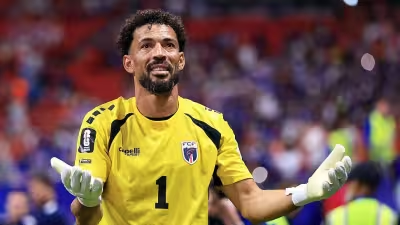
Idrissa Gueye's current Everton contract runs until the end of June, and the club is considering whether to offer the 36-year-old a fresh deal on reduced terms.
Gueye signed a one-year contract last summer after returning for a second spell at Everton — he has made 236 appearances for the club, scoring 10 goals and supplying 11 assists across his two stints, separated by a three-year spell at Paris Saint-Germain.

The case for keeping him is straightforward: he is a seasoned Senegalese international with a long record at Goodison Park and in the Premier League, and any short extension would buy Everton experienced depth in central midfield at a moment when continuity matters.
But the weight of the decision rests on clear numbers. Gueye ranked in the top three for tackles won in five of his first six Premier League seasons; last season he slipped to 102nd in the league for tackles won and only eighth within the Everton squad. His tackles per game average fell from 3.9 in 2024–25 to 2.1 per 90 last season, and younger team-mates are closing the gap: Tim Iroegbunam made 68 tackles to Gueye's 43 while playing 615 fewer Premier League minutes.
Those on-field trends collide with off-field arithmetic. Gueye is reported to earn £120,000 per week, placing him among the club's top five earners, and the available option is expected to be a contract on reduced terms rather than a renewal at current pay. Everton also know another central option is arriving automatically — Merlin Röhl will become a permanent signing after his loan, with an obligation to purchase for £17.3 million after the current campaign.
Put plainly: the club must balance the value of Gueye's experience against a measurable decline in his tackles output, a costly wage, and a pipeline of younger midfield options. A short, lower-paid extension preserves leadership and rotation cover; refusing to extend frees salary and minutes for emerging players and the incoming Röhl.
The friction in the decision is not ideological but practical. Gueye's name still carries authority in the dressing room and his career totals at Everton underline that; but the drop from a 3.9 tackles-per-game high in 2024–25 to 2.1 per 90 last season, the comparative statistics from Iroegbunam, and the impending arrival of a purchased Röhl make the case for moving on equally tangible.
Everton's immediate deadline is fixed: the deal expires at the end of June. The club can offer a further one-year extension — sources indicate a reduced package is expected if any offer is made — or allow Gueye to leave when his contract lapses. That outcome will determine whether Everton tilts toward short-term continuity with a veteran presence or accelerates the younger, lower-cost midfield profile emerging around Iroegbunam and the incoming Röhl.
What the facts support is simple: a fresh contract for Gueye, if offered, will almost certainly be shorter and lower-paid than his current terms; whether Everton proceeds with such an offer before the end of June remains the single unresolved question that will shape their midfield depth and wage strategy for the season ahead.