A Los Angeles judge on Monday refused an emergency request to overturn FIFA’s ban on the pre‑revolutionary Iranian flag, allowing the restriction to stand just hours before Iran’s opening World Cup match at SoFi Stadium. The lawsuit was filed Thursday in Los Angeles County Superior Court by the Institute for Voice of Liberty and Sam Kermanian and was expedited for a Monday morning hearing.
The plaintiffs argued that ticket holders should be permitted to bring their own flags into the stadium and that the ban improperly stripped fans of a form of expression. Lawyer Shahrokh Mokhtarzadeh, representing the plaintiffs, told the court: "They are ticket holders, with a right to attend game with their own flag. This is being violated. It may be trivial to many, to them it is critical." He added to the judge that the case did not present an immediate danger: "This is not someone yelling fire in a theatre."

Judge Curtis A. Kin rejected that argument and denied the application to block FIFA’s rule. "Free speech is incredibly important, it is sacred, a bedrock of our society, but it is not without limitation, such as private actor, on private property, and as shown by previous cases, regulating in reasonable way. I deny the application," Kin said, citing the legal authority of venue operators to set conduct rules. He also warned of operational risks, saying, "There may be harm to some 2,500 staff members who have to deal with safety protocols."
FIFA was represented in court by Chris Boehning, who told the judge that the plaintiffs had plenty of notice of the match and the governing body's rules. Boehning argued the organization had set a clear stadium code of conduct listing banned items and that enforcement was a necessary safety and venue‑management measure. "the plaintiffs were well aware of this match for many, many months," he said.
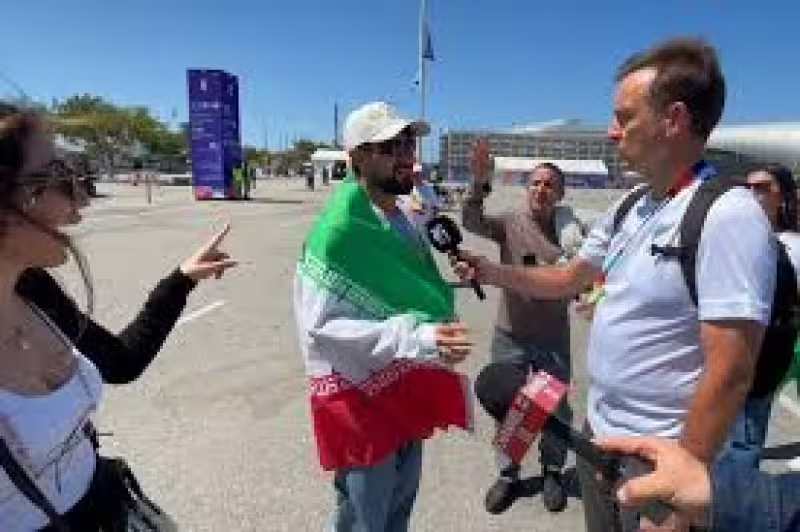
The disputed emblem is the pre‑revolutionary Iranian flag, the one with a lion and sun motif at its center associated with Iran’s monarchy that was deposed in 1979. FIFA’s ban targets that historic banner rather than Iran’s current official flag, and the organization has relied on its stadium code of conduct to define and prohibit specific items ahead of matches at World Cup venues.
Timeline matters: the suit was filed Thursday, the case was expedited to be heard Monday morning, and Judge Kin issued his ruling Monday — days that mattered because Iran was scheduled to kick off its tournament against New Zealand at SoFi Stadium in Inglewood later the same day. The expedited schedule left little time for further judicial review before the match.
The immediate practical effect is straightforward: ticket holders at SoFi Stadium were barred from bringing the pre‑revolutionary flag into the venue for Iran’s opening game. The ruling reinforced the authority of stadium operators and FIFA to impose entry rules intended to manage safety and the match‑day environment for staff and the broader crowd.
The dispute exposes a legal friction the judge recognized on the record: plaintiffs pressed a free‑speech claim tied to personal expression on public matters, while the court treated the stadium and its operators as private property entitled to set reasonable limits. That gap — private control of venues versus the expressive claims of ticket holders — framed the hearing and the ruling.
The ruling leaves a larger question unresolved: whether FIFA will face similar legal challenges at other World Cup venues and whether courts elsewhere will reach the same balance between free expression and venue control. No further legal move was confirmed in court Monday, and the decision answers the immediate dispute at SoFi Stadium while leaving open how the policy will be applied across the remainder of the tournament.