



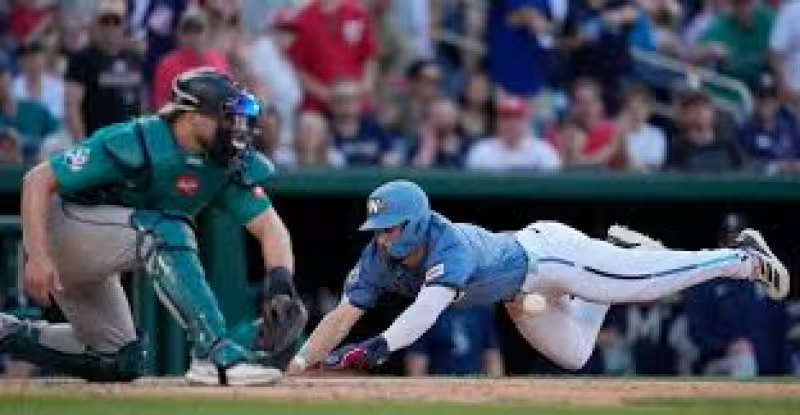
The Washington Nationals beat the Mariners 8-3, and Dylan Crews supplied the play that closed it: he went 1 for 4 and raced from first to home on a single up the middle to seal the victory.
Crews’ run was more than flair. It turned a routine hit into the final, decisive margin in a game the Nationals won by five. The baserunning scored a run and ended any realistic chance of a Seattle comeback; the box score lists Crews at 1 for 4 in the game and credits him with the game-clinching dash from first to home.

The hard numbers show why that moment mattered beyond the highlight. Crews is hitting.192 with a.562 OPS this season. For his career — in nearly 500 at-bats — he sits at a.208 average and a.623 OPS. His expected weighted on-base average (xwOBA) is.333, while his actual wOBA is.252, a 40-point shortfall that suggests his bat has underperformed the quality of his contact.
There are measurable changes beneath the surface. Crews’ average launch angle has risen from 8.5 degrees to 12.1 degrees, and his ground-ball rate has fallen from over 50 percent to 42.6 percent. At the same time he chases a lot — his chase rate is 37.2 percent — a habit that helps explain a lower on-base component even as his batted-ball profile shifts toward harder contact trajectories.

The timeline of the recent stretch underlines the split between impact plays and overall production. On June 13 he went 1-for-3 with a home run, driving in a run and scoring once. After that game — following a loss the same week — he was slashing.189/.241/.324 with three homers, eight RBI, eight runs and two steals across 20 games. Yesterday’s one-for-four effort nudged his average slightly, but the underlying gaps remain.
That mix creates the tension: Crews is already delivering clear value in the field and on the bases, producing winning plays that change games, even while the offensive ledger reads poorly. The split between a.333 xwOBA and a.252 wOBA is the clearest sign: his batted-ball data projects a substantially better outcome than what shows up in the box score. Rising launch angle and a lower ground-ball rate are the mechanics-driven progressions that, in theory, should produce better results.
Yet the practical effect so far is limited. A.192 average and.562 OPS are not the numbers of a middle-of-the-order producer; they are the numbers of a player whose value is currently concentrated in speed and defense. The chase rate — 37.2 percent — helps explain why better contact metrics have not fully translated into runs and extra-base hits, and it’s the most obvious behavioral correction Crews must make to close the gap between xwOBA and results.
The single most consequential question after Sunday’s win is sharp: can Crews turn the improvements in launch angle and ground-ball rate into sustained offensive production that matches his xwOBA? If he does, the Nationals get a near-ready everyday bat who already influences games with defense and base running; if he doesn’t, Crews’ primary value this season will remain situational impact rather than consistent run creation.
For now, the Nationals are getting the benefit of his legs and glove. The next step for Crews is clear on paper — reduce chasing, let the improved batted-ball profile produce better results — and the answers will determine whether his contributions stay as timely game-changing plays or expand into reliable offense that lifts a lineup already enjoying the payoff from his speed.



