



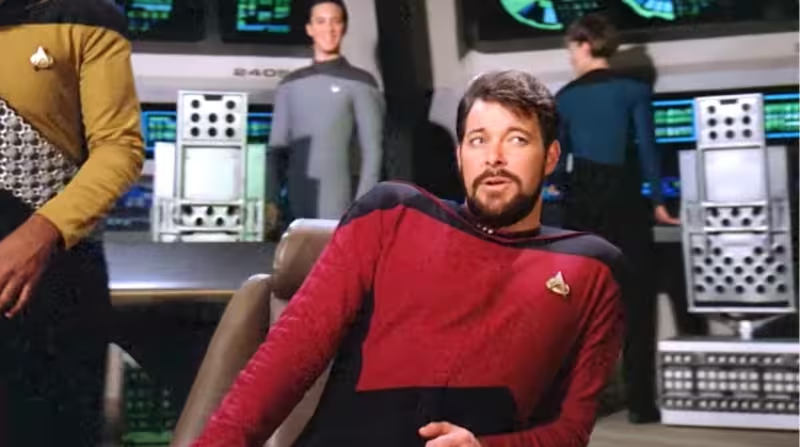
Thomas Riker returned to franchise continuity not as Will but as a man who had walked away — Jonathan Frakes reprised the role mere months after The Next Generation left the air, appearing in Deep Space Nine Season 3's "Defiant" as the transporter duplicate who had been stranded on Nervala IV.
The moment carried weight because it rewired a single-character mystery into a bridge between two series: in The Next Generation Season 6 episode "Second Chances," the Enterprise discovered a transporter duplicate of Will Riker on Nervala IV — the crew labeled him a "transporter duplicate" — and that duplicate spent eight years isolated on the planet before rejoining Starfleet life under the name Thomas. "Defiant" made that duplicate the man who chose to become one of the Maquis.

That choice mattered numerically and narratively. The episode is set in Deep Space Nine's third season, and Frakes’s appearance arrived just months after TNG wrapped, at a moment when the franchise was shifting resources toward feature films and a new series. Bringing a familiar face back so quickly underscored how closely producers wanted to knit the shows together: Thomas’s backstory — a duplicated Riker stranded for eight years who later took a posting on another vessel — supplied DS9 with an immediate, explosive link to TNG’s unresolved beats.
What "Defiant" did not do was tidy the moral or political consequences. The episode revealed that Thomas had joined the Maquis, the band of former Starfleet officers formed in response to Cardassian attacks on Federation colonies. The Maquis engaged in what amounted to terrorism to resist those attacks and, in doing so, violated Starfleet's treaty with the Cardassians. By placing Thomas among them, the episode turned a character study into a piece of franchise geopolitics: a Starfleet-trained officer who rejected the Federation’s official line.
That friction is the episode’s sharp edge. Thomas’s decision to embrace the Maquis put him on the other side of a treaty his original self had sworn to uphold. The show layers the tension: Ro Laren, a figure already tangled in the Maquis storyline, appears in the orbit of Riker’s duplicate, and the record includes a moment where Riker tried to talk Ro out of joining the rebels. Those threads make Thomas’s choice read as both personal and political, but the script leaves the mechanics of his conversion unexplained.
Context matters here but must come after what the episode showed. The Maquis were not abstract villains; they were a group of veterans reacting to real losses — settlements on the Cardassian border were attacked, and former officers took up arms. DS9 used Thomas’s presence to show how that insurgency could corrode loyalty and infect familiar faces. The crossover functioned: a TNG character stepping into DS9’s darker, borderland drama sharpened both shows’ stakes without pausing to replay TNG’s last season.
The unresolved gap is the story’s last, loud beat. "Defiant" makes Thomas a Maquis, but it does not explain why a man who had been a Starfleet duplicate stranded for eight years would ultimately abandon Starfleet protocol and join a faction that violated the Cardassian treaty. Viewers are left with the fact of his choice and the political consequences — not the interior turn that led him there.
That omission is also the episode’s creative move: by turning a one-off transporter mystery into a moral crossroads, "Defiant" secured the crossover and gave DS9 a direct, personal stake in the Maquis conflict. The result is clear — Thomas Riker’s appearance tied TNG and DS9 together — and incomplete: how he became a rebel remains the single unanswered story beat. For a franchise that prized continuity, the choice to leave that bridge partly unbuilt is the moment that still asks for an answer.



