



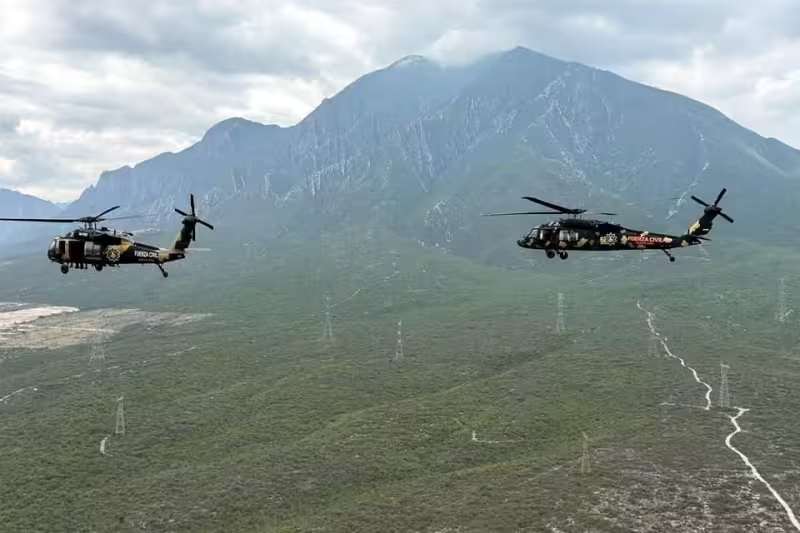
The state deployed 500 security personnel and two Black Hawk helicopters to patrol the metropolitan area around Estadio Monterrey, Guadalupe on June 14, 2026, as Nuevo León prepared to host the tournament's opening match this Sunday.
Fuerza Civil led the ground contingent with support from the Guardia Nacional and the Secretaría de Seguridad y Protección Ciudadana, and the new Unidad de Control de Multitudes was folded into the operation. Authorities said the effort is meant to cover thousands of visitors expected at Estadio Monterrey and at the FIFA Fan Fest.

Miguel Ángel Flores Serna, who took part in the daily security briefings this week, described the strategy as aimed at keeping the event celebratory while remaining ready for emergencies. Flores Serna said officials are seeing large numbers of foreign visitors on the streets and expect more arrivals in the days around the opening match.
The two Black Hawk units were sent into metropolitan air patrols on June 14 and were framed by officials as a force multiplier for surveillance and rapid response, particularly along arrival routes to the stadium and at high-traffic fan zones.
On the ground, security teams were deployed at the airport, on major highways and in public and tourist spaces across the state. The operation was presented publicly as a visible show of preparedness for fans traveling to Estadio Monterrey, Guadalupe and to the nearby FIFA Fan Fest.
Those public preparations were paired this week with daily coordination meetings that brought together state security and emergency services, FIFA representatives and consular delegations from Tunisia, Sweden, Japan, South Korea, the United States and Canada. Officials said the meetings were intended to synchronize responses to medical, logistical and safety incidents involving foreign visitors.
The deployment was described as comprehensive, but officials also reinforced it with the aerial patrols and the intensified interagency and consular coordination — a sign that planners judged additional measures necessary beyond routine ground posts.
Certain operational details remain unresolved. The state has released the aggregate force—500 personnel—and the presence of two Black Hawks, but it has not published how many officers will be assigned to each site, how shifts are organized, or how long the heightened posture will be maintained after the inaugural match.
For visitors, the immediate effects will be more visible police and military presence around transit hubs and fan zones and the likelihood of roving patrols and checkpoints near arrival routes. Authorities say those measures are designed to keep flows moving while offering rapid aid if required.
Officials have committed to continuing the daily security coordination that began this week and to maintaining the deployed units through the opening. What remains the most consequential unanswered question is the duration and local distribution of the 500 personnel as the World Cup schedule advances—information that will determine whether the current posture is a short, intensive spike around the opener or the first phase of a longer campaign across Nuevo León.



