



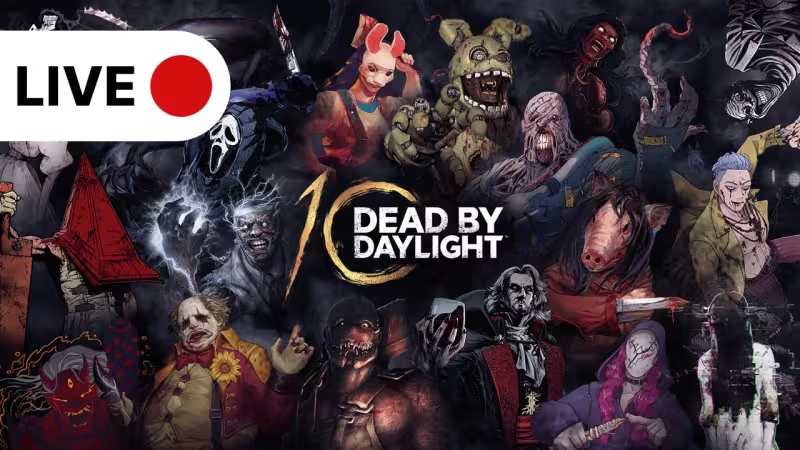
Behaviour Interactive announced during Dead by Daylight’s anniversary broadcast on June 15, 2026, that it will overhaul the game’s visuals and animations instead of building a boxed sequel or a separate Dead by Daylight 2.
The studio laid out a broad plan: new character models and more detailed faces, revamped hair, updated maps, denser fog and mist, reworked animation rigs and refreshed audio, plus a future dynamic weather system with light rain, heavy rain and snow. Behaviour showed more detailed character models for a couple of Survivors and a more expressive facial animation of a Survivor getting impaled by a hook to illustrate the direction. The work will come from a separate dedicated team inside Behaviour, and the full modernization is tentatively scheduled for sometime later in 2027, though the studio said the timing could shift.

Creative director Dave Richard framed the change as an aesthetic and mechanical necessity: "Obviously, there are a lot of ways to deliver horror experiences," he said, adding, "We want to sell fear and suspense through the visuals, graphics, and immersion in our world." He also warned that the studio’s current toolset limits that ambition: "Currently the tools that were are using aren’t to the level of our ambition, so we want to take that immersion to the next level so the trials feel closer to you and you feel that fear."
Behaviour presented the overhaul as a continuity decision as much as a technical one. Executive producer José Ramos reiterated the studio’s longstanding opposition to a sequel: "People have asked about DBD2 over the years many, many, many times" and "And we have always said it is not something we want to explore." Ramos said the core reason is practical and player-focused: "Why? Because starting over would mean leaving too much behind — player progress, the purchases they have made, the time they have invested in the game — and that’s not a trade we are willing to make." He concluded the announcement with a promise: "So, instead of building a sequel, what we want to do and what we are going to do is evolve DBD itself." Behaviour also noted that a boxed sequel would require renegotiating contracts for licensed characters, an additional legal and financial hurdle.
The decision matters now because Dead by Daylight is ten years old: the game launched in 2016 and has since accumulated original Killers and Survivors alongside dozens of licensed collaborations. Keeping a single evolving live game preserves that history and the purchases players have already made, which Behaviour cited as central to the choice to modernize rather than reset.
The plan carries a clear limitation that will shape how players experience the overhaul. Behaviour warned that the visual style change may not apply to every system the game currently runs on; PS4, Xbox One and Nintendo Switch were singled out as platforms that might retain the current visuals rather than receive the full graphical upgrade. That gap leaves players on older consoles with a different experience and raises the practical question of parity across the player base when the overhaul arrives.
What happens next is straightforward in direction and unresolved in detail: Behaviour is proceeding with a dedicated team to upgrade graphics, animations and audio, aiming for a 2027 rollout window that could shift, and it has committed not to launch a Dead by Daylight sequel. The single most consequential unanswered item is platform coverage — which systems will get the new visuals when the overhaul ships — and Behaviour has not specified that timetable. For players worried about losing progression, the studio’s pledge to evolve the existing game should be reassurance; for players on PS4, Xbox One and Switch, the practical effect is likely to be continued support with potentially different visual fidelity until Behaviour clarifies the platform roadmap.



