John Quincy Adams stepped to the podium at the New York Historical Society on April 30, 1839. The occasion was neither casual nor ceremonial alone: his appearance fell on the 50th anniversary of George Washington’s inauguration and on the jubilee of the Constitution.
That double anniversary is the hard fact that gives Adams’s appearance muscle. It tied a living former president to the precise moment Americans marked half a century since the republic’s birth rites — a rare public re-linking of one generation to the founders at a moment intended for national reflection.

For readers today who follow the Adams family or constitutional anniversaries, the moment is threaded back into contemporary debates by the work of modern writers. Bob Crawford, who wrote America’s Founding Son: John Quincy Adams, From President to Political Maverick, has helped put Adams’s later years back on the shelf of subjects worth reading; Crawford is also known to many as a member of the Grammy-nominated band the Avett Brothers.
Context sharpens the gesture. The 1830s and 1840s are framed in the material as “America’s tortured adolescence,” a period in which, by some accounts, the original Founding Fathers had ceded public attention to their sons and grandsons. That makes Adams’s 1839 address striking: here, a son of the founding generation — himself a former president and the child of John Adams — was publicly reasserting the living memory of the founding rites even as historical focus shifted to the next generation.
The friction is plain. If the decades after the Revolution are described as a time when heirs took the stage, Adams’s presence at a major historical society challenges that tidy handoff. He was not a relic in a museum; he was a speaker at an institution meant to steward public memory. The fact of his address on April 30, 1839, sits uneasily with any narrative that imagines the founders’ influence already faded by midcentury.
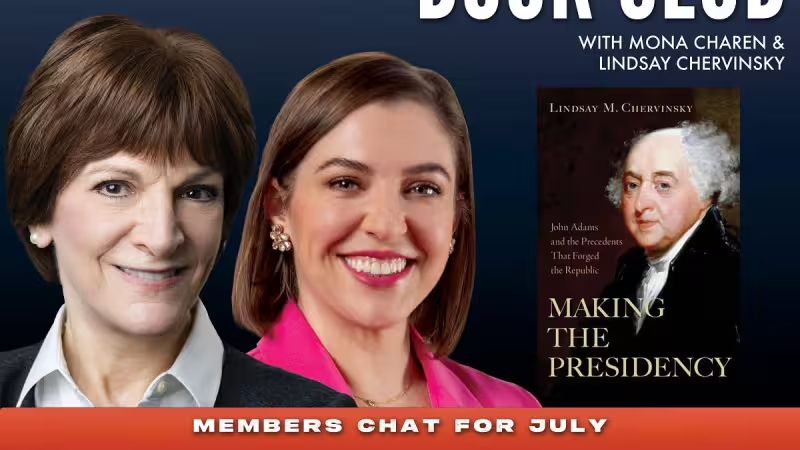
That uneasy fit is part of why the Adams family and the founding era continue to invite examination now. The conversation about presidential precedents is active elsewhere this summer: the Bulwark Book Club for July will feature Lindsay Chervinsky’s Making the Presidency: John Adams and the Precedents That Forged the Republic. Mona Charen and Chervinsky will discuss the book during a special edition of The Mona Charen Show the week of July 4. Chervinsky is the executive director of the George Washington Presidential Library at Mount Vernon, linking the scholarly conversation back to institutional memory.
What the record of the 1839 speech does not supply is a tidy lesson for contemporary governors, legislators or citizens. The material provides no single, spelled-out statesmanship takeaway that readers can lift intact for today’s politics. Instead the address functions as a reminder: the founding generation, and those closely connected to it, continued to speak into public life decades after 1789 — sometimes to insist on the precedents they believed mattered.
The unresolved question is consequential. Will historians and public conversations translate Adams’s 1839 posture into concrete guidance for current officeholders? The next scheduled public moment to test that translation is the July discussion of presidential precedents, where work on John Adams will be foregrounded. Until participants in that and similar forums articulate a sharper, actionable lesson, Adams’s New York Historical Society appearance remains a vivid emblem — a former president restoring a direct line to the inaugurations and constitutional jubilees that defined the republic’s origins.