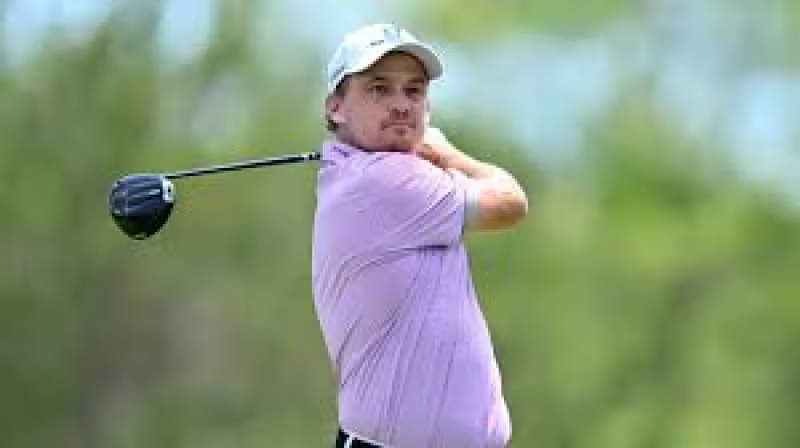
"The worst thing that’s ever happened to me led to like the best thing that’s ever happened," Bud Cauley said, and the sentence sits at the center of a story that begins with a life‑threatening car crash and ends, for now, in a family kitchen. Cauley met Kristi through a mutual friend right after the June 2018 wreck in Dublin, Ohio, and the two now have two kids; Kristi says he is "the best dad. He’s super involved and super present."
The details of the crash are straightforward and stark: Cauley was a passenger during the 2018 Memorial Tournament, and he left the scene with a broken leg, a collapsed lung, six broken ribs and a concussion. "So they put me in the ambulance and that’s when I learned that I had fluid getting into my lungs," he said. He credits the meeting with Kristi to that moment off the course: "Had it not been for that car accident, I would have been out on the road playing golf."

Kristi Cauley, a University of Florida graduate who works as a digital marketing coordinator for TGR Ventures, describes what the accident created at home: a father deeply present in day‑to‑day family life. "When he’s here, he’s totally here. He’s doing all the school runs and all the drop‑offs. It softened him up a little bit. It brings out his little playful side, which is great to see," she said. Those hands‑on hours with the children are the clearest measure of the accident’s long, private consequence.
On the surface, Cauley’s comeback looked quick: he returned to golf five months after the crash. Underneath that return, though, a different timeline unfolded. A sudden pain in the side of his chest later halted his progress. Doctors attempted to remove surgical plates, but the procedure failed because his chest‑wall bone had grown over them, and medical setbacks plagued him for three years. "Three years is a long time. It was happening to me, but she was really going through it as much as I was," Cauley said.
The friction between an early return and a prolonged struggle is the heart of the story: a player who was back on a course within half a year but who then endured repeated interventions and consultations. The failed plate removal is the specific snag that converted a comeback into a long repair job; it is why those first five months do not read like recovery complete. "I couldn’t have gotten through any of it without my wife, Kristi," Cauley said, crediting her with helping him through the grind.
The most concrete medical break came at the Mayo Clinic in Jacksonville, where Cauley underwent a procedure he described as a hydro dissection. "The final thing I did up at the Mayo Clinic in Jacksonville, which was the hydro dissection, which finally kind of released some of those muscles in my chest wall and it was able to start swinging and felt a lot better," he said. The procedure mattered physically; it also matters to the story because it marks the end of a chapter of interventions that stretched over three years.
Still, the narrative closes on an unresolved, consequential question rather than a tidy conclusion: did the hydro dissection restore the parts of Cauley’s game that the accident and the subsequent failed procedures cost him? Cauley has been blunt about how marriage and fatherhood changed his priorities—"Getting married and starting a family, it changed my perspective on life a lot. I spend all day just thinking about them."—but the single most consequential unanswered question is whether the medical work in Jacksonville returned the swing that would send him back to life on the road.