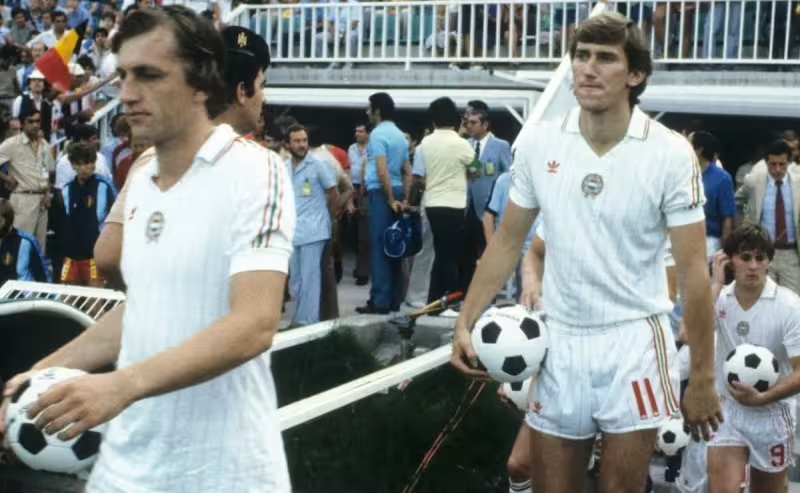
The highest scoring World Cup game by one team is Hungary’s 10-1 victory over El Salvador, played on June 15, 1982, in Elche, Spain. Hungary led 3-0 at halftime and added seven more after the break to complete the 10-1 scoreline, the only occasion a side has reached double figures at a World Cup.
The scale of the result is stark: 10 goals by one side and a nine-goal margin. FIFA and Guinness World Records both list the 10-1 score and the nine-goal difference as the tournament’s record for most goals by a single team and the biggest winning margin, figures that still stand decades later.

Goals in Elche came from Tibor Nyilasi, Gabor Poloskei, Laszlo Fazekas, Jozsef Toth, Lazar Szentes and Laszlo Kiss, while El Salvador’s solitary reply came from Luis Ramirez Zapata. Kiss, who entered as a substitute, produced a hat-trick in seven minutes — the fastest in World Cup history and the only hat-trick by a substitute in the tournament’s records.
The match is often cited alongside other dominant World Cup results — Germany’s 8-0 win over Saudi Arabia in 2002 and Spain’s 7-0 win over Costa Rica in 2022 — but those scores fall short of the Hungarian total. The 10-1 result is not simply notable for its goal tally; it remains the extreme outlier in a competition where single-game scoring feats rarely change overall fate.
And here the story takes a sharp turn: despite the rout, Hungary did not advance from the group. After Elche, Hungary lost to Argentina and drew with Belgium, finishing third in the group and leaving the tournament at the first hurdle. The match that produced the highest scoring World Cup game thus did not secure progression — a fact that turns the result from a campaign-defining triumph into a historical curiosity.
The records record the numbers; they do not explain the campaign. The verified facts stop at the scores and the standings: Hungary’s 10-1 spree, the subsequent loss to Argentina, the draw with Belgium, and a third-place finish. Why a single, extraordinary victory failed to alter Hungary’s fate is not spelled out in those match sheets. What is clear is practical: one game, however explosive, sits inside a group where other results and points decide who advances.
The standing facts leave a pointed question in plain view. If the 10-1 win is the highest scoring World Cup game, why did it not carry Hungary out of the group? That unresolved gap — between historic performance in a single match and the team’s ultimate elimination — is the lasting story from Elche: a record that still towers over World Cup history, and a reminder that statistics and tournament success are related but not identical.