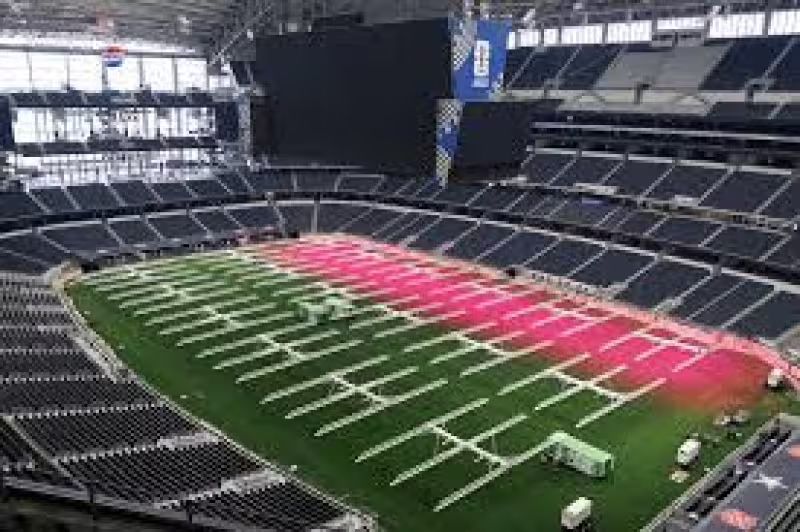
Curacao will make its World Cup debut in Houston on Sunday at 18:00 BST, facing Germany and carrying the distinction of being the smallest nation ever to qualify for the tournament with a population of just 158,000.
The achievement rests on results: Curacao won all four games in its first qualifying group and remained unbeaten in the second, a run that brings thousands of Blue Wave fans to Houston — some on same-day charter flights — and a squad that will enter Group E alongside Germany, Ecuador and Ivory Coast.

Practically every headline about the island’s qualification points to the numbers that built it. Only one member of the World Cup squad, Tahith Chong, was born on Curacao; the other 25 players were born in the mainland Netherlands. Eighteen players represented the Netherlands at youth levels, and two — Riechedly Bazoer and Joshua Brenet — have senior caps for the Netherlands.
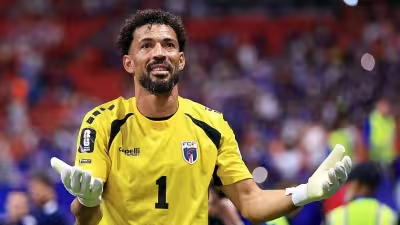
The recruitment strategy that produced this squad began a decade ago when Curacao started hiring high-profile Dutch managers. Patrick Kluivert began that shift in 2015. Eloy Room was the first player from the current roster to appear for Curacao in 2015; Leandro Bacuna joined in 2016 and has since become one of the faces of the campaign. "We've done something so nice for Curacao. I started this journey 10 years ago and wanted to make the people from Curacao proud," Bacuna said.

Managerial experience adds to Curacao’s story: Dick Advocaat will become the oldest boss in World Cup history at 78 when he leads the side in Houston, a fact that underlines the unusual nature of the island’s rapid rise to football’s biggest stage.
On the island, the qualification is being framed as a national triumph. "It brings so much joy and pride to the island that you can't describe it. The whole island is turning blue," Gilbert Martina said as Curacao prepared to travel. That celebration, however, sits beside a clear tension: the team celebrated as a Curacao national achievement is composed almost entirely of players born in the Netherlands, not on the island itself.
Bacuna put the emphasis on unity and results rather than biography. "People look at us always having fun and dancing. We are all together. But as soon as the referee blows the whistle we have one thing on our mind - getting a result," he said. He added a broader aim: "The manager keeps saying we are not finished. We want to show people as small as we are, we have a big heart. If you have a big heart I believe you can get far."
For viewers and supporters, the immediate detail is simple: Curacao opens against Germany on Sunday at 18:00 BST, then meets Ecuador and Ivory Coast in Group E. Thousands of traveling fans and an outsized media curiosity will test whether the island’s momentum and the overseas-born core can translate into competitive performances against established nations.
The single most consequential unanswered question as Curacao steps onto a World Cup pitch for the first time is whether this largely diaspora-based team can turn qualification into competitive results in Group E against Germany, Ecuador and Ivory Coast — and in doing so, redefine what national success looks like for a territory of 158,000 people.