The Furious opened wide in 2026 after a noisy September 2025 festival debut and is arriving in theaters as one of the year’s most critically adored action films — it carries a 99% Rotten Tomatoes score from 83 critics and a 96% audience rating.
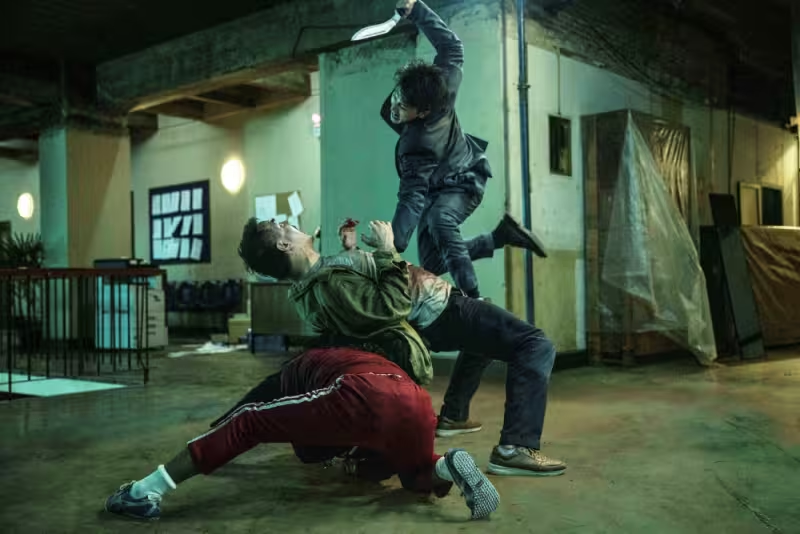
That critical consensus rests almost entirely on the movie’s fighting. Directed by Kenji Tanigaki and shaped in the ring by action choreographer Kensuke Sonomura, The Furious is being sold as a hardcore martial‑arts crossover: a Hong Kong production with a reported $20 million budget, a quartet of credited screenwriters and a cast that includes Xie Miao, Joe Taslim, Miao Xie and Yayan Ruhian.

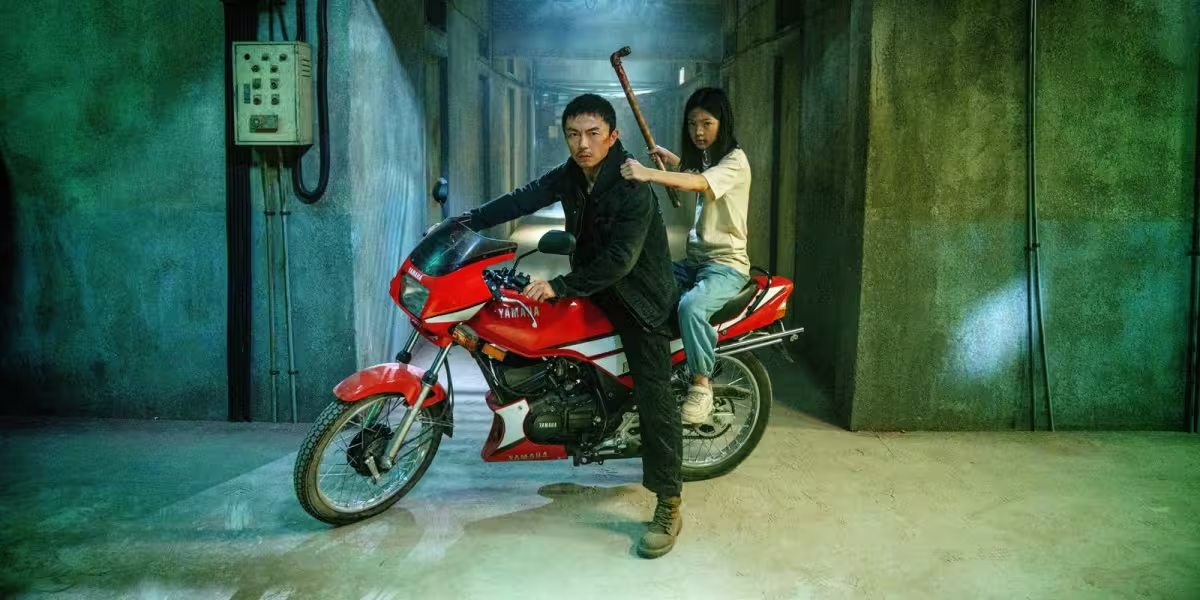
The story is a stripped, punch‑first premise. A blue‑collar worker (Xie Miao) teams up with a journalist after his daughter is kidnapped and the journalist’s wife disappears; the onscreen world is presented as somewhere in Southeast Asia and features dialogue in English, Mandarin, Thai and Tagalog. Variety summed up the appeal bluntly: "Here’s a film where you come for the fighting and stay for the fighting, and are unlikely to feel shortchanged." Tanigaki, who spent decades as a stuntman across 50+ different films before turning to directing, and Sonomura’s fight design are the film’s primary selling points.
The movie’s festival run supplied the launch pad that now matters: it debuted in September 2025, finished second in People’s Choice voting in Toronto’s Midnight Madness section, and has since been positioned for a global theatrical push. That momentum — festival buzz plus a near‑perfect aggregator score — is unusual for an action film built around practical stunts and physical choreography rather than franchise IP.
There is a glaring friction between the applause for the choreography and the rest of the picture. Critics repeatedly describe The Furious as "slimly plotted but action‑crammed," and note that a significant portion of the English dialogue reads as clunkily dubbed. Those shortcomings undercut any claim that the movie is a complete, character‑driven drama; it is a visceral object, not a conversational one, and many reviews treat the thinness of plot and line readings as a deliberate trade‑off for sustained kinetic set pieces.
That trade‑off creates the central question now that the film is wide: will critical reverence translate into box office muscle? The movie arrives with a solid festival pedigree and a $20 million production figure that suggests distributors expect more than cult returns, but there is no public box office record yet to show whether mainstream audiences will follow the critics or treat The Furious as a critics’ favorite with limited mainstream reach.
The stakes are practical. If the film converts its Rotten Tomatoes cachet into ticket sales, it may open new windows for similarly staged, non‑franchise martial‑arts films to travel internationally; if it doesn’t, The Furious will likely be remembered mainly as a festival phenomenon that proved how far choreography can carry a picture. For readers tracking release details and timing, see our earlier coverage:
Bottom line: The Furious is the year’s most acclaimed pure‑action movie on paper — a critics’ triumph built on Tanigaki and Sonomura’s fight work — but its final verdict will be written where critics’ scores meet theater receipts. Box office performance over the next weeks will determine whether this is a crossover hit or a celebrated outlier.