



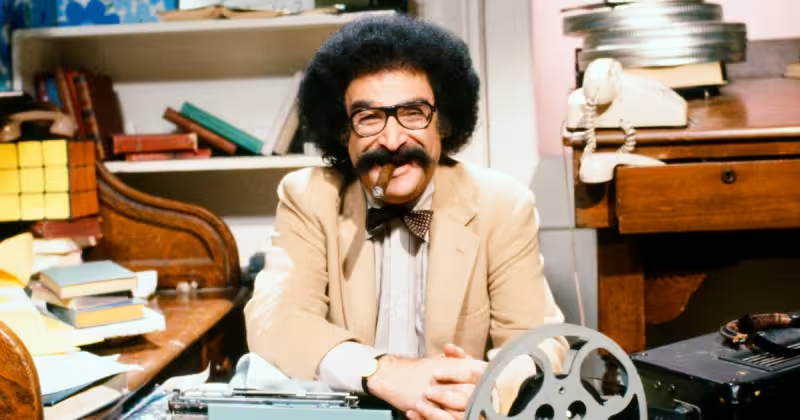
Gene Shalit, the longtime film critic whose walrus mustache and colorful bowties made him one of television’s most recognizable reviewers, died Friday at age 100, his family said.
Shalit was a fixture on NBC’s "TODAY" show for four decades, starting as a part-time contributor in 1970, moving to a full-time role three years later and remaining on the program until his retirement in 2010. His family said he "passed away peacefully today after 100 years of an amazing life."

He built a reputation on the program for exuberant wordplay and short, memorable verdicts — lines that often doubled as headlines. In one signature turn, he wrote of The Silence of the Lambs that "The 'Silence of the Lambs' may be all wool and a yard wide, but it makes a terrific yarn." He called X‑Men a picture that "should not be taken seriously. In fact, it should be taken with two aspirin." A later review of Funny People rendered the film "passable," adding the zinger "speaking colonically."
Those puns and one-liners carried him into interviews and television moments beyond criticism. He interviewed stars including Oprah Winfrey and Harrison Ford and once asked Kermit the Frog whether he planned to marry Miss Piggy. Viewers came to expect the performance as much as the judgment: a bowtie, a bushy mustache and a short, witty take on whatever was playing in theaters.
Shalit’s televised fame, however, rests on a longer resume that predates his time on morning television. He began as a print journalist, was senior film critic for Look Magazine and wrote the "What’s Happening?" page for Ladies Home Journal for a dozen years. His byline also appeared in, Cosmopolitan, TV Guide, Seventeen, Glamour and McCall’s. From 1969 to 1982 he broadcast a daily "Man About Anything" essay on NBC’s coast-to-coast radio network, and he was a regular panelist on game shows such as "What’s My Line?" and "To Tell The Truth." That breadth of work — print, radio, panel television and broadcast criticism — is the piece of his career that often gets overshadowed by his morning show persona.
Former "TODAY" co-host Meredith Vieira paid tribute to Shalit’s place on the program, saying, "It’s hard to imagine not having him here. He is the 'TODAY' show." The remark underlines how his presence had become part of the program’s shape: viewers turned to his segment for both guidance about films and a familiar comic cadence.
Shalit’s life began in New York on March 25, 1926; he was raised in New Jersey, and he graduated from the University of Illinois in 1949 after editing his college paper, The Daily Illini. Early efforts — creating an elementary school paper called The Spotlight, buying a fedora to look the part of a publisher, writing a high school humor column — foreshadowed a career built on words and performance.
The immediate consequence of his death is the end of a four-decade chapter on morning television: a recognizable critic who translated moviegoing into short, shareable pronouncements. What remains unresolved is the cause of death; his family’s statement said only that he "passed away peacefully today after 100 years of an amazing life." No further details or public arrangements were announced.
Shalit’s retirement in 2010 closed his regular broadcasts, but his lines and look persisted in viewers’ memories. With his passing, the industry loses not just a familiar voice on a morning show but a figure whose career crossed the print pages, radio airwaves and studio panels that shaped American entertainment criticism in the second half of the 20th century.



