



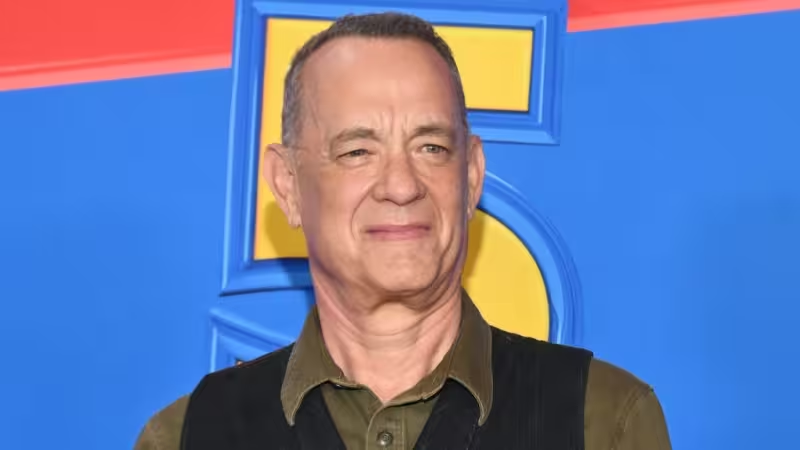
“I think they have enough categories,” Tom Hanks said in a Gold Derby interview, cutting straight through a debate that has been building around performances that live entirely in the voice. Hanks made the remark as he prepares to return as Woody in Toy Story 5, which premieres in theaters on June 19.
The remark carries weight because Hanks is a two-time Oscar winner whose career spans on-screen lead roles and voice work. He went on to explain his reasoning bluntly: “The truth is, a voice actor can win Best Actor. The judgment is, ‘any performance that moved you.’”

Hanks pointed to motion-capture and performance-capture work as precedent, singling out Andy Serkis as an example of how a nontraditional performance can generate awards momentum. “Even though he does not appear as Andy Serkis, he gives all the raw material for it. There’s been people who have been close to being nominated that do not appear on camera. That could happen to a pure-vocal actor,” Hanks said, framing voice work as eligible under existing acting standards rather than something that demands its own statue.
That argument sits against a clean historical fact: no voice actor has ever won in the acting categories at the Academy Awards. The Academy of Motion Picture Arts and Sciences has changed its ballot before—the Best Animated Short Film category dates back to 1932, the Best Animated Feature category was added for the 2002 ceremony, and the organization has continued to evolve its honors into the 21st century. This year the Academy handed out the first Best Casting award to Cassandra Kulukundis for One Battle After Another, and it has announced Achievement in Stunt Design will begin in 2027—evidence that the institution will create new categories when it sees fit.

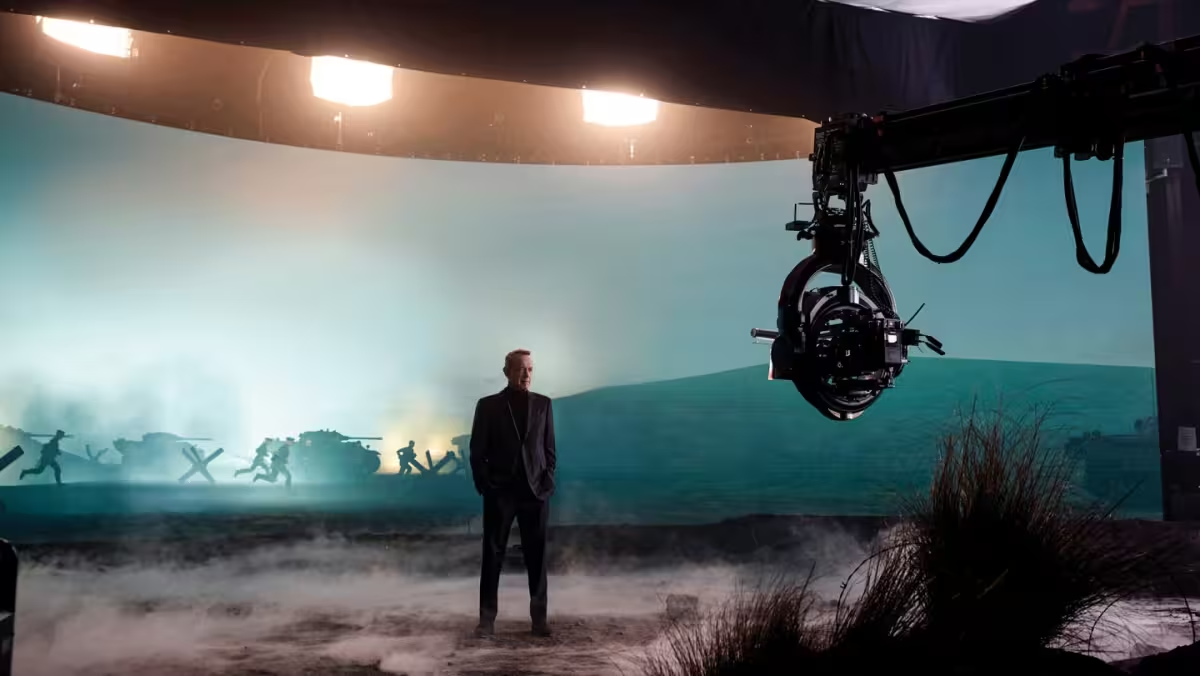
That history is precisely the friction in Hanks’s case. He insists the rules, properly applied, allow a voice performance to contend for Best Actor, yet the Academy’s record shows voice performances have been shut out of wins in the acting fields. Critics of Hanks’s stance argue that a category would spotlight a set of crafts otherwise invisible to voters; Hanks counters that the fundamental standard should remain whether a performance moves the audience, not the medium through which it is delivered.
Hanks’s comments arrive while he is actively re-entering an animated franchise that began in 1995 with the first Toy Story, a franchise long associated with moving, character-driven voice turns. The timing sharpens his point: as Woody returns to cinemas June 19, the conversation about how the Academy recognizes vocal work is not theoretical for the performers who will be heard, not seen.
Whether the Academy will create a separate voice acting category remains the central unanswered question. Hanks has staked a clear position—that existing acting categories, judged on whether a performance moved you, are sufficient—while the Academy’s recent additions to its ballot show it is willing to add categories. The practical outcome for voice actors and the awards that reward them will depend on whether voters decide a vocal performance can meet an acting standard they have never yet rewarded, or whether the institution opts to enshrine a separate lane for that work.
For now, the immediate next act is plain: Tom Hanks returns as Woody in Toy Story 5 on June 19, and his Gold Derby interview has sharpened a debate that will likely resurface when voice-led features reach awards season—if and when they push voters to reconsider what counts as an acting performance.



