



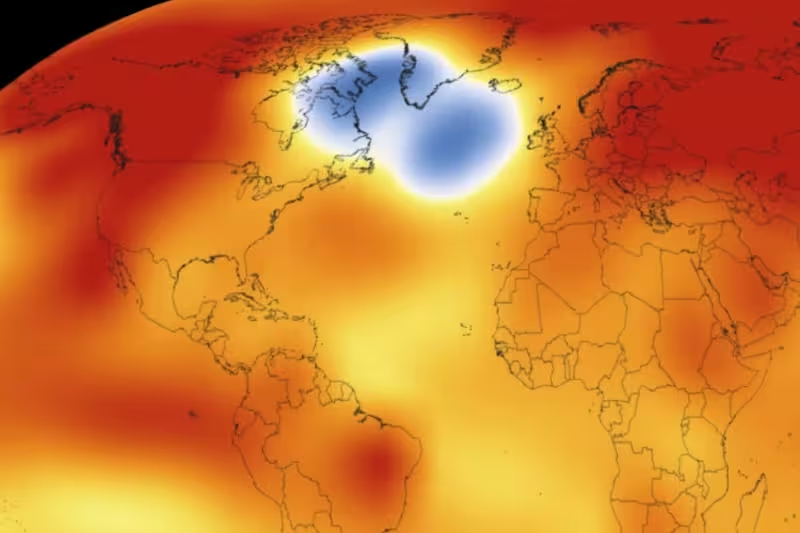
Scientists report that the Atlantic "cold blob" — a patch of ocean south‑east of Greenland that has cooled by as much as 1°C over the past 150 years — is not just a surface oddity: the region has been cooling down to 1,000 metres, a pattern researchers say strengthens the case that a weakening Atlantic Meridional Overturning Circulation is driving the anomaly.
That deeper cooling, detected in climate reanalyses based on satellites, buoys and ships, is the headline result. Researchers found heat loss from the ocean surface in the cold blob began declining around 1955, and the same analyses show the temperature drop extends far below the skin of the sea — a finding that is hard to square with explanations that rely mainly on short‑term atmospheric quirks.

The development matters because the AMOC is the engine that carries warm, salty water from the Gulf of Mexico to the north Atlantic, where the water cools, becomes dense and sinks before returning south along the ocean floor. If that overturning weakens, less tropical heat would reach the north Atlantic. Some modelling and paleoclimate work suggest the AMOC could cross a tipping point within decades, with consequences that include much colder winters in Europe and disruptions to monsoon rains that African and Asian agriculture depend on.
Stefan Rahmstorf and colleagues led the reanalysis work. Rahmstorf said winds and clouds account for only a modest fraction of the warming hole and that the data show the ocean is the driver: "Even if, in some modelling approaches, it seems possible that the cold blob is caused by the atmosphere, in fact, the data show it is caused by the ocean." He also warned the result reveals Atlantic circulation has already been changing for decades and raises the possibility of collapse not only of the AMOC but of the subpolar gyre, a massive swirl of currents around the cold blob.
The ocean mechanism has a plausible physical trigger. Freshwater from Greenland’s melting ice dilutes the salty north‑bound water, making it less dense and slower to sink. Climate modelling long suggested a slowing AMOC could be carrying less warm water to the region and so creating the cold blob; the new reanalyses give observationally anchored evidence that cooling has penetrated deep enough to implicate circulation rather than only surface weather.


Yet the picture is not settled. Other modelling has placed most of the blame on the atmosphere. A 2022 study by Chengfei He and colleagues argued that rapid Arctic warming reduced the temperature contrast between pole and tropics, nudging the jet stream north into the cold blob region. The 2022 work said stronger westerly winds increased evaporation and churning that drew heat from the ocean, and that greater evaporation also produced clouds that shaded the surface and kept it cooler.
The reanalyses combat that argument by showing reduced ocean heat loss at the surface since 1955 and matching cooling at depth — signs you would expect if circulation were changing. But the competing explanations expose a key uncertainty: atmosphere‑only mechanisms can act quickly and regionally, while a circulation slowdown is a longer, deeper shift in the ocean system. Distinguishing them is essential because the stakes diverge: atmospheric patterns can flip back seasonally; a sustained AMOC slowdown points to a persistent change in climate patterns.
Practical certainty remains limited by the record. Scientists have 22 years of direct AMOC observations, a short window for a circulation that operates on multi‑decadal timescales. Reanalyses knit together many types of measurements to extend understanding backward, but they cannot substitute for long, continuous in‑situ monitoring when answering whether the AMOC is near a tipping point.
The immediate consequence of the new work is a shift in the balance of evidence: deeper cooling gives weight to the ocean‑driven explanation and amplifies concern that Atlantic circulation has been changing for decades. FilmoGaz has previously examined related evidence that AMOC weakening may already be cooling the Atlantic’s cold blob (
The unresolved and most consequential question is how close the AMOC is to a collapse. The reanalyses do not settle a timeline. They tighten the case that the ocean has been altering heat transport for decades, but whether that trend continues into a tipping‑point crossing within decades remains unknown — and it is the single outcome that would reshape weather and agriculture across Europe, Africa and Asia.



