The Cook Islands government last week launched an online fuel dashboard that publishes real-time stock levels and shipment schedules and shows there is sufficient fuel until the next shipment.
Updated on 28 May and viewed on Friday local time, the dashboard reported Rarotonga had 51 days of petrol, 57 days of diesel and 25 days of jet fuel, with 44 days of power supply. For Aitutaki the dashboard listed 10 days of petrol, 41 days of diesel, 19 days of LPG and 29 days of electricity, while noting the island’s overall supply remained stable and there was no need to panic-buy.

The Office of the Prime Minister said the dashboard strengthens monitoring of domestic fuel supplies and is part of an all-of-government response coordinated by the Energy Response Technical Working Group. Officials launched the tool amid ongoing global fuel supply pressure linked to the Middle East conflict and presented the dashboard as an early-warning system for households, businesses and outer-island communities.
The public data are granular: indicators include fuel stock levels, shipment schedules, estimated days of supply remaining and infrastructure status, and the government says the page will be updated weekly. The dashboard also lists island-by-island notes: Tongareva, Mauke, Mangaia, Pukapuka/Nassau and Palmerston were shown with adequate stock; Rakahanga received a partial delivery and was awaiting a data update; Atiu and Manihiki have shipments planned; Mitiaro’s shipment arrived on May 13 and Mangaia’s was due on May 30.
The new transparency arrives after a severe petrol shortage in Aitutaki in late April that forced temporary pauses on public fuel sales and led to cancelled tourism activities; that situation eased last month when supplies arrived. The dashboard is intended to reduce the sort of panic-buying that caused the April disruption by giving people a weekly public view of remaining days of supply.
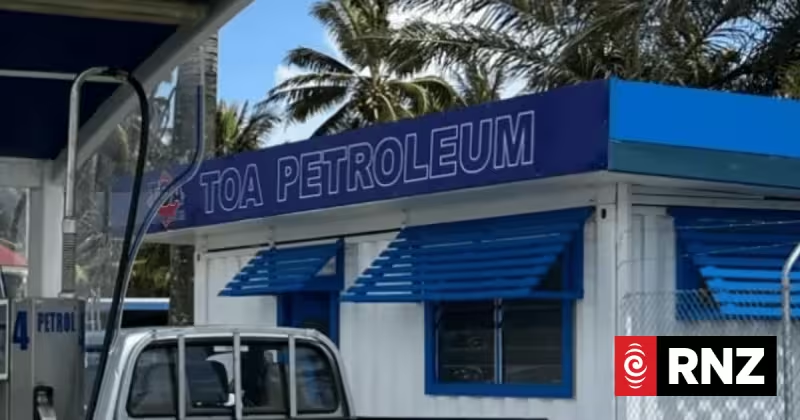
Still, a clear discrepancy has surfaced between the dashboard’s 10-day petrol figure for Aitutaki and reports from local suppliers. John Lockington, speaking for local operators, said one supplier received a full tanker on last week’s boat and added, "There should be more than 10 days. And plus, there's a boat next week Tuesday." He also said, "There's obviously no shortage now, so that's a good thing," and that Spider Energy, Aquila and TNM "have sufficient fuel and have experienced no shortages."
The mismatch highlights an unresolved operational question: whether the dashboard’s days-of-supply calculations reflect stock already landed and held by private suppliers, or only fuel recorded in government inventory feeds. The dashboard itself says Aitutaki’s fuel supply remains stable, but it does not explain the methodology that produced the 10‑day petrol figure shown on 28 May.
For households and businesses the immediate consequence is practical: the dashboard’s overall picture points to sufficient national stocks, with shipments expected next week and in two weeks and the tool updated weekly, which should blunt the impulse to panic-buy. For islands with recent disruptions, the weekly cadence promises faster public notice of supply changes than the last incident in April.
The most consequential open question is operational: will the government and the Energy Response Technical Working Group reconcile dashboard calculations with suppliers’ records so the public can trust island-level day counts in real time? The dashboard reduces uncertainty at the national level, but until reporting lags and data sources are aligned, outer islands may still see short, sharp local scares even when bulk stocks are adequate.