



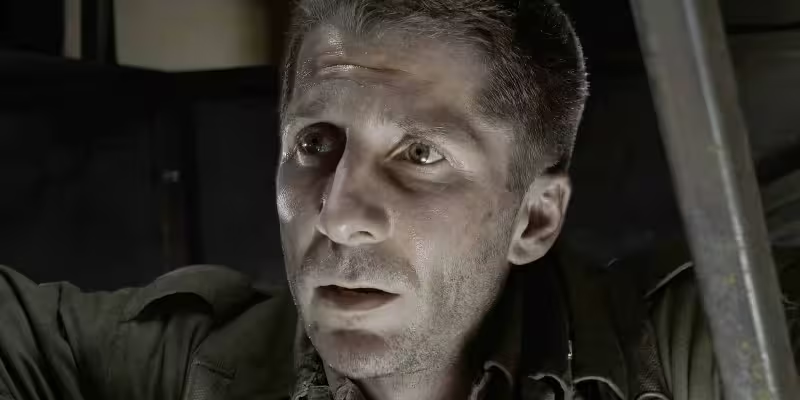
“Here we have a little bit of mythology, the idea that no armour made it ashore at Omaha Beach. Actually, a lot of armour made it ashore at Omaha Beach,” John McManus said, bluntly regrading the opening minutes of Saving Private Ryan. The World War II historian’s comments have resurfaced as the film returns to wide circulation this month, prompting viewers to watch the D‑Day sequence with fresh scrutiny.
McManus did not dismiss the scene. “Yeah, [overall] I would say I’ll give it an eight out of 10 [for historical accuracy],” he told an interviewer. But he identified two specific departures from the record that, he says, push the battle’s choreography away from what happened on June 6, 1944. The most consequential is the portrayal of allied armour at Omaha: the film leans on a narrative that little or no armour reached the beach, while McManus says the historical record shows otherwise.

He detailed the nuance. “You hear him refer to DD tanks. Those are duplex drive, like amphibious tanks that swam their way in. Yes, it’s true that 27 out of 32 of those sank, but at the opposite end of Omaha Beach from where they are. On the side of the beach where they are, all the DD tanks got in because they were brought in by landing craft,” McManus said. The numbers — 27 out of 32 — are the data point that upends the idea that armour simply failed to arrive across the entire beachhead.
McManus also called out a different detail that many viewers might not notice but which matters for method and morale on the sand. “Bangalore torpedoes were a major way that the Americans got off the beach,” he said, explaining what those devices were: explosive‑laden tubes that had to be assembled together and used to blow gaps in barbed wire. The film shows engineers and infantry using explosive means to clear obstacles; McManus argued the prominence of Bangalore torpedoes in the real assault was one of the practical mechanics that helped men move inland.

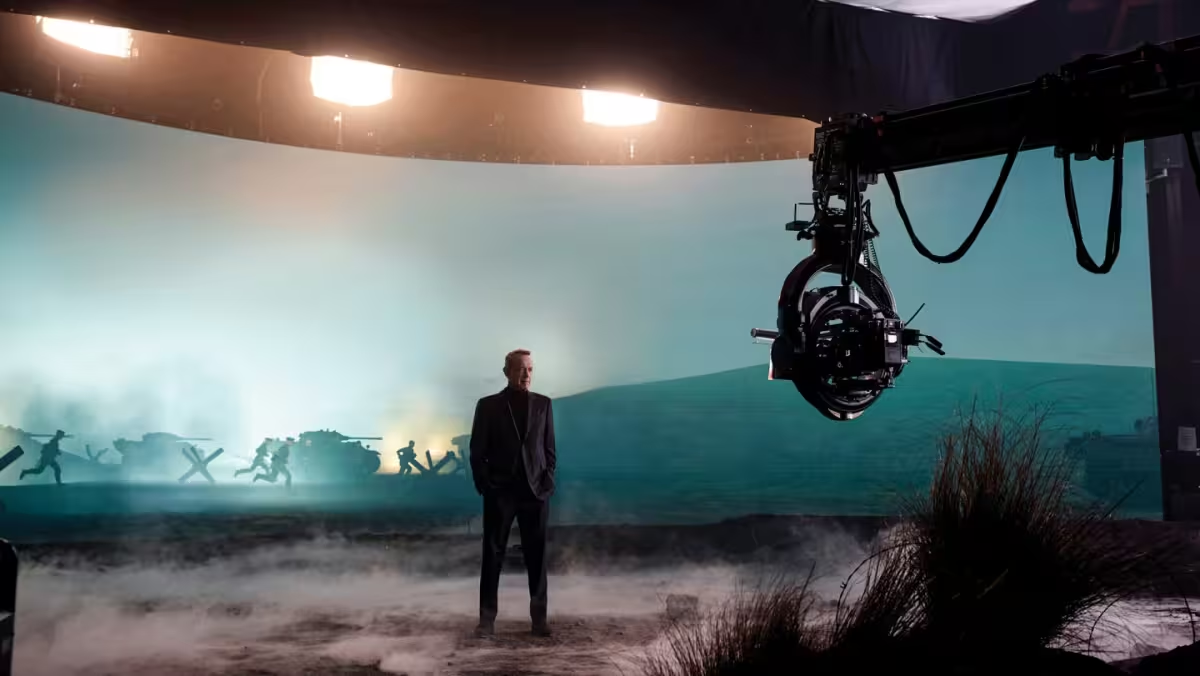
The second inaccuracy he flagged was less about logistics and more about set dressing and defensive placement. “Although, when you see in this last part of the clip, the way the machine gun nest is portrayed is not necessarily all that accurate. It’s certainly right out there, completely vulnerable, and the Germans probably wouldn’t have had that many sandbags at a position like that,” McManus said. The nest in the film reads as a dramatic focal point; the historian suggested its construction and visibility are amplified for cinematic effect.
Those critiques arrive against a well‑established reputation. Saving Private Ryan, which opens with the American landing on Omaha Beach on June 6, 1944 and stars Tom Hanks, is widely lauded for its realism. That general praise is the context for McManus’s assessment: he is not dismissing the sequence, only tightening the frame on two elements where staging and history diverge.
The friction is telling. A single myth about armour — that none made it ashore — can change how viewers interpret command choices and soldier behavior in the film. McManus’s correction does not erase Spielberg’s combat choreography, but it does knock the scene down a peg from myth to dramatized truth. His eight‑out‑of‑10 score is both praise and a calibrated caveat: most of what is shown fits the record, but key details matter.
With Saving Private Ryan available for free streaming this month on Pluto, McManus’s reading will likely send audiences back to Omaha Beach with checklist in hand — watching not just for terror and bravery but for which props and tactics match the historical ledger. The larger unanswered question is not whether the scene is compelling; it is how much of the rest of that opening sequence is cinematic compression rather than close adherence to what actually happened. McManus’s judgement answers part of that: the film remains broadly faithful, but its most repeated claim about armour is mythology — and that matters for anyone who wants the film to stand as a precise record rather than a powerful dramatization.



