



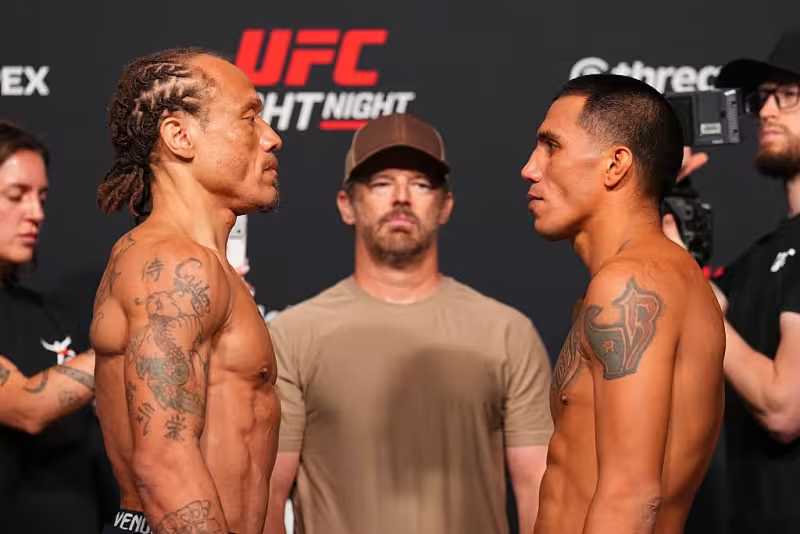
"This is the way the cards have fallen," Marcus McGhee said, then added, "We almost lost this one but thank you to John Yannis for pulling up and deciding to take the fight, so super-grateful to be here now." McGhee, 36, will step back into the Octagon this weekend to meet 31-year-old John Yannis, ending an 11-month absence that began after his July 2025 loss to Petr Yan in Abu Dhabi.
The arithmetic around the fight stacks in McGhee’s favor on paper: DraftKings Sportsbook lists him at -455 while Yannis is a +350 underdog. McGhee stands 5 feet 8 inches with a 69-inch reach and averages 5.50 significant strikes at a 45 percent connect rate. Yannis is a shade smaller at 5 feet 7 inches but carries a 70-inch reach, a 10-4 record and six knockout wins, four of those coming in his last four victories. Yannis also enters off his first UFC win in April over Jamie Siraj.

McGhee did not treat the layoff as a vacation. "You choose what you can, and you adapt to what you must adapt to, but here we are," he said, describing how he stayed in other fighters’ corners and in teammates’ camps rather than sitting idle. He said he went through Kyler Phillips’ whole camp in Winnipeg and shared camps with Mario Bautista, and that he has been in the gym with Abdul Kamara, who has been fighting regularly for Fury FC. "I was just (in Winnipeg) with Kyler (Phillips); I went through his whole camp with him," he said.
That proximity to live camps is the story’s heft: before losing to Petr Yan, McGhee had ridden a six-fight winning streak, five of those victories by knockout or submission. He says being around active teammates kept the gym sharp and forced him to keep growing. "One of the favorite parts of our gym is that we’re there for each other, so even though I haven’t been fighting, all my guys have been fighting," McGhee said.
Still, the break has been emotionally mixed. "It’s frustrating, obviously," he admitted, and later: "I think in any career field, being shelved for that kind of time, you go through so many different emotional moments." McGhee insisted he used the time constructively—"Using the time wisely has been good for me"—and credited family life for grounding him: "Gratefully, I have a really based family, a really based lifestyle, and that has kept me grounded." Yet he also conceded, "Obviously, I didn’t want to take that much time off, and I would have liked to be a lot more active."
The friction is simple and practical: McGhee believes the layoff was longer than he wanted, even as he tried to turn it into growth. "I’ve just been using it for what it is and getting better in the gym, building my family, building my own mental fortitude," he said. "Even when I’m competing regularly, I still feel like I get that chance, but since I haven’t had to do it with it being my fight, it’s been slightly different."
On paper this weekend will test that claim immediately. Yannis brings recent finishing power; McGhee brings experience, a recent run of finishes, and the work he says he did inside other camps. The unanswered, consequential question now is plain: after 11 months away, will McGhee’s time training alongside active teammates and tending to his mental game translate into the speed, timing and sharpness needed to handle a heavy-handed, in-form opponent?



