



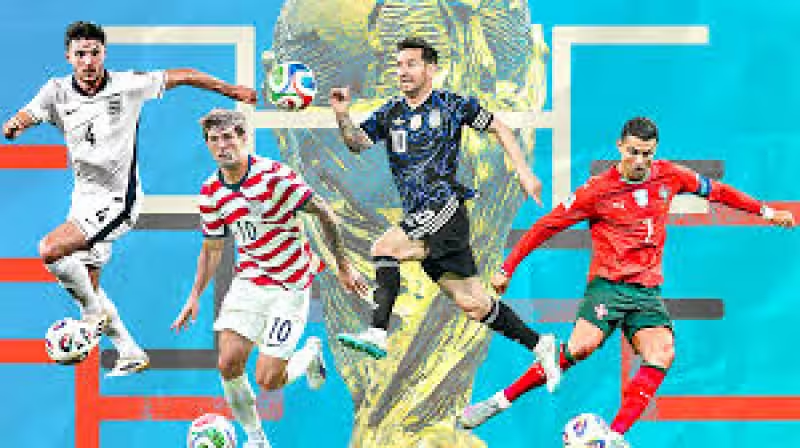
When does World Cup start is a common search this year, but the immediate question for fans should be simpler: with a 48‑team 2026 field, which countries still have a realistic path to the trophy? Using nearly a century of World Cup history and winner patterns, the picture narrows quickly.
The World Cup has a 96‑year history, missed two editions during World War II and, across 22 tournaments to date, produced winners from only eight countries. That concentration matters: betting markets put Brazil, Germany, England, Argentina, France and Spain among the top seven favorites for 2026, and historical trends suggest those traditional powers are the likeliest houses to hold the trophy again.

Two lines of historical evidence drive that conclusion. First, winners cluster by ranking: 15 of the 22 World Cup winners entered tournaments ranked inside the top four by Elo Rating, and Uruguay is the outlier — the only winner who began a tournament outside the top 15, entering the 1950 competition with an Elo of 17 and going on to win in Brazil. Second, geography and finals history narrow the map: only 13 nations have reached a World Cup final, ten from Europe and three from South America, and only eight countries have ever lifted the Cup.
Applied to 2026, those patterns disqualify some hopefuls and spotlight the familiar names. Italy, a multiple-time winner, did not qualify for 2026 and so is removed from any realistic title calculus. That resistance of the trophy to new owners — and the tight link between pre‑tournament strength and winning — helps explain why the six traditional powers named by bookmakers sit atop expectation lists despite an expanded field.


That said, expansion and tournament quirks keep an outsider lane open. Only three times in history has a country from outside Europe or South America reached a World Cup semifinal: the United States in 1930, South Korea as co‑hosts in 2002, and Morocco in the most recent tournament. Morocco’s recent results add texture: it reached the 2022 semifinal run, won the 2025 Under‑20 World Cup, took bronze at the 2024 Olympics and has made the quarterfinals at the last two U‑17 World Cups since 2022. Those youth and senior results argue that certain nontraditional contenders can become dark horses.
Practical numbers from the current rankings underline the gap between favorites and outsiders. Mexico was listed at 19th, Morocco at 24th, Canada at 25th and the United States at 36th in the article’s ranking snapshot. Those positions are not impossible — Uruguay’s 1950 run proves that — but they show why models anchored to Elo and historical winners still favor long‑standing powers.
There is one clear tension: history points strongly to a winner drawn from a handful of traditional champions, yet the tournament’s past also contains shocks that no ranking system could have predicted. As one observer put it, it’s reasonable to expect a champion among the established six, but it’s also defensible to remain open to a first‑time winner in 2026. Both positions can coexist because the record is both concentrated and capable of surprise.
The practical consequence for fans and bettors answering 'when does World Cup start' is straightforward. The 48‑team format increases the number of plausible entrants but, when the century of evidence is applied, the shortlist tightens back to historically dominant nations — Brazil, Germany, England, Argentina, France and Spain — with a handful of well‑positioned outsiders like Morocco and Mexico that could overperform. What remains unresolved is the tournament itself: a small historical sample and a handful of memorable upsets mean the one question nobody can answer in advance — which specific team will win — will only be settled on the pitch in 2026.



