



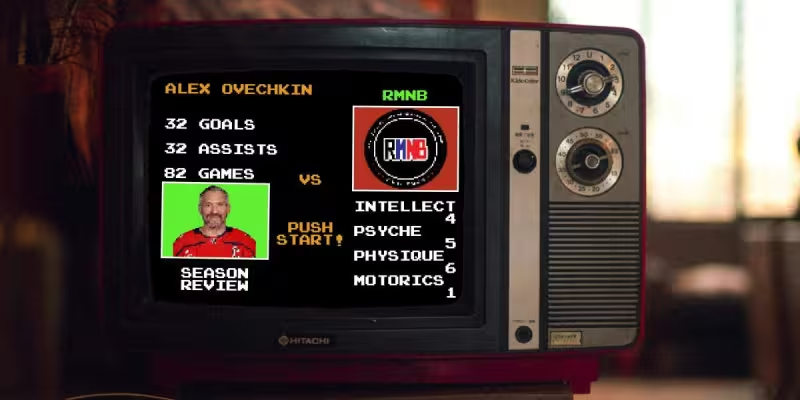
Alex Ovechkin finished the 2025–26 season with 32 goals — a total almost unheard-of at age 40 — but the headline number carried an asterisk: only five of those goals came on the power play, a career low that undercut what otherwise might have felt like a landmark finish.
The raw rarity of a 32-goal campaign at 40 is real. Historically only Gordie Howe (44 goals) and Johnny Bucyk (36 goals) have topped Ovechkin’s haul at that age, underscoring how uncommon his scoring remains. Yet the season’s defining evidence is the collapse on the man advantage: five power-play goals and a 5.8 percent power-play shooting rate, both career lows for Ovechkin and a steep fall from his 2024–25 numbers — he shot more than three times that percentage on the power play the year before.

Those metrics matter because the Capitals’ power play was supposed to be a steady engine. Instead it was a problem area all season: the team struggled to gain the zone with consistency, and when they did they were often statuesque, failing to move the puck in a way that created Ovechkin’s usual high-quality chances. The consequence was not just individual: a once-reliable scoring avenue that historically amplified Ovechkin’s value produced almost no lift at all in 2025–26.
The shift shows up in the numbers and in the personnel choices. The club did not replace the power-play coach before Thanksgiving — a decision the review identifies as costly, saying it cost the Capitals a playoff appearance — and the fallout includes the departure of Kirk Muller, who is gone now. Those moves and non-moves frame why 32 goals felt short of expectation: the context around Ovechkin’s finish was a power-play unit that failed to function as it had in prior seasons.
Ovechkin himself reacted to the season in plain terms. “I’m stunned,” he said, a short sentence that captured both surprise and frustration about how the campaign unfolded relative to the individual milestone. The quote lands differently once the power-play metrics and coaching choices are attached: a personal achievement threaded through institutional disappointment.
The tension here is straightforward. A 32-goal season at 40 is historically rare and should be a headline; instead it reads like a qualified achievement because the part of the team that historically made Ovechkin more dangerous barely worked. His drop to five power-play goals and a 5.8 percent power-play shooting rate changes the story from an all-time late-career flourish to an account of what a faltering special team can do to even the greatest shooters.
What happens next is the unanswered, consequential question. Ovechkin is not under contract for 2026–27, and the choices the Capitals' organization now makes — whether to rebuild the power play’s structure, to hire new technical staff, or to extend their veteran scorer — will determine whether that 32-goal season becomes the start of another chapter or a last, qualified flourish. The facts point to a narrow conclusion: Ovechkin’s scoring at age 40 proved he still has elite finishing ability, but the collapse of the power play and the coaching turmoil leave his immediate future, and the Capitals’ ability to revive their most important set piece, unresolved.



