



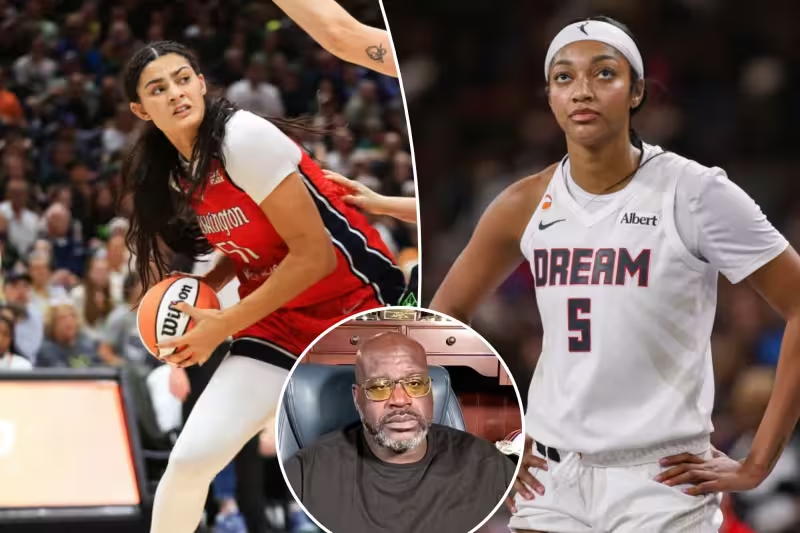
Shaquille O’Neal told the Rich Eisen Show last week he wanted to physically confront some of the people attacking two of his Reebok athletes, saying he “could punch some of these guys in their face that just pick on my Angel and pick up on my Lauren.”
The remark was blunt and immediate: “Because enough is enough,” O’Neal told host Suzy Shuster, and then set the defense in two registers — personal and professional. He reminded listeners that both Angel Reese and Lauren Betts answer to the Reebok basketball brand, where he serves as president, and that he has a longstanding, father-figure relationship with Reese dating back to her LSU days.

O’Neal layered numbers and career notes around the rebuke. Reese, in her first season with the Atlanta Dream after being traded from Chicago, is averaging 13.1 points and 11 rebounds, while rookie Lauren Betts is contributing 5.1 points and 2.7 rebounds. “They are having fun, they are playing fabulous, they are both determined to do great things,” he said, adding, “They have my number” and “They know if they need me, they can call me.”
Those lines carry weight because they connect a celebrity executive’s blunt intervention with two working players who are under his brand. Reese has been an active lightning rod — previously criticized for taunting Caitlin Clark when Clark played for Iowa — and Betts is still carving out a role in her rookie season. O’Neal’s public backing signals that criticism of women players has moved beyond the court into the orbit of corporate responsibility and personal loyalty.
O’Neal didn’t limit himself to threats of retaliation. He framed the problem as a media and social-media pathology, saying sports media now lets “amateurs come in and think they have the same rights as established media members,” and accusing some people of taking a hot topic and promoting it on their pages “to get their followers up.” The behavior, he said, is “a lot of nonsense, and just a lot of [it is] embarrassing, and a lot of bullying sometimes.”
The friction in O’Neal’s case is explicit. He drew a line about gender: “Guys bullying guys is fine, but I can’t let you just bully females just so you can get likes.” That distinction — tolerating hyper-competitive male sparring while rejecting targeted online abuse of women — is both a moral stance and a practical one for a brand executive whose athletes are being publicly mocked for engagement.
O’Neal’s defense of Reese is also plainly personal. Reese told in 2024 that O’Neal was a “father-figure” to her during college, and he has said he supported her at LSU. That history gives his on-air promise of a phone line more than rhetorical force; it turns an offhand threat into an explicit offer of protection and mentorship.
What O’Neal did not do on air was announce any formal action by Reebok. Beyond saying the players “have my number,” he left unanswered whether the brand — or he, as its president — will pursue any policy changes, public relations moves, or legal steps in response to the trolling. His words amount to a public spotlight rather than a documented plan.
O’Neal’s intervention sharpens a simple, urgent question: will his public admonishment of online harassers translate into concrete measures from a major brand, or will it remain a high-profile rebuke? For now, the answer is unresolved; he has placed himself between two young athletes and the chorus of critics, but he has offered personal support, not a corporate remedy.
FilmoGaz has previously profiled O’Neal’s business moves in "Shaq Net Worth: $500M, a New Master's at 54 and a Move Toward LSU Faculty," and his appearance on the Rich Eisen Show keeps those commercial responsibilities visible — and, for Reese and Betts, audibly protective.



