



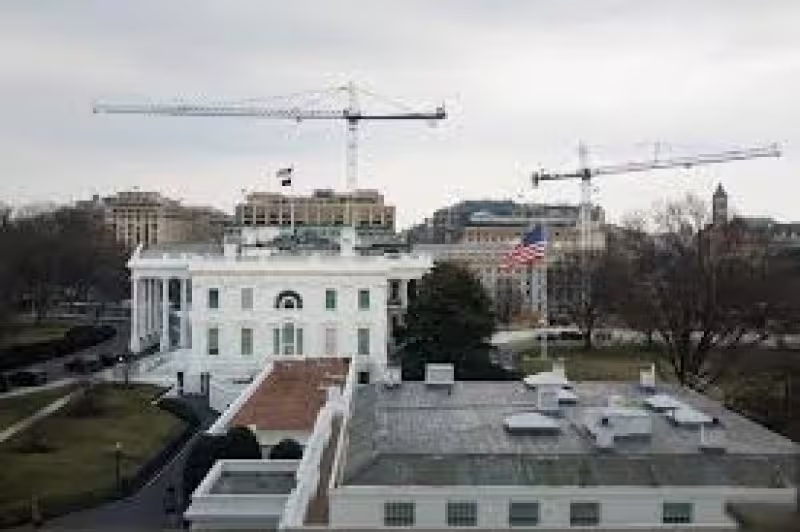
The Trump administration asked a federal appeals court on Friday to reverse an order blocking construction of a $400 million ballroom at the White House, arguing that no court has authority to stop the project even as the legal fight continues over a separate underground staff bunker.
Yaakov Roth, representing the administration, told the DC Circuit that if Congress has already weighed the equities in a particular case, a court should not second-guess that judgment. He said, in substance, that when lawmakers have reached that kind of conclusion, judges may not have the power to override it.

The dispute has become a test of how far presidential control extends over federal property. The ballroom is planned for the site of the White House’s demolished East Wing, and construction began before the review and approvals required by district and federal statute were completed. The National Trust for Historic Preservation sued the National Park Service and the administration in October after Trump ordered the East Wing’s demolition, arguing that the work could not move ahead without following the required process.
The administration has repeatedly pointed to national security concerns as the reason for the project. Trump has used the same rationale in public remarks, and in April he invoked the failed assassination attempt at the White House Correspondents Association event as an example of the danger. On Friday morning, Congress also removed $1 billion in Secret Service security upgrade funding for the proposed ballroom from a long-delayed immigration spending bill, a move that underscored how politically fraught the project has become even as litigation played out in court.
The sharpest exchange came when Justice Patricia Millet pressed Roth on when the ballroom and bunker complex became, in her words, a fait accompli for the government’s purposes. She asked whether that point came when the destruction happened or when underground work began, which the court was told was inseparable from the ballroom above.
Thad Heuer, for the historic preservation trust, answered with a very different view of the judiciary’s role. He said that under Marbury v. Madison, it is “emphatically the province of the judicial department to say what the law is,” and added that the government’s position would mean even a lawless action of this type could never be stopped by a court. “That is entirely wrong,” he said. “That’s exactly the court’s job.”
The lower court had already blocked the ballroom construction, while allowing the secure bunker for staff underground to continue. The appeals court now has to decide whether to leave that ruling in place or let the project proceed while the broader dispute over presidential authority and federal property keeps moving. For now, the ballroom remains on hold, but the bunker does not.



