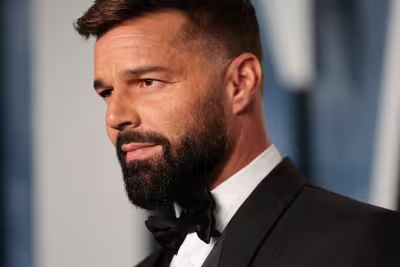
Carlos Alberto Solari — known to generations as Indio Solari — died on Friday at his home in Parque Leloir, in the Buenos Aires locality of Ituzaingó. He was 77. Doctors declared his death at the residence after an operation was mounted there, and the UFI N°2 of Ituzaingó ordered the corresponding procedures.
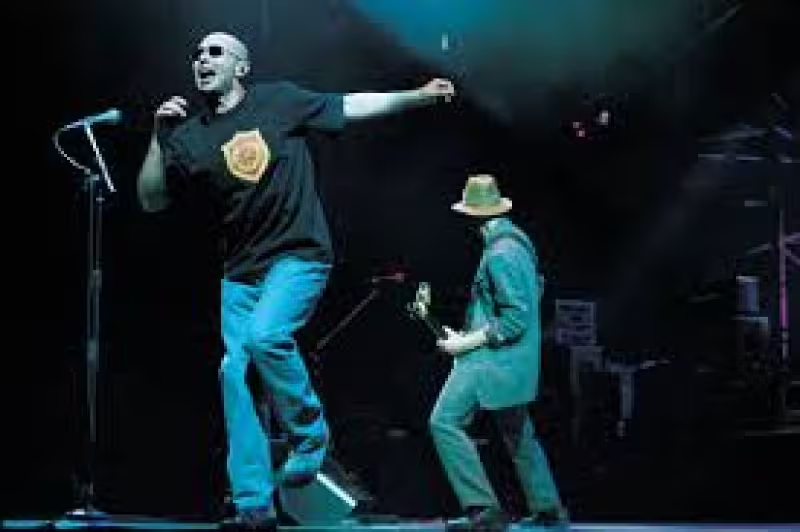
Solari was a founding member and the singer of Patricio Rey y sus Redonditos de Ricota and later led Los Fundamentalistas del Aire Acondicionado; he also performed with El Mister y los Marsupiales Extintos. Reports say no other cause of death was indicated beyond Parkinson's disease. His passing removes one of the most influential voices in Argentine rock, a figure whose records and concerts shaped decades of the country’s musical life.

Health had been part of Solari’s public story for years. He publicly rejected speculation that he had cancer or AIDS, telling a radio audience in 2015 that those were not his illnesses. Onstage in Tandil in March 2016 he acknowledged Parkinson’s, saying the disease was “coming up on my heels,” and in 2022 he told Rock FM that the progression of Parkinson’s was evident and that he had been in treatment for about seven years. He described the condition as painful and disabling and sometimes left him stiff and contracted.
Even as his health curtailed live performance — his last full concert took place in Olavarría in 2017 and he later used holographic techniques for a 2020 virtual show — Solari remained a public presence. His final public appearance came in January, when he received an Honoris Causa from the University of Buenos Aires.
There is a clear point of friction between earlier family statements and the immediate reporting of his death: in February Solari’s family and close circle denied that he had suffered an ACV and said he was undergoing routine checkups. The recent reports identifying Parkinson’s disease as the only cited cause do not resolve whether a specific acute event at home precipitated his death.
Authorities have opened the standard judicial and medical procedures for a death at home: the local prosecutor’s office ordered the corresponding steps, and an autopsy will be carried out by protocol. That examination is the next factual step that can establish the immediate medical event that led to his death; until results are released, the question of a precise terminal complication remains open.
His death leaves a clear immediate trail: official procedures will determine the technical cause, while fans and colleagues will measure his absence by the music and the decades of influence he leaves behind. For now, the autopsy and the prosecutor’s findings will be the only path to the specific medical answers that are still missing.