



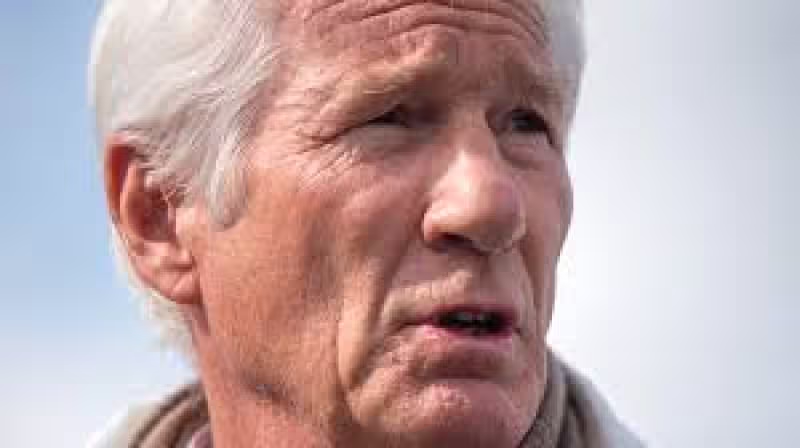
“We’re living in the darkest moment that I’ve experienced on this planet,” Richard Gere told an audience at the Oslo Freedom Forum on Tuesday, then turned that alarm directly toward the United States and a presidency he said has already undone much. Speaking with Venezuelan‑Norwegian activist Thor Halvorssen and helping present the Vaclav Havel International Prize for Creative Dissent, Gere said Americans must stop treating democratic decline as someone else’s problem.
Gere kept the language blunt. “How is this even possible? Because we went to sleep. We didn’t care. We didn’t vote. We didn’t really listen,” he said, arguing that complacency and a failure of attention allowed damaging changes to take root. He criticized Donald Trump’s actions as immediately corrosive: “On the first day, this guy dismantled almost everything that was good about the U.S. government and the U.S. people,” Gere said, adding that citizens now face a task of seeing the signs and pushing back.

The weight of those remarks came against an intimate detail Gere offered about how quickly societies can change. He said a visit to the Dachau exhibition — showing “the transformation of German society and German government and how quickly it happened there” — left him struck by the speed with which ordinary people can become instruments of abuse. “Good people turned into monsters,” he said, and then returned to the practical admonition that threaded his talk: “We have to be vigilant.”
Gere’s use of an international human‑rights stage to criticize the state of U.S. democracy sharpened the moment. He did not confine his rebuke to distant analysis; he placed part of the blame on himself. “I didn’t do enough work to skillfully convince people around me, close to me, not close to me, that this was insane to elect this person as president of the United States,” he said, naming his own failure to persuade friends, acquaintances and the broader public before the election.
That admission is the story’s tension: a high‑profile figure who has publicly criticized the president acknowledging his own shortcomings in the political fight. It undercuts a neat moral posture of moral clarity from afar and converts the speech into a confessional call to action — not only for the audience in Oslo but for Americans he describes as having settled into private comforts. “We can’t sit back and go, ‘Ah, life is good. I’m fine. You know, I’ve got food. I got money. Blah blah blah. I got my house. I got another car. I’m thinking about this. I’m OK. I know he’s a bad guy, but it’s OK,’” he said. “But it’s not OK. It’s not OK. It’s never OK.”
Contextually, the talk fits a pattern: Gere has previously criticized the president’s policies and conduct, and on Tuesday he matched that stance with historical comparison and a personal rebuke. Presenting the Vaclav Havel prize at a forum dedicated to human rights added symbolic weight — a reminder that the safeguards of open society depend on public attention and action, not prestige or comfort.
Gere left the audience with an imperative rather than a policy roadmap. He warned about “the cues, this dictatorship of the monsters, how quickly it happens,” and urged people to watch for those cues and act. What he did not list were the specific signals he thinks are the most urgent to recognize, a gap he acknowledged by stressing vigilance over a catalogue of grievances.
That gap is also the decision the speech forces on listeners: accept his judgment that Americans slept through a threat and now must engage, or treat the warning as another celebrity rebuke. Given his admission of personal failure and the public stage he chose, his judgment lands as a call for continued public pressure and organizing rather than private regret — a straightforward demand that Americans pay attention, vote and resist the erosion he says is already underway.



