



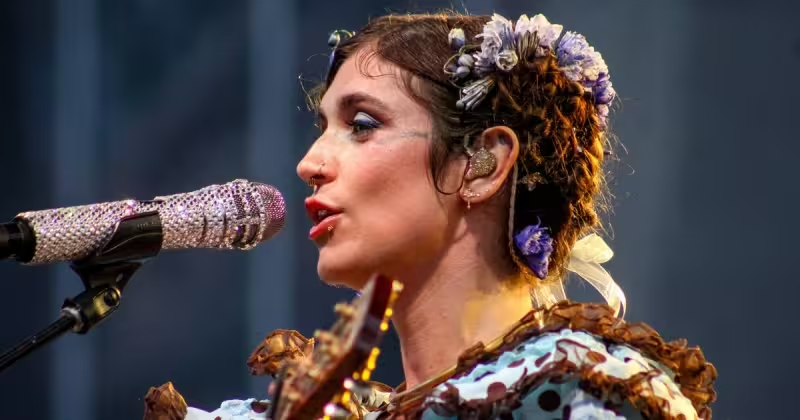
Sierra Ferrell and the Brudi Brothers opened the Gesa Credit Union Pavilion’s summer season Sunday evening, and the show immediately established itself as the standard future bookings will be measured against.
One reviewer captured the night succinctly: "From busking the streets of Seattle to kicking off the Gesa Credit Union Pavilion’s summer season in a major way, Americana star Sierra Ferrell and the Brudi Brothers put on a tough show to beat." That verdict landed on concrete evidence: Ferrell’s voice carried through intimate acoustic passages and full-band crescendos, while the Brudis supplied both the streetwise grit of longtime Seattle buskers and a more amplified punch than they’d shown earlier in the season.

Ferrell, born in Appalachia, staged a string of moments that made the headline slot feel decisive. She walked onstage in a polka dot dress and stripped her biggest song to date — "In Dreams" — down to two guitars, her voice and a mandolin, a pared-back arrangement the reviewer said changed the course of her career. Later she ran through "Fox Hunt," and another blunt appraisal of her night read: "Powerhouse is truly the only word to describe one of the best live vocalists I’ve ever seen." Backing textures included classic instruments — fiddle, mandolin, upright bass, banjo, pedal steel guitar and harmonica — which kept the set tethered to Americana even when the band pushed louder.
The Brudi Brothers arrived as the night’s counterweight. Longtime Seattle-area buskers who have also worked as commercial fishermen in the Pacific, they brought Conrad Brudi on lead vocals and harmonica, George Brudi on electric bass and Johann Brudi on lead electric guitar. Eleni Govetas joined them as a fourth member on fiddle and the drum kit. Their presence tightened the show’s low end and added a sharper electric edge: the reviewer praised them as "a breath of fresh air" compared with a September show where they opened for Wyatt Flores at Washington State University, but also noted that their sound at Gesa had grown more electric than in that earlier set.
That trade-off was the night’s single stylistic rub. The added electricity gave the Pavilion set more muscle and a stadium-ready momentum; it also smoothed some of the looseness that makes street-busking performances feel immediate and unpredictable. In practical terms the change mattered because it changed how the band supported Ferrell: at times they framed her as a delicate focal point; at others they pushed like a full rock band, which amplified crescendos but reduced the raw textures of their busker roots.
The decisive moment came with the pared-down "In Dreams." In that near-quiet arrangement the audience could hear micro-details — a mandolin pluck, a harmonica sigh, the grain of Ferrell’s vocal — and the set’s arc snapped into focus. That choice made the rest of the evening read as purposeful rather than scattershot: pushes of full-band drive alternated with acoustic restraint, and the balance favored songs that showcased voice and songcraft over spectacle.
Context matters: Ferrell’s visibility has risen in recent seasons, including a collaboration with Mumford & Sons on a new version of "Here," and the broader Americana circuit has been reshaped by tours that pair folk and country stars. Those associations have nudged Ferrell into bigger rooms and higher expectations — expectations she met Sunday at Gesa.
The night leaves one clear outcome: the Pavilion now has a benchmark. There was no confirmed follow-up date announced in this report, so the immediate test for the summer schedule is simple — can upcoming acts match the vocal force and the unpredictable chemistry Ferrell and the Brudi Brothers showed? If they do, this opener will be the opening act of a strong season; if not, Sunday will stand out as the show to beat.



