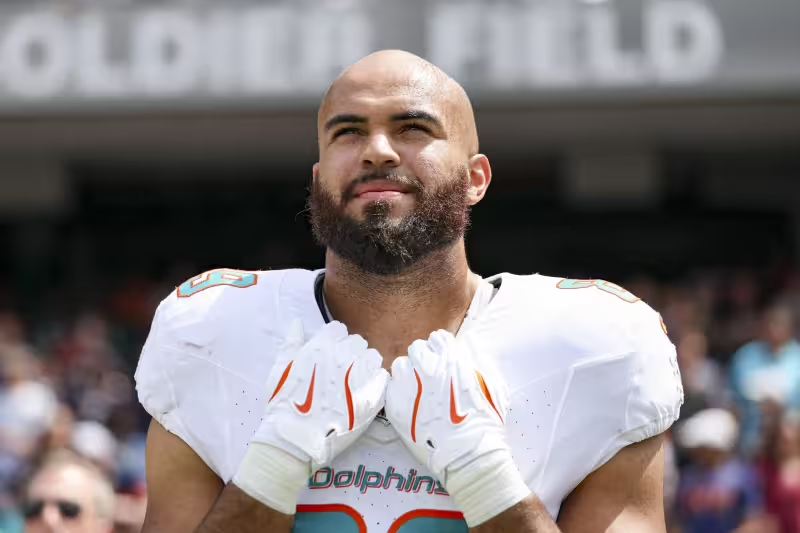
The New England Patriots placed Julian Hill on injured reserve on Monday after a knee injury in practice, ending his 2026 season before it truly began.
Hill, who signed a three-year, $15 million contract with the Patriots in March, was expected to serve as a blocking tight end and the rotational No. 2 behind Hunter Henry. His move to injured reserve makes him the first member of the 2026 Patriots team to be removed from the active roster for the season.

Financially, the roster move carries immediate clarity. Hill will still receive his regular base salary and is entitled to his signing bonus. Because he did not earn any of his per‑game active roster bonuses this season, the Patriots will get a $630,000 credit on the 2027 cap. That change drops Hill’s 2027 cap number from $5.4 million to $4.635 million; the maximum bonus amount of $765,000 will not count against New England’s books next season unless it is earned again.
The Patriots entered the spring hoping Hill would complement Henry and provide the kind of in‑line blocking and situational receiving the roster had targeted in free agency. Instead, Tuesday’s on‑field work at the second open organized team activity showed the immediate consequences: the team inserted Jack Westover as its TE2 and increased snaps for younger options Eli Raridon and C.J. Dippre. The 90‑man roster at tight end now lists five players: Hunter Henry, Jack Westover, Eli Raridon, C.J. Dippre and Tanner Arkin.
The replacement moves are straightforward but unproven. Westover’s promotion to TE2 and the uptick in snaps for Raridon and Dippre are practical short‑term answers in an offseason context. None of those three had been signed with the expectation of carrying the rotational No. 2 role that Hill was given when he arrived in March.
That gap is the immediate friction. The Patriots invested in Hill with a multi‑year deal tied to the idea he would be available to block regularly and relieve Henry. He was removed from that plan before the pads went on in meaningful work, and the team is left to lean on less experienced options while the roster carries Hill’s salary and the club adjusts its cap picture.
Context sharpens the change. The signing of Hill came after New England completed its trade for a veteran wide receiver and was trimming toward a 90‑man offseason roster; until Hill’s injury the team had avoided any major injuries since the start of the workout program in April. The roster move on Monday therefore represents the first major personnel disruption of this offseason.
What happens next is the outstanding, practical question for the Patriots: whether they will add veteran help. It would not be a surprise for New England to host veteran free agents on workouts in the near future, but no specific addition has been confirmed. For now the club appears willing to run with Henry as the clear starter and a depth group of Westover, Raridon, Dippre and Arkin while Hill recovers away from the roster.
The cap consequences soften the long‑term hit but do not replace Hill’s role on the field. With Hill sidelined, the team’s decision makers must choose between trusting the internal rotation or seeking a veteran who can step into that blocking and situational receiving job. The unresolved question is immediate: who, if anyone, will the Patriots add to shore up the tight end room before training camp?