



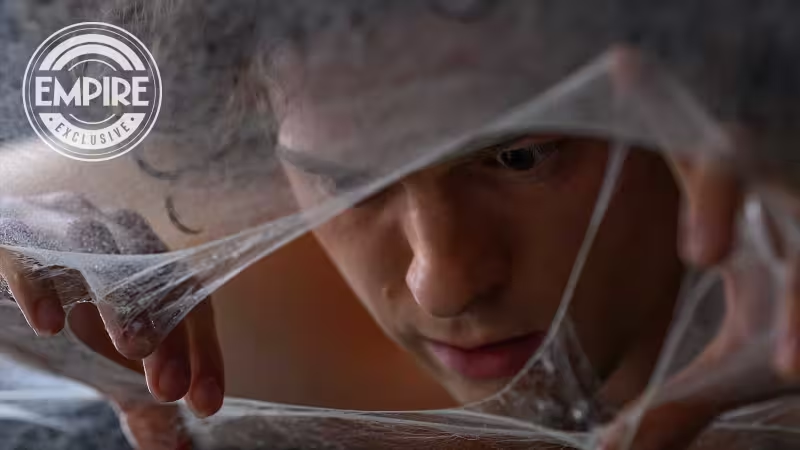
Tom Holland says he finally earned a seat at the table — and he used it to pitch a story he calls "Spider-Puberty." "This is the first time in my tenure as Spider-Man that I was kind of welcomed into the writers’ room," Holland said, describing regular creative meetings with producers during development of Spider-Man: Brand New Day.
Holland said he and the producers met once every two weeks, and that his pitch was blunt: "My pitch when I came to the table with it was called ‘Spider-Puberty’" — a shorthand for the question he kept asking, "What happens if Peter Parker is losing control and things are changing?" Holland added that "‘Spider-Puberty’ was my tagline pitch to the studio — which was immediately shot down," but that the studio liked the kernel of the idea and it grew into what appears in the finished movie.

The fact that Holland’s pitch survived the studio’s initial rejection is what makes his involvement notable. Holland first entered the MCU as Spider-Man in Captain America: Civil War a decade ago, and this is the first film in the cycle he describes as one where Marvel explicitly let him into the room where the character’s future is sketched. Marvel Studios president Kevin Feige has framed the movie as a return to the character’s basics: "It is the first Spider-Man film that we’ve made in the MCU that is focused on the classic elements of Spider-Man," Feige said, adding that Peter Parker in this story is "living in a sad, small apartment, listening to the police scanner and going out and using his great power responsibly."

The weight of Holland’s new role is practical as well as symbolic. He said the writers’ room was a place to test tonal gambits and character beats, not simply to read lines; the twice-monthly sessions gave him a recurring forum to push the idea that Peter’s powers might be changing in unsettling ways. Holland’s pitch did not survive intact in title form, but the concept—the loss of control—survived into the film, Holland said, and helped steer the story away from pure spectacle toward personal disarray.
That matters because Holland is explicit about what he wants the film to do beyond telling one more Parker story: to set up what comes after. "For whoever’s next, whether that is a Miles Morales or a Spider-Gwen or a Spider-Woman or something like that, I would love to be a part of setting up the next chapter," he said, offering a line that reads like a promise and a plea at once. He also invoked the example he’s lived under: "Whatever that looks like, I don’t know. But if I could do what Downey did for me, then I would be so content swinging off into the sunset."
The push-and-pull in these accounts is the story’s tension. Holland’s title — and the blunt, marketable label "Spider-Puberty" — was rejected outright, yet the central dramatic question he raised survived. How exactly Peter’s powers will change in Brand New Day remains unrevealed; fans have speculated about everything from a symbiote to monstrous transformations, but the filmmakers have not confirmed specifics. That gap between Holland’s on-the-nose pitch and the studio’s subtler adoption of its core idea is the clearest friction point: Holland’s work shaped the movie, but not on his terms.
What comes next is straightforward and immediate: Spider-Man: Brand New Day arrives in cinemas from July 29 (another source lists July 31), and audiences will see how much of Holland’s "losing control" idea ended up on screen. Beyond ticket sales, the film will function as a test of Holland’s newly amplified creative voice — and whether his input helps lay the groundwork for the next generation of Spider heroes, as he has said he hopes to do. If Brand New Day uses the changes Holland pitched to pivot the franchise toward new successors, his time in the writers’ room will look less like a late-career novelty and more like a deliberate passing of the torch.



